


|

|

|

|
|
 |
||||
 |

|
 |
||
Chapter IX.
GENERAL REMARKS. COST OF COMMENCING AN ESTABLISHMENT. COST OF ERECTING BLAST FURNACES IN THE NORTH OF ENGLAND AND IN WALES, OF ERECTING THE NEATH ABBEY WORKS; OF PRODUCING ONE TON OF IRON IN WALES, STAFFORDSHIRE, DERBYSHIRE, CLEVELAND, AND SCOTLAND. LOWEST PRICES AT WHICH PIG IRON, PUDDLE BARS, AND HEAVY BARS CAN BE PRODUCED, ETC.
Miscellaneous Estimates, etc.
Commercially speaking, after the smelting of pig Iron from the ore, the next branch is the manufacturing of the pig or cast Iron into wrought Iron, such as bars, rods, sheets, &c., which is done at the forge and mill; and of similar importance is the department where pig Iron is cast into articles of general use, either for domestic or building purposes, as grates, ranges, balconies, girders, beams, pipes, bridges, &c., which is carried on at the foundry. These branches of the business are frequently conducted independently of each other, sometimes the whole are carried on together at the same works, or any of the two are occasionally combined. It is generally the case where the smelting of Iron is pursued, that the manufacturer raises his own Coal and Ironstone, and makes his own coke, fire-bricks, &c., and then either sells his pig Iron to the forge and mill or foundry proprietor, or converts it himself into wrought Iron or foundry goods. Generally, forge and mill proprietors purchase the pig Iron and the Coal they require from other parties, and convert the pig Iron into bars, rods, sheets, &c.; and the iron-founder usually also purchases the Iron and coke he requires, making his profit by converting the pig Iron into gas and water pipes, beams, bridges, &c. In some few instances parties engaged in iron-smelting purchase the whole of their Ironstone, Coal, limestone, and other materials: by this method works may be undertaken with a smaller amount of capital than would be needful in the case of opening up materials; but there is also less opportunity of making large profits, as in the case of proprietors of works raising the minerals for themselves, there is no intervening profit.
When parties are desirous of establishing Iron works, great care should be taken in selecting a proper site as to carriage, quality of materials, royalty, &c., and the exercise of a sound judgment in carrying out works, even where all the arrangements and requisite preliminaries are of a favourable character. Persons of great experience only ought to superintend the planning of the furnaces and other appliances. Want of care in proportioning the various mineral workings, so as not to have always a regular and sufficient supply of all materials for the furnaces, frequently causes much annoyance, interruption to the works, and consequent loss. Other errors sometimes made in starting works are, to have furnaces too large for the engine or other power; deficiency of steam owing to having the boiler surface too limited, deficient arrangement of tramways and inclines; depositing spoil, cinder, and other refuse in such spots as to render it needful to incur the expense of their removal at some future time; and erecting works of such magnitude as to swallow up at once so large a proportion of the whole capital of the undertaking, as to leave little or nothing for conducting the commercial business of the enterprise; the consequence being that sales of Iron have to be made as fast as it is produced to meet current expenses, at whatever may be the market price, tending at the same time to make the price lower in the market than it otherwise would have been. In calculating the cost of fuel, Ironstone, and limestone, statements are frequently made that the coke costs so much per ton, or so many cwts. of Coals at a certain price, wages for burning and delivering at the furnace, &c., this being based on the amount paid per ton for cutting and raising, for delivering at the coke ovens, and for royalty; now the cost of the Coals or other minerals arrived at from such data is not altogether correct. Not only should the cost of cutting and raising of royalty, and delivery at the ovens be included, but also a proportion of the outlay for sinking pits, driving levels, erecting pumping and winding engines, making tramways, inclines, &c., as capital has thus been expended and altogether sunk; all estimates, indeed, should include repayment of capital, and in some cases surface damage and way-leave have also to be added. But there is more in the administration than in any mere cost, or difference of cost in materials and labour.
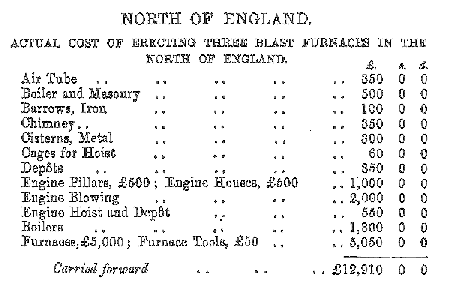
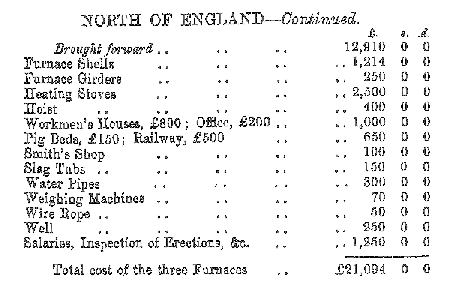
To commence on a sound basis, an establishment consisting of Blast Furnaces, Refineries, Puddling Forges, and Rolling Mills, a capital of at least £20,000 per blast furnace (that is, including rolling mills, &c.) where there are four, is required; and with a fewer number of blast furnaces, a larger amount of capital in proportion will be requisite. The following estimates for erecting blast furnaces, forge and shingling mill, and the cost of producing and manufacturing Iron, are from reliable sources; but all such calculations are necessarily based upon the price of building materials, the cost of Ironstone, Coal, limestone, labour, carriage, and other details as applicable to particular localities, and to be of value must be carefully revised and remodelled to suit the altered details arising in each individual case.


Please Note: These web pages retain the original pagination from the publication




 Contains public sector information licensed under the

