


|

|

|

|
|
 |
||||
 |

|
 |
||
manner to that pursued with the argillaceous ores. The operation is usually performed at the mouth of the pit. From the larger percentage of carbon in the ore, calcination is effected without using more fuel than suffices to ignite the mass at one or more places. Consequently on this abundance of carbon in ores of this class, their calcination is effected at a comparatively cheap rate for the open air system; but the pecuniary advantages will vary with the cost of the fuel.
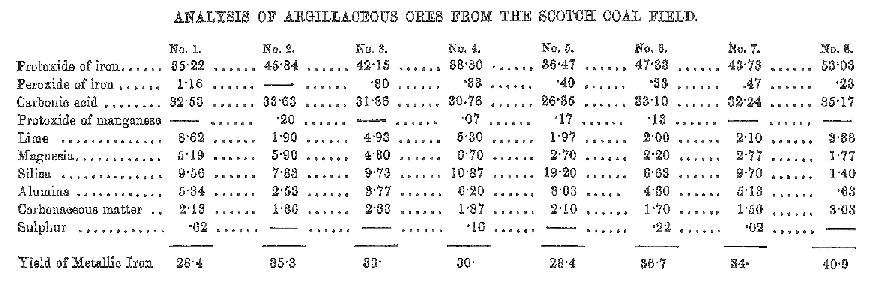
The Scotch mineral field also contains large quantities of argillaceous ore. Before the discovery of the more fusible carbonaceous ore, or Black Band, these formed the chief supply of the blast furnaces, but of late years they have been comparatively neglected. The great value of these ores is, however, very manifest, judging from the following by the same analyst :—
Ayrshire, Lanarkshire, &c.
Ayrshire and Lanarkshire are the principal Iron-producing districts in North Britain. Of the 181 Blast Furnaces in the whole of Scotland, there are 46 in Ayrshire and 99 in Lanarkshire. William Baird & Co. have at the Eglington Works, eight blast furnaces; at Blair, five; at Lugar, four (will have to be rebuilt); at Muirkirk, three; and the other proprietors in Ayrshire are — Merry and Cunningham, who have four blast furnaces at the Ardeer Works, and nine at the Glengarnock Works; Freeland and Lancaster, at Portland Works, have five; the Dalmellington Iron Company, five; and the New Cumnock Iron Company, three. In Lanarkshire, Wm. Baird & Co. have 16 blast furnaces at the Gartsherrie Works; W. Dixon, eight at Calder and six at Govan; Merry and Cunningham, six at Carnbrae; Shott's Iron Company, three at Castle Hills and five at Shotts; Colin, Dunlop & Co., nine at Clyde and Quarter; Coltness Iron Company, nine; trustees of J. Wilson, eight at Dundyvan; Addie & Rankin, six at Langloan; Monkland Iron and Steel Company, nine; J. R. Stewart, four at Omoa; Wilsons & Co., eight at Summerlee; and Messrs. Bell, two at Wishaw. At four of these establishments, rolling mills, forges, and other requisite apparatus are erected for the production of malleable Iron. One of the great causes of the unprecedented advancement of the Iron Trade in these districts, is the abundant command of the Black Band Ironstone, united to the introduction of the hot air blast, in the application of which several improvements are stated to have been made by Messrs. Baird, the extensive Iron-masters. Of the Ironstones the following are the principal bands found at Monkland, Lanarkshire :— 1. The Upper Back Band, which lies about 21 fathoms above the Eli-Coal, and is of local occurrence, and known as Palace Craig Ironstone. 2. The Airdrie Black Band, also called Mushett's Black Band, is the great staple ore for the supply of the Iron market; its aver age depth below the Splint Coal is about 21 or 22 fathoms, and it varies in thickness from 14 to 18 inches. 3. Airdrie Hill Black Band, which is in New Monkland, and varies from 2 to 4 feet in thickness. 4. Fossil Black Band, worked near Glasgow — it consists of two bands 9 inches thick, and 19 fathoms metal between them; its position is supposed to be six fathoms above the famed Lesmahagow Sea Coal. In Ayrshire Black Band is worked very extensively at Kilbirnie, Daley, Dalmellington, Lugar, Cumnock, and Common, its average thickness 18 inches; the position of the band at the first three places is supposed to be the same as the Fossil Black Band, near to Glasgow; its local position 50 fathoms above the mountain limestone, and the position of the band at the last three places is similar to the Airdrie Black Band of Lanarkshire. Its local position is supposed to be about 150 fathoms above the gas water, or lower limestone of the district.
Iron-masters. — The following are the Iron-masters in Scotland, and the number of furnaces worked by each, in addition to those of Ayrshire and Lanarkshire: Fifeshire — Forth Iron Company, seven blast furnaces at Forth; Lochgelly Iron Company, four at Lochgelly; A. Christie & Co., one at Lumfinnans. Linlithgowshire — Wm. Wilson & Co., one at Kinniel. Stirlingshire — James Russell & Son, three at Almond Bank; Carron Company, four at Carron. Clackmannanshire — J. Miller, three at Devon. Dumbartonshire — Montgomerie and Fleming, two at Garscube. Haddingtonshire — C. & A. Christie, one at Gladsmuir or Westbank. Argyleshire — Harrison, Ainslie & Co., one at Bunawe, in Lorn.
The consumption of ores of the carbonaceous class to produce a ton of crude Iron is probably lower than that of any other; and from the volatile nature of a portion of the matter in alloy, the quantity of cinders produced (under 20 cwt.) is the least with which the operations of the furnace can be profitably conducted. The average percentage of the Scotch carbonaceous or carboniferous ores, when calcined, is nearly 60; the quantity consumed to the ton of crude Iron averages 35 cwt. ; the metallic Iron in this quantity of ore weighs nearly 20 cwt.; but 1 cwt. is lost in alloy with the cinder, leaving 19 cwt. of metallic Iron in the ton of crude Iron. This comparatively small loss, the result of the small quantity of cinder produced, contrasts most favourably with the lean argillaceous ore. The yield from calcareous ores is superior to that from argillaceous, inasmuch that the cinders produced do not bear so high a proportion to the crude Iron. Lime being present in the ore in nearly sufficient quantity for fluxing the other earths, the quantity of cinders produced is of limited amount. The produce of crude Iron from silicious ores of a given richness is inferior to that of the other classes. The


Please Note: These web pages retain the original pagination from the publication




 Contains public sector information licensed under the

