


|

|

|

|
|
 |
||||
 |

|
 |
||
There are 199 Blast Furnaces in South Wales, viz. :— Glamorganshire, using bituminous Coal or coke, Aberamman Works, belonging to Crawshay Bailey, three furnaces; Abernant, four, and Aberdare, three, the Aberdare Company; Briton Ferry, two, Briton Ferry Company; Bute, five, Rhymney Company; Cefa Cwsc, two, North British Banking Company; Cwm Avon, five, and Oakwood, two, Governor and Company of Copper Miners; Cyfarthda, seven, and Ynisfach, four, W. Crawshay & Sons; Dowlais & Ivor, eighteen, Guest & Co.; Duffryn, five, and Plymouth, five, Anthony Hill; Gadlys, four, Wayne & Co.; Llwynvi, four, and Maesteg, four, Llwynvi Company; Millbrook, one, Sir G. B. Morris; Pentyrch, two, T. W. Booker; Penydarren, seven, Wm. Forman; Tondu, two, Brogden & Sons. The following use anthracite :— Abernant, Glyn Neath, three, and Banwen, two, Abernant Company; Onllwyn or Brin, two, W. Llewellyn & Son; Venalt, two, Fothergill & Co. and Aberdare Company; Ystalyfera, eleven, Ystalyfera Company. Brecknockshire, using bituminous Coal or coke — Beaufort, eight, Sir J. & C. Bailey; Clydach, four, Powell & Co.; Hirwain, four, Francis Crawshay. The following use anthracite :— Abercrave, one, T. Walters; Yniscedwin, six, Yniscedwin Company. Caermarthenshire, using anthracite :— Bryn Amon, two, L. Llewellyn; Gwendreath, three, T. Watney & Co.; Trimsaran, two, E. H. Thomas. Pembrokeshire, using anthracite :— Sandersfoot, two, Pembroke Iron and Coal Company. Monmouthshire, using bituminous Coal or coke :— Abersychan, six, Ebbw Vale, four, Pentwyn, three, Sirhowy, four, and Victoria, four, Ebbw Vale Company; Blaina, two, Cwm Celyn, two, Coalbrook Vale, two, F. Levick; Cwmbran, one, J. Lawrence; Varteg and Golynos, six, Crawshay, Bailey & W. Morgan; Nantyglo, seven, Sir J. H. Bailey; Pontypool, four, Pontypool Company; Rhymney, four, Rhymney Company; Tredegar, nine, Tredegar Company. The produce of pig Iron in South Wales, in 1858, was 886,478 tons, viz. :— In the bituminous district — Glamorganshire, 451,043 tons; Brecknockshire, 69,537 tons; Monmouthshire, 315,124 tons; and in the anthracite district, 50,774 tons.
The Iron-producing districts in England not yet noticed, are those of Shropshire, Northamptonshire, Gloucester, Wiltshire, and Somersetshire, and the Iron ore district of Cornwall. Coal and Ironstone are worked in Shropshire, the Iron ore being argillaceous carbonate, of which 150,500 tons were raised in 1858, valued at £38,135. There are 32 Blast Furnaces, viz. :— Castle Iron Works, two blast furnaces, Horshays, two, Lawley, one, and Light Moor, two, belonging to the Coalbrookdale Company; Dark Lane two, The Jerry, two, Langley, one, B. Botfield; Ketley, two, the Ketley Company; Lodge Wood, four, Prior's Lee, four, Lilleshall Company; Madeley Court, three, W. O. Foster; Madeley Wood, three (cold blast), Madeley Wood Company; Old Park, Shifnal, four, Old Park Company. The annual produce of pig Iron is above 100,000 tons. In the Northamptonshire District the produce of ore is about 140,000 tons, valued at £35,000; and there are but 3 Blast Furnaces, viz. :— Heyford (Weedon), two, belonging to Bell & Co. ; and East End (Wellingborough), one (cold blast), the property of T. Butler & Co. The total produce of pig Iron in 1858 was 9,750 tons. Gloucestershire — Forest of Dean. The Forest of Dean has been long known for its produce of Coal and Iron. There are ten mines, which produce annually upwards of 200,000 tons of ore, of the average value of 9s. per ton; and 10 Blast Furnaces, viz. — Cinderford, four, Alloway & Crawshay; Park End, two, James & Greenham; Dark Hill, one, Messrs. Mushett; Oakwood, one, Ebbw Yale Company; Sondley, two, B. Gibbons, Jun. The make from the furnaces in blast in 1858 was 23,580 tons of pig Iron. In Wiltshire there are two Iron ore mines (hydrated oxide), which produce about 10,000 tons of ore; and 4 Blast Furnaces, viz. :— Westbury two, belonging the Westbury Iron Company; and Seend, two, belonging to Sari & Sons. Coal and Iron are also found in Somersetshire. There are six mines, producing about 26,000 tons of ore, of the value of £13,000. The character of the ore is brown hematite, spathose, and argillaceous. There is only one Blast Furnace in the district, the Pennywell Road Works, belonging to Langford & Co. The produce of pig Iron in 1858, of Wiltshire and Somersetshire, was 2,040 tons. The ores of Cornwall are brown hematite, spathose, and magnetic. There are 21 mines, the produce from which in 1858 was 55,150 tons, valued at £19,988. The total produce of Iron ore in that year, from all the districts of England and Wales, Scotland, Ireland, and the Isle of Man, was 8,040,959 tons, of the estimated value of £2,570,701 15s. 10d.
Scotland — Its Ores and Iron Works.
The Black Band of Scotland is the most valuable of the carbonaceous or carboniferous ores hitherto discovered. It is found varying from a few inches to several feet in thickness, and differs little in appearance from the black and brown shales contiguous to the Coal. The composition of the richest seams is represented in the following analysis by Dr. Colquhoun :—
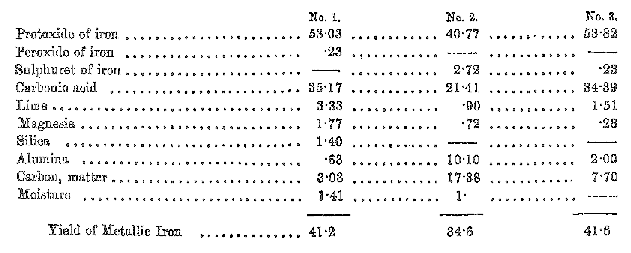
From numerous experiments, the quantity of carbonaceous matter in the above is below that found to be really existing in the mass of the Scotch carbonaceous ores. For many years the ore, known as the Black Band, escaped observation as containing Iron; and although its riches were discovered, and occasioned the erection of the Iron works in the neighbourhood of Airdree, that district was, for a considerable period, understood to contain the only bed of that description in the country. But since the rage for Iron making became so intense, search has been made in many parts, and that search has been rewarded by the discovery of various beds in Fifeshire and the Lothians. The neighbourhood of Kilburnie, Dalry, Cummick, and Dalmellington, in Ayrshire, have presented abundant supplies, which have induced the erection of extensive Iron works, enjoying the advantage of large fields of cheap working Coal. A great advantage is possessed by this Black Band Ironstone in its ready calcination. The carbonaceous ores of Scotland are calcined in large heaps in a similar


Please Note: These web pages retain the original pagination from the publication




 Contains public sector information licensed under the

