


|

|

|

|
|
 |
||||
 |

|
 |
||
Varieties of Coal.
HOUSEHOLD COAL. — Seams of Coal not only vary in thickness, but they also differ in quality; and even the same seam alters occasionally in the same district as well as in other districts. The best quality of Coal is considered to be that which has been found most suitable for household purposes, and termed on that account Household Coal. It is described generally as bright and cubical; it preserves its form in regular blocks after the small is taken from it. It burns to a black cinder, which in turn is consumed, so that only a small portion of ashes remain. Its freedom from sulphuret of iron renders it admirably adapted for household purposes. The collieries in the Northern Coal-field, producing the best household Coal, are situated principally in the south-eastern district, from Haswell, Hetton, Houghton, to Port Seaham, county of Durham; it also abounds in other Coal districts. An analysis of this and other varieties of Coal is in preparation for this work: these tests will be found of considerable value to the consumer and purchaser; and in the article on the "Coal Trade," which will conclude Division I., a series of analytical tables will be introduced.
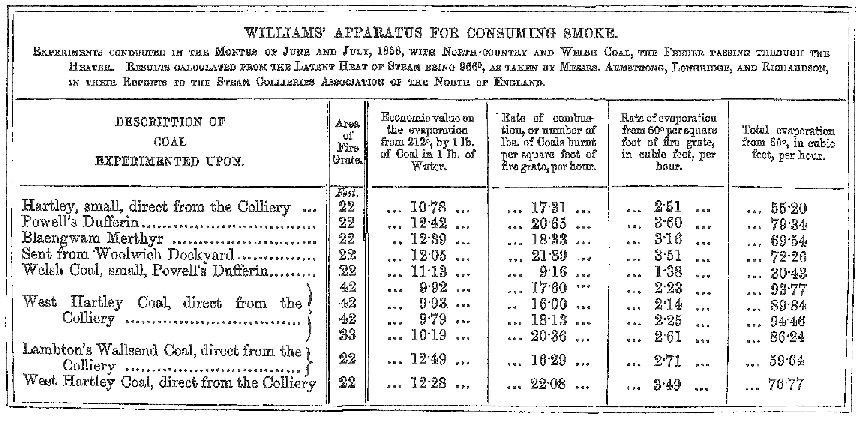
STEAM COAL. — The collieries in the Northern Coal-field, producing Coal of a quality suitable for steam purposes, are situated in the north-eastern division of the district, along the sea coast from about Killingworth to near Warkworth, in the county of Northumberland; and is also abundant in some parts of Wales. This Coal is distinguished by the rapidity with which it generates heat. Its combustible elements readily unite, and burn with great intensity, leaving a white ash, which, after a time, disappears through the fire-bars or the draft of the chimney. Instead of the dark cinders and bright clear fire produced by the best household Coals, there is a large portion of dust and dirt unconsumed. It is principally used for the purpose of heating engines and steam boilers, especially those of sea-going vessels. Steam Coal is found in seams of considerable thickness, from about six to seven feet, of a different appearance from that which is called splint or cannel in the Newcastle district. It looks like the best household Coal, but it burns like splint to a white ash. The experiments that are being conducted with superheated steam, to economise Coal, &c., are engrossing considerable attention; and should the subject be found of sufficient importance we will hereafter have occasion to refer to it. The great demand of late years for steam Coal has given rise to a spirited competition for a preference between the collieries of Wales and those of the North of England. In order to settle the differences of opinion entertained as to the superior quality of Coal from each district, a series of experiments were arranged to be made under the superintendance of competent engineers, appointed by the Board of Admiralty, from which the following is extracted : — Admiralty Report. — A Report on the evaporative power and economic value of Hartley Coal, Northumberland, and on the properties of Welsh Steam Coal, was presented by Messrs Miller and Taplin to the Board of Admiralty, and ordered in 1859 by the House of Commons to be printed. The Report describes in detail the manner in which the various experiments were conducted, and states in conclusion :— "That when the smoke from North-country Coal (Northumberland) is consumed, its evaporative value is nearly equal to that of Welsh Coal, while its rapidity of combustion is greater, and, therefore, that it is capable of generating a larger quantity of steam in a given time.
"That from the harder nature of the North-country Coal, it is less liable to be broken up from motion than Welsh Coal, and from the large heaps which had been exposed at the pits' mouths for nearly twelve months, which we saw at some of the collieries, without exhibiting any symptoms of falling into small particles, thereby showing that atmospheric changes had but little effect upon it; and, therefore, for these reasons, it is better adapted for store or conveyance to distant parts of the world than Welsh Coal, which, from daily experience, is found not only to be greatly reduced in size by motion, but to be reduced to dust when exposed to the changes of atmosphere in stores, &c. These comparisons are only made upon the supposition that the smoke from North-country Coal may be reduced to the same minimum as that which may arise from Welsh Coal, or be entirely prevented by Mr. Williams' or some effective apparatus for this purpose. — That from our experiments at Elswick, Newcastle, and our observations elsewhere, it is possible to consume the smoke arising from North-country Coal by the use of Mr. Williams' apparatus, and by the modifications of it as introduced by the Association to some of the collieries in this part of the country, and also fitted on board the "Expert" steam tug, and now being introduced generally into the steam tugs of this port."
The following table exhibits the leading results of the various experiments conducted at Elswick, Newcastle-upon-Tyne. and at Cardiff, South Wales :—


Please Note: These web pages retain the original pagination from the publication




 Contains public sector information licensed under the

