


|

|

|

|
|
 |
||||
 |

|
 |
||
Coal, "from Great Britain appear to be annually diminishing. For a time there was an increasing foreign importation, viz. :— from 22,123 tons in 1821, to 181,551 tons in 1839: by the operation of the American tariff, this advance was not only checked, but a retrograde movement was produced, so as in 1843 to amount to only 41,163 tons, according to the United States returns." It is true, that from 1841 to 1845 there was a falling off in the foreign demand for Coal, but since the date of Mr. Taylor's work, the American importations have been on the increase, as appears by the following table, carefully prepared by Mr. T. Y. Hall, from documents consulted during a residence in America, which exhibits the progressive development of the United States Coal Trade from its commencement :—
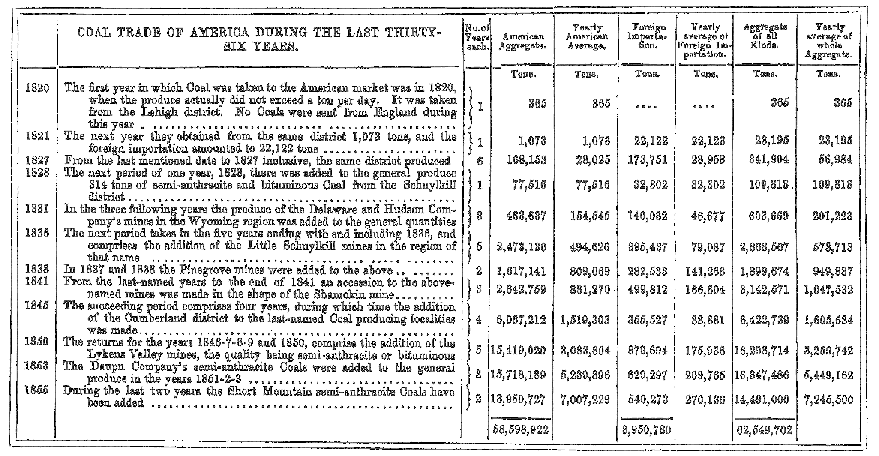
By referring to the column in the above table, giving the yearly average of foreign importation, it appears that America had averaged 88,881 tons during the years 1841 to 1845; that after that period the increase continued, and in 1854 and 1855, her importations of Coal reached 270,136 tons. During this period the produce of the country had also kept pace with the foreign supplies, In the four years from 1841 to 1846, the American yield of Coal averaged only 1,519,303 tons; whilst in 1854 and 1855 it reached 7,007,229 tons, independent of the quantity required in some districts for local consumption. For the year ending 1858, the following returns have been made
Tons
The three anthracite fields of Pennsylvania . . . . . . . . . 6,759,787
Broad Top, Blossburg, and Barclay Coals . . . . . . . . . 164,933
Alleghany and Pittsburg Coals, carried on Pennsylvania Railway . . . . . 325,637
Monongahela Navigation Company's Coal tonnage . . . . . . . 917,738
Cumberland region . . . . . . . . . . . . . . 642,725
Total Coal product of the United States, 1858 . . . 8,810,820
To this total various quantities have been added, as the probable yield of several states not enumerated in the above; but as there are no returns for these districts upon which reliance can be placed, we omit the speculative quantities given by the press of the United States.
Canada, Nova Scotia, and New Brunswick, are rich in Coal mines, having thick beds of the mineral, which are now beginning to be worked extensively; and a portion of the produce is annually shipped to the United States.
In European Russia, to the northern shore of the Black Sea, bituminous Coal has been found in abundance, and is said to be equal to the best English Coal. An opinion has long been held that Coal could not, geologically, exist in any part of Siberia, and that the Ural chain of mountains, rich in gold, copper, and other valuable metals, was entirely destitute of the most important material for rendering some of the metals useful to Russia. This opinion, however, on the authority of Mr. Robert Wardropper, an English engineer, is now found to be incorrect. Mr. Wardropper was formerly of Newcastle-upon- Tyne, but for several years past a resident in Russia, and during a visit to his native country in 1859, proved to Sir Roderick Murchison and other geologists, that Coal does not only exist in those parts of the Russian empire, but also that in the Kergese Steppes he has discovered, and been able in one place to trace distinctly for several miles, no less than sixteen seams of Coal, varying in thickness from 2 feet to 28 feet. A seam of 28 feet thick, running along the bottom of the ridge, cropping out at the surface, is now actually being quarried out. These seams of Coal appear to be of excellent quality, judging by the specimens exhibited by Mr. Wardropper; and as the sixteen seams of coal at present discovered cropping out exist within a horizontal distance of two miles, and extend a distance of many miles in length, it cannot be doubted that this is one of the most important discoveries for the development of the great mineral resources of this part of the vast Russian empire, though from its great distance to St. Petersburgh, the Coal will not be available there for domestic purposes. — Coal is found in Poland and Sweden; and in India, China, and other parts of Asia; also in New Zealand, South America, &c., though no mineral fuel has been found in Cuba.


Please Note: These web pages retain the original pagination from the publication




 Contains public sector information licensed under the

