


|

|

|

|
|
 |
||||
 |

|
 |
||
required was only three tons and a half. It was on the scale of 1 cwt. to 4 fathoms — 4 2/3 lbs. to each foot, and was considered capable, when new, of sustaining a weight of 27 tons. Evidence was adduced that nine wire ropes had given way in the Coxhoe and Jarrow Collieries; while, on the other hand, it was shown that wire ropes were used at various collieries throughout the country, and that they were generally looked upon as much safer than hemp; that they were better, and that any symptom of weakness was sooner perceived. The decision of the jury and the valuable evidence produced, fully demonstrated the superiority of the wire rope over that manufactured of hemp.
There is a very decided advantage in the application of springs to wire ropes; for their rigidity is such, that without their not only is there a great strain laid upon the rope at starting, but also a similar strain is experienced by the whole of the machinery attached thereto. If a more perfect spring could be contrived than has hitherto been in use, much lighter ropes might be used, and with greater safety.
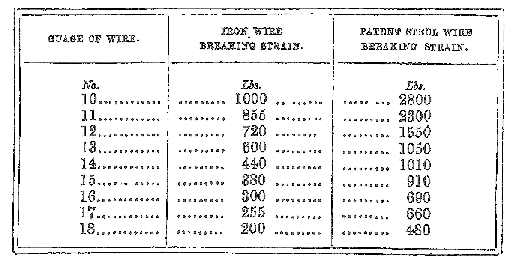
It must be understood, that the wire rope here spoken of is iron wire; but there is now being introduced into collieries and other establishments, wire made from steel. As a general rule, the average breaking strain of iron wire ropes is 2 tons per lb. per fathom — weight of rope. A steel wire rope is stronger than one made from iron wire above twice the weight. This must be a great improvement in many respects, and well worth, we should think, the difference between the price of iron wire and that of steel. Messrs. Makin and Sons, of the Attercliffe and Clifton Steel Works, Sheffield, who have introduced the steel wire, give the following quotation of prices :—

The following is a table of the comparative breaking strains of steel wire, patented by Messrs. Webster and Horsfall, Birmingham, as compared with the best charcoal iron wire :—
A great improvement of late years has been made in rope rolls, or drums, and pulleys; instead of the 6 or 7 feet wheel, they are now used as large as 12, 14, and even 16 feet diameter.
Screens and Screening.
Wallsend Coal, Seconds, Nuts, and Dead Small. — Near the pit's mouth is erected a long line of sheds, under which are the screens, which are large equally inclined sieves, or grated boxes. When the tub of Coal is received by the banksmen from the pit, it is conveyed, either by a tram-way, or a new suspending apparatus, to one of a series of trap-doors in the bank-floor, through which the Coal is teamed, so that it reaches the screen below. To prevent breakage, checks or stoppers are hung over the screen at intervals to interrupt the Coals, and thus give them a more gentle descent. The small Coal which passes through the screen bars is either delivered into waggons for immediate sale, accumulated in heaps, or hoisted up and re-screened. In 1852 a screen was introduced by Mr. T. Y. Hall, of Newcastle; his invention is contrived for the purpose of separating various sizes of Coal at pleasure, in the same screen, thus accomplishing with one screen, fixed near the pit's mouth, the same results as previously required three or four screens. The system of parallel adjustment of the bars resembles that adopted in Mr. Jamieson's ingenious "zig-zag expanding and contracting wraith," of the cotton manufacture, the screens being connected to a system of jointed zig-zag levers, the greater or less angularity of which defines the proportionate width of the screening spaces. Besides the facilities thus afforded for screening any size of Coal within defined limits, the attendant is enabled to screw the bars quite close, so as to form a dumb screen, when the Coals are merely to be discharged without screening. This improvement may be adopted either in the form of a fixed or portable machine, at railway coal depots. The portable screens, for example, may be used for discharging Coal from ships into barges or lighters, or for use where they are only temporarily required. In situations where mechanical power is available, and where the height or amount of inclination is limited, a lateral movement is given to the screen, technically known as a "shake," in order to assist the screening action. All Coal which passes over the screen, whose meshes are 5- 8ths to one inch asunder, 'without falling through, is called "Wallsend Coal." The same Coal, when teemed over a 3-8th screen, is vended as "Second Coal," and sold to the merchant or ship-owner at a less price than the best Wallsend. A third sort, called "Nuts," is obtained from those which have fallen through the screen in getting the Wallsend and Seconds; and a fourth, termed the "Dead Small," is procured from that which falls through in the preparation of the "nuts." The screened Coal is collected on a wooden stage, and shovelled into the waggons ranged in rows underneath; the waggons are made to contain each 63 cwt.


Please Note: These web pages retain the original pagination from the publication




 Contains public sector information licensed under the

