


|

|

|

|
|
 |
 |
 |
||
Source: 1878 Mines Inspectors Report (C 2321), South Western District by Thomas Cadman, H.M. Inspector of Mines, page 421
Explosions of fire-damp.
There was only one fatal explosion of fire-damp during the year, but that was unfortunately one of so terrible an extent that it caused the deaths of 208 persons. It occurred on the 11th of September in the Abercarn Colliery in Monmouthshire.
I will here give a copy of the report upon the case, which in accordance with your instructions I had the honour of transmitting to you.
(Copy)
Lydney, 30th January 1879.
Sir,
In compliance with the Home Office note No. 77262/26, herewith enclosed, I have the honour to report to you upon the Abercarn Colliery Explosion which occurred on the 11th September last, and by which 268 lives were lost.
At the time of the accident I happened to be within two miles of the colliery, and was sent for immediately it happened, so that I was down the pit within about an hour of the explosion. Unfortunately the timber and coal had taken fire in several places near the shaft bottom, and at at least one point some distance from the pit. The roof had also fallen very heavily, and a large portion of the workings were full of gas.
Everything that was possible was done to extinguish the fires and get into the workings, but the explorers after being down for five or six hours were beaten back by gas and fire upon all sides, and then ascended the shaft for consultation on the surface.
The pit was not left, however, before it had been ascertained that no one could be alive in the workings. At this time I expected a second explosion every moment, as fires were raging at the bottom of the shaft, and the gas was coming out so strong that it would fire at the top of the pit.
As the fires continued to rage, vast masses of black smoke coming up the up-cast pit, it was determined by the engineers present, as the only safe method, to flood a portion of the mine, and so extinguish the fires.
This was commenced the next morning, and it was some weeks after getting out the water again before they were able once more to descend and commence afresh exploring operations. I may say here that the water did not reach many of the bodies, as will be seen by reference to the accompanying map, where the water line is shown. Nearly the whole of the bodies are in the working places indicated by small numbers in each district on the plan, the reference upon which gives each person's name, showing the place where his body is supposed to be lying.
The district marked No. 2 was comparatively uninjured by the explosion, and all the men working there escaped, but no one came out alive from any other.
When the bottom of the shaft was reached, after the water had been taken out, repairs were immediately commenced, and everything done to reach the bodies of the unfortunate men as quickly as possible. The roadways were cleared night and day, and matters progressed, although slowly, yet apparently surely, until, as I reported to you at the time, the Ebbw Vale Company were compelled, as they stated, through want of means, to stop all operations underground, and now they are simply keeping the pumping engine at work, so as to prevent the mine filling with water.
The road coloured blue marked "No. 4 Dukey Road engine plane" on plan was cleared for a distance of about 520 yards from the shaft, and the return airway coloured red, nearly parallel to it, not not quite so far.
The roads on the other side of the shaft marked "Main Dukey Road engine plane" and "Main Return" on plan were cleared not quite 400 yards.
I made very careful examinations of the underground roads as they were cleared from time to time, and everything pointed to the 21st district as the seat of the explosion. Indeed, I think this is evident, and, with the exception of one collier, every witness at the inquest appeared to be of that opinion.
A very careful inquiry was held by Dr. Brewer, the coroner, assisted by Mr. Wheelhouse, Q.C., who was sent down by the Home Office, and lasted 23 days, when the following verdict was returned: "John Hall met his death by an explosion of gas in the Prince of Wales Pit, Abercarn, but how it occurred we have no evidence to prove."
Many of the witnesses spoke of gas having been seen in the No. 4 district on the Friday, Saturday, Sunday, and Monday previous to the explosion, when a "squeeze" or settling down of the roof occurred in a portion of that district, and some falls took place, but others declared that the quantity of gas was comparatively small, and that prompt measures were taken to make the place safe ; and that before the Wednesday (the day of the explosion) everything was in working order again. I met the manager of the colliery on the morning of the accident, before it happened, when he told me of the "squeeze" in No. 4, and that some gas had been given off, but that all was then safe and clear.
Gas was also seen at different times in other parts of the mine from time to time, but I think I may safely say that the Abercarn Colliery was about as fiery as any pit that I have ever had anything to do with, and without ample ventilation in all its parts, and the most careful attention to all matters connected with the ventilation, danger would quickly arise.
The 21st district was spoken of as the warmest portion of the colliery, and upon a few occasions gas was seen in the working places, but it invariably appeared that when this occurred the officers of the mine withdrew the men and took the necessary steps to clear the places before the colliers were allowed to re-enter.
Until lately the colliery was worked upon a system known as double stall. Openings were driven in the coal about 16 yards wide, taking two roads — one at each side — as shown upon the rough sketch section marked A. The space between the roads was sometimes only partially filled, and when these stalls had been driven up about 60 yards the place was abandoned and the two mouths of the openings filled up as tightly as possible with the spoil or rubbish.
About two years ago the system of working was however changed to long work, by which means all the coal was wrought with the exception of about 3 feet left up as a roof.
Thus it was thought that less space would be left open in the old workings for any accumulation of gas, and also that the mine would be better ventilated. There were, however, a few places spoken of in evidence which had been bashed or stowed off in the long work and which were not altogether filled. Nevertheless considerable currents of wind passed along the roads outside these stoppings.
In addition to the resident certificated manager at Abercarn, the Ebbw Vale Company employed a certified manager who had the general supervision of all their mines, visiting them all from time to time and checking the other managers.
Mr. Higson, mining engineer of Manchester, also acted as consulting engineer, and I believe was in Monmouthshire about once a month, inspecting Abercarn at most of his visits.
Some few years ago the general ventilation of the colliery was not considered satisfactory, when it was determined to sink a third shaft for the purpose of improving it.
This was done, and the communication with the workings was only completed last April. This pit is shown upon the plan marked Cwmcarn Pit, and is sunk to a depth of about 250 yards, being a round shaft 20 feet in diameter.
In my opinion this would have been better arranged as an up-cast or outlet for the air after passing through the workings, but when this was mentioned some time ago I was told that the engineers had decided for the present to make it a down-cast, taking in fresh wind there, joining a current from another pit, and passing to the old up-cast. Of course the cost would have been considerably increased by erecting a ventilating apparatus at the top of the Cwmcarn Pit, and reversing the air currents, but as that is the higher shaft it would have been the natural outlet. Nevertheless, when the Cwmcarn Pit was completed the quantity of wind passing through the workings was increased from 90,000 to 135,000 cubic feet per minute, with the arrangements made, and fresh air was introduced in the working faces. Only one seam of coal was worked, anil this quantity was distributed in the workings in that seam. It will be noticed that the 21 district was the furthest away from either of the down-cast pits, and therefore the most difficult to ventilate.
The last time that I inspected that district was in March last when I failed to detect the presence of gas, and all appeared in fair order. It will be observed that this was before the completion of the roads connecting the workings with the Cwmcarn Pit, and therefore when there was less wind passing through the colliery than afterwards.
Both my assistant and myself have been into the mine since that upon several occasions. I made an inspection chiefly in the return airways on the 21st August, one month before the explosion, when they were in a better condition than I had ever seen them in before. My assistant, after his inspections, has invariably reported finding the working places free from gas as far as he observed.
The mine was worked by three shifts of men — two shifts cutting coal and one repairing.
When it can be avoided I think it is objectionable to have one shift of men following another into their working places without allowing any space of time to intervene, especially in a very fiery mine. The places have to be examined when men are actually in them before one turn goes in.
Nevertheless at Abercarn there were several overmen and firemen in each district, so that all places were usually examined by an official several times each night and day.
With regard to the verdict formed by the Coroner's jury under the circumstances, I think it would have been difficult to have arrived at any other.
The only definite conclusion which they could come to from the evidence was that an explosion had occurred, and that it originated in the 21 district, but it was stated to be free from gas on the morning of the explosion, and as no one has been able to examine that part of the colliery since the accident happened, it is impossible to determine whether any indications exist there which might throw some further light upon the matter. I very much regret that the whole of the mine has not been re-opened.
I stated my opinion before the Coroner that some derangements occurred in the ventilation of the district where the explosion happened, and gas was thereby allowed to accumulate, which it would do in a very short time, and fired at one of the so-called safety lamps in use. The lamps are those generally used in Monmouthshire and South Wales. The mine was very dusty, and to this fact I attribute the disaster extending over nearly the whole colliery.
The coal worked at Abercarn is more bituminous than most of the Welsh steam coals worked, and the fine dust upon the roadways at a high temperature would increase the explosive mixture and therefore add to the force of the explosion immensely, carrying the fire beyond the limits to which it would have reached if simply the mixture of fire-damp and air had been ignited.
Blasting was strictly prohibited in the mine, and excepting at the one lamp station in the mine and at the bottom of the down-cast pit all lamps were kept carefully locked. It appears that in years gone by large and sudden outbursts of gas have ocurred in the colliery completely filling the workings with an explosive mixture, and the managers believe such an outburst must have occurred in the 21 district on the 11th September. I am, however, more inclined to believe that some derangement of the ventilation occurred, allowing the air to pass into the return ways before passing through the faces, and gas accumulated.
I am, &c.,
(Signed) Thos. Cadman.
The Right Honourable R. A. Cross, M.P.,
Home Office, Whitehall.
With regard to the fact of the explosion having extended over nearly the whole mine, I may say that when the gas became ignited in the 21 district, possibly by a defective lamp, the fire was fed by the dust upon the roads, and any gas in the old workings travelling from district to district until the whole of the workings on the north-east sides of the pit had been cleared of all life and the blast reached the two shafts on the Abercarn side.
The plan appended to this report clearly indicates the positions of the different shafts.
After the water was let into the Abercarn shafts and had risen some distance, extending in the workings to about the mark shown on the map, it was found that large quantities of gas continued to ascend through the Cwmcarn Pit. That pit was then covered over, with the exception of a hole through which a pipe was fixed one foot in diameter. The temperature at the top and bottom of the shaft, the barometer at the top, and the quantity of gas passing up the pipe were carefully taken every half hour, from six o'clock in the morning until six at night, from day to day until the water was lowered again to within a short distance of the top of the arches, or roads, at the bottom of the Abercarn shaft.
The following shows the figures taken at 6 a.m., at noon, and at 6 p.m., as supplied by the manager:—
Table showing readings of barometer and thermometer, and quantities of gas ascending Cwmcarn shaft in cubic feet per minute while the water was in the Abercarn Pit, as given by the manager :—
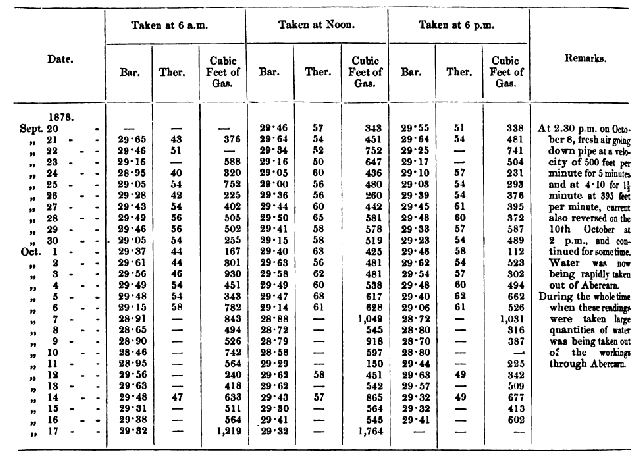
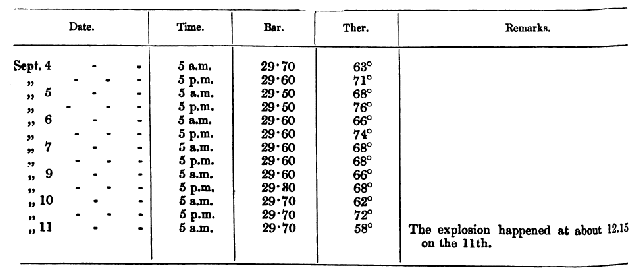
Table showing readings of barometer and thermometer for seven days previous to the explosion at Abercarn, taken at the top of Abercarn Pit, 300 feet above sea level, as given by the manager:—





 Contains public sector information licensed under the

