


|

|

|

|
|
 |
 |
 |
||
Point Of Origin And Cause Of Explosion.
Opinions differed as to the precise point of origin of the explosion but it was generally agreed that that point was either in George Rees’ conveyor face or George Rees’ road. As to the cause, no one in the witness box could or would give any definite opinion.
The flame safety lamp of the fireman Cheney and the three electric hand lamps of Cryer, Bowen and Evans were suspect, but on being tested by the Testing Officer (Captain C. B. Platt) at the Mines Department Testing Station at Sheffield, were found to be in order and not a possible cause of ignition.
Mr. Thomas Sheppard, Overman, said he could not be certain where the explosion occurred, but he placed it approximately in George Rees’ working place, in which he included George Rees’ road as well as George Rees’ conveyor face, but he had no idea whatever how ignition came about.
Mr. E. Sims Rees, Senior Inspector, thought the explosion had started at the face of George Rees’ conveyor face and suggested that a "pop" shot had been fired in the coal in the left side. He based this suggestion on the appearance of that part of the face and the presence of a break in the roof immediately above, but in view of the fact that the only shotfiring apparatus available in the seam was not found in the place and was found by the Manager, Mr. John Whitticombe, in a box in the fireman’s lodge near the downcast pit bottom, before anyone had been into George Rees’ road or conveyor face subsequent to the explosion, the firing of a shot as being the cause of the explosion may definitely be dismissed.
Mr. Rees did not think the ignition could have been due to the striking of a match for some purpose or other and gave his reasons in the following words :— "First of all, to have smoked in such a place as George Rees’ face was known to be and in the presence of the fireman of the district, would betoken such a degree of slackness and stupidity as to be almost incredible. That is one reason. If you accept the explanation of smoking, then you must assume that the fireman or one of the workmen struck a match in an explosive mixture of air and gas, of which they must have been aware because of the fireman’s lamp. That is too much for me to assume, at any rate. And the other reason is, as far as I know, there is not a particle of evidence that they were smoking or anyone else was smoking."
Mr. Rees was then asked
"Q. 1728. Come down to the place where Herbert Evans was found on George Rees’. Do you consider it possible that a match might have been struck there? — A. No, Sir, I do not."
"Q. 1729. Herbert Evans himself would not have the advantage of the flame safety lamp at that particular point, supposing the gas was there? — A. No, he would not."
"Q. 1730. Do you think it possible that Herbert Evans could have struck a match? — A. It is possible, but we have no evidence of it, and moreover, if he did strike a match there, as far as I am able to judge, there was no gas there."
The explosion, in Mr. Rees’ opinion, began as a firedamp explosion and was carried on by coal dust.
Mr. T. Britten Bassett, Junior Inspector, in view of the fact that the signs of flame were much more evident near the face of George Rees’ road than in George Rees’ conveyor face — the brattice in the former was burnt whilst in the latter it was very slightly singed — considered that there had been an explosive mixture in George Rees’ road at the rippings and that, at the time of the explosion, there was more firedamp at that point than in the conveyor face; but, as to the cause of ignition, he could not "arrive at a solution at all." He could not "imagine any smoking going on there, and the fireman was there at the time." As a fact, the fireman was not there; he was at the face of George Rees’ conveyor face.
Mr. William Henry Mainwaring, Miners’ Agent for the No. 1 Rhondda District of the South Wales Miners’ Federation, said that he had not been able to satisfy himself as to the cause of ignition. The only thing he could think of was that Cheney and Morgan Bowen were improving the brattice in George Rees’ conveyor face and that, either in driving a nail to hold up the brattice or by the hammer they were using slipping and striking the conveyor troughs, a spark had been caused which ignited firedamp.
He thought the fact that there had been a "fly" sheet at the end of Squint’s airway indicated that at some time prior to the explosion, gas must have been found at the face of George Rees’ road, but when he searched after the explosion he found no sign of gas there. He considered that in all probability if gas had been present at that point before the explosion, certainly a fresh quantity would have accumulated there under the conditions of ventilation after the explosion.
On this last point, it may be remarked that, as a result of the arrangements made following the explosion, there would be more ventilation at the face of George Rees’ road after the explosion than before, and on the question of the possibility of firedamp being ignited by sparks caused by a hammer striking a nail or the conveyor troughs, Professor R. V. Wheeler, when giving evidence, said that the experiments which he and one of his assistants, Mr. Burgess, had made, had been negative.
The striking of a match as a possible cause of ignition, Mr. Mainwaring excluded, because, to use his own words, "first of all so far as the bodies in the face are concerned, they would be in the clothes that they would be working in normally. I do not know where their coats would be found. No man would carry matches in the clothes that he works in, in that sense. So far as the body of Herbert Evans is concerned, the very position in which he is eliminates any possible suggestion of smoking."
Mr. Mainwaring was then asked
"Q. 2562. The position in which he was found? — A. Yes."
"Q. 2563. How do you know that was the position he was in when the explosion happened ? — A. Well, I do not think anyone can presume that he has moved — particularly Herbert Evans."
"Q. 2564. Can you assume he did not move? Can you tell? — A. No, one cannot tell."
"Q. 2565. So far as the men in the face are concerned, for the reason that men are not given to carrying matches in the clothes in which they work right at the face, you would except matches? — A. Yes, I would definitely on that score alone.
"Q. 2566. Have you any other score on which you would except matches? — A. Yes, ordinary common sense.
"Q. 2567. When you speak of ordinary common sense, is it ordinary common sense to take a match into a pit at all ? — A. Well matches may be taken into the pit."
"Q. 2568. Answer my question? — A. No, not from common sense."
"Q. 2569. Then can you bring common sense into it? — A. One must bring common sense into it even if it is only in defence of those men who are gone. The very idea that men of this experience such as Cryer, and the fireman, who workmen in the district have testified to me personally as being a careful man, and Morgan Bowen — the suggestion that either of these three men working in a place where they know there is gas, would either let off an explosive there or presume to tamper with a match, if they had one — the whole thing is so utterly absurd that I cannot conceive of it being done by anybody."
"Q. 2570. That is your strongest argument is it, that they would know there was gas there and it would be absolutely fatal to strike a match. That is your strongest point ? — A. Yes, and I think this too. The workmen Cryer and Herbert Evans knew of this condition. It was a strange working place for them, and they knew of its condition before they went there. That these men did know there was gas in that place, I have proof of."
"Q. 2571. And there is the fact that the fireman was with them? — A. Yes."
Mr. Mainwaring agreed that the greatest signs of burning were not at the face but back on George Rees’ road. He also said there was a slight fissure in the roof at the conveyor face and that he would not be averse at all to accepting the suggestion that owing to the proximity of the fault, it would be natural to get exudation of gases in that particular place. He added that he thought faults of this character were frequently the cause of the exudation of gases; it was a place where normally any practical man would expect to find gas.
That of course is true, but it is also necessary to remember that the fault crossed George Rees’ road at the rippings and the likelihood of gas issuing at that point was equally to be expected, and according to the firemen’s reports had, in fact, been found there more often than in George Rees’ conveyor face.
Mr. David Davies, M.P., until recently Miners’ Agent for the No. 2 District of the South Wales Miners’ Federation, after considering the possible causes of ignition, finally suggested that, as the conveyor in George Rees’ conveyor face had been working in the same position for at least six weeks, there would be a tendency for the dust and small coal underneath it to be heated, by the trays of the conveyor rubbing against it, to such an extent that, once it was so started to heat, it would then by itself go on increasing in temperature until eventually it fired, and so ignited firedamp.
He said that he would have expected, if sufficient heat had been generated to ignite the coal dust and small coal, coke would have been produced, and, although he made a careful examination, he failed to find any. He had examined some of the material from under the trays and found that its surface looked as if it had been caked by friction and heat; underneath this coating was small coal. He saw no coking whatever, but he added, it did not follow that there was no coke there for he was looking for other things as well.
On this particular point, the evidence given by Mr. Mainwaring is apposite and is as follows
"Q. 2530. There was no indication of spontaneous combustion or anything of that sort ? — A. No. We made a special examination, in fact I might say we made almost a special visit for the purpose of eliminating that possibility. There was no evidence."
"Q. 2531. None at all? — A. None at all. It was a point which occurred to us. As a matter of fact we talked about it, and paid a visit in order to discover evidence if it was there."
On this question, Professor R. V. Wheeler, in the witness box was asked :— "Q. 2981. If there had been any heating sufficient for the coal to get hot enough to ignite firedamp, would there have been something left to show that that coal had been hot?" and he replied :— "I think that is certain. In order that heated coal shall ignite (firedamp), of course there must be flame produced. The ignition of firedamp cannot take place simply from a glowing coal, or from coal in the earlier stages of spontaneous combustion when it is simply glowing red. There has to be actual flame produced, and with that flame being produced the coal must be very nearly completely coked — in a caked form at all events, which is unmistakable or should be unmistakable and observed."
Mr. Trevor L. Mort, Director and General Manager of the Ebbw Vale Steel, Iron and Coal Company Limited, and of other colliery companies, said the ignition took place in the area comprised in the heading known as George Rees’ conveyor face and George Rees’ road but he had no evidence to support any theory as to the cause and therefore he had none to advance. He considered it was chiefly a gas explosion and that coal dust had not entered into it to any great extent.
Mr. Frank L. Jacob, Mining Engineer, said he was more inclined to place the point of ignition in George Rees’ road than in the conveyor face, but he was not prepared to express an opinion as to the cause. He thought coal dust had taken some, but very little part in the explosion. He searched for matches but found no evidence, of them at all.
Mr. Jacob based his inclination to the opinion that the point of ignition was in George Rees’ road rather than in the conveyor face solely on the fact that there were more signs of heating in the road. He thought "a lick of flame" only had gone up through the face.
All the above witnesses were agreed that there was evidence of greater heat in George Rees’ road than in the conveyor face. There was similar material in both — brattice cloth. In the face, the brattice according to Mr. Rees was not affected whilst in the road it was consumed by flame. Mr. Bassett agreed that in the road the brattice was burnt but said that in the face "had been just singed a little bit, not much." Mr. Mort said there were timbers and material absolutely burnt in the double parting, i.e., in the road and Mr. Jacob agreed and said there was nothing like that up in the face. Mr. Davies, whilst agreeing that there was greater heat shown on the road than in the face, considered evidences of greatest heat were to be found in the airway between George Rees’ face and Randall’s where there was coking on both sides of two props.
Mr. John Whitticombe, Manager, said he had given the question much thought but he could give no opinion as to the cause of the explosion.
All possible causes of the explosion having been examined and the reasons of the several witnesses for rejecting the use of matches as a possible cause having been stated, it remains for me to record that when the first party of explorers went into George Rees’ road after the explosion, and after the body there had been seen by the rescue men, there was found in the pocket of a waistcoat close by that body a small tin box which contained an unsmoked cigarette and a tram ticket for a "return" journey.
The finding of this unsmoked cigarette is ominous and, in my opinion, considered in conjunction with the laxity with which searching was carried out and of which something will be said presently, points to the actual cause of ignition.
As has already been recorded, Mr. Bassett was of opinion that there had been an explosive mixture in the rippings of George Rees’ road and that at the time of the explosion there was more firedamp at that point than in the conveyor face. With that opinion I agree.
If the three men at the face of George Rees’ conveyor had been in an explosive mixture of firedamp and air they would have been aware of it by reason of its effect on the fireman’s lamp, and he, as told by Mr. Mainwaring in evidence, being a careful man would surely have withdrawn the two workmen and himself from the place.
If, as suggested by Mr. Davies, ignition took place due to the heating of the coal dust underneath the trays "a bit further up than the engine," the same contention holds good, for in such case the three men at the face, by reason of the rising gradient of the "conveyor face" must have been enveloped in an explosive mixture of firedamp and air.
Herbert Evans had no means of telling whether there was firedamp in the rippings of George Rees’ road or not. Those rippings were in the faulted area and, as Mr. Mainwaring said, in such places any practical man would expect to find gas. Gas had in fact been found there, though not within fourteen days of the explosion, and a "fly" sheet had been erected to keep the rippings clear, but as the roof at the rippings was ten feet above the floor and the "fly" sheet was open at the side as well as at the top and the course for the air was up Rees’ conveyor face, there can be no doubt that gas given off at the rippings would not be diluted as it issued. There would also be leakage of air through the sheet placed across George Rees’ road some fifty feet back from the rippings, more particularly so because of the very small size of the airway between George Rees’ face and Randall’s. In such circumstances, no imagination is needed to picture an accumulation of firedamp at the rippings of George Rees’ road in the faulted area and tailing out towards the brattice outbye. It is my opinion that such an accumulation existed on the evening of Monday, 25th January, in that place; that it was ignited by the striking of a match for the purposes of smoking, and that the explosion thus caused was propagated by coal dust.
The violence of the explosion was such that of the door and its brick sidewalls which had been across Old Camm’s just on the inbye side of the entrance to Cooper’s, nothing was left, or in the words of Mr. Mort "there was practically no evidence except a little bit of stick on the frame on the left side walking out. There was nothing else. The brickwork and everything else had been blown away. Then we went to look for the other door (that is the one some 50 to 60 yards further outbye) and we found that was blown all to smithereens. There was nothing to be seen there." The block sheets across Joe Davies’ and Bulgin’s headings — the latter sheet some 650 yards from the site of the ignition — were also blown down.
Presence of Coal Dust.
It must be remembered that coal had been dumped off the conveyor on to the floor at the inbye end of George Rees’ road for several weeks and thence filled into trains — operations very conducive to the making of dust — and that there was a brattice across George Rees’ road fifty feet outbye. The area between the dump and the brattice could not help but be a receptacle for coal dust.
Squint’s airway is in the same category; it had been a working face which on being stopped became Squint’s airway and it was never treated with stone dust.
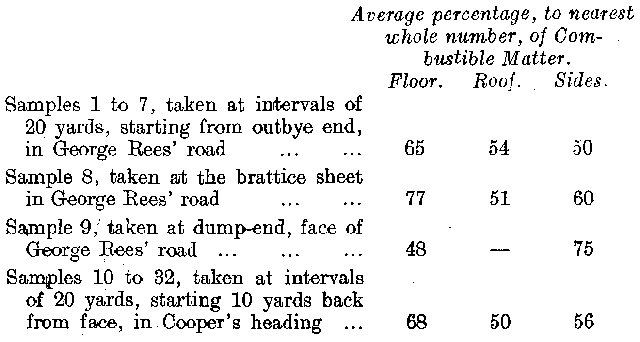
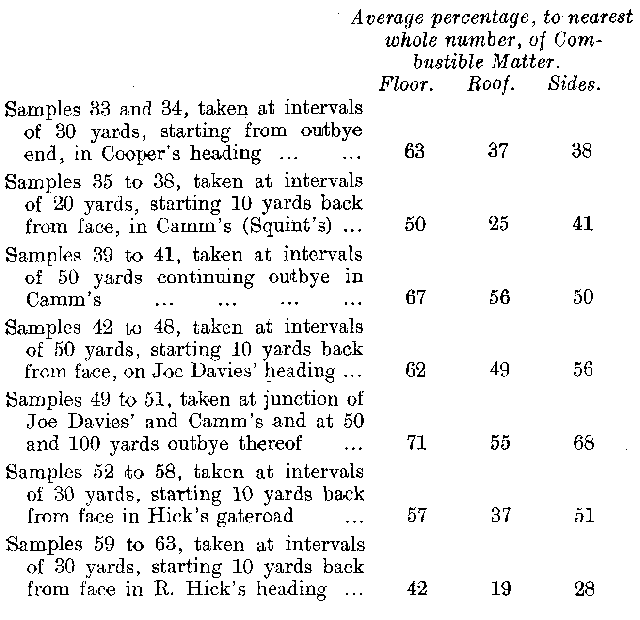
On the day following the explosion Mr. E. A. Owen and Mr. R. J. Bennett, H.M. Sub-Inspectors of Mines, took samples of the dust on the roof, floor and sides of several roads. On being analysed at the Mines Department Testing Station, Sheffield, these samples were found to contain the percentages of combustible matter shown below :—
Samples of dust taken by Mr. Bennett in the Pentre Seam on 11th January, 1929, 2nd January, 1930, and 19th November, 1930, contained the following percentages of combustible matter :—
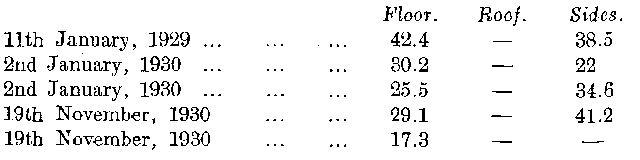
There is a considerable difference between the percentage of combustible matter in these samples and that in the samples taken on the day following the explosion, and the explanation would appear to be that given in evidence by Mr. Bennett, namely, that the samples taken prior to the explosion were taken during inspections in reference to shotfiring when "they clean up very cleanly when we are there and put some stonedust down afterwards," which is a very right and proper thing to do and in accordance with the requirements of the Explosives in Coal Mines Order. But this explanation, according to the evidence, does not apply to the analyses given of samples taken by the Overman, T. Sheppard, on 26th November and 21st December, 1931. The combustible matter shown by analysis to be contained in these samples was :—
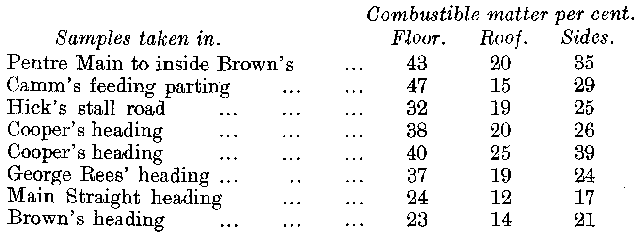
The Overman explained that each of these samples was taken over a length of 50 yards and then sieved through a 28-mesh gauze. I am not able to explain the difference between these analyses and those of the samples taken by Messrs. Owen and Bennett on the day following the explosion.
Gwlwym Griffiths, Instructor at the Porth Rescue Station, who with Benjamin Thomas Davies and Morgan J. Hosking, members of the rescue brigade at that Station, was the first to enter George Rees’ road and George Rees’ conveyor face after the explosion, said in evidence that the air was quite clear but it "was of a stinging character" and it irritated the eyes "as if there was sulphur in it." He added that he experienced the same thing when in J. Alsop’s earlier in the evening.
As indicated in 1896 by Doctor J. S. Haldane in his *Report on the Causes of Death in Colliery Explosions and Underground Fires, this smarting of the eyes is probably due to sulphurous acid present in the afterdamp following a coal dust explosion.
* Report to the Secretary of State for the Home Department on the Causes of Death in Colliery Explosions and Underground Fires, with special reference to the explosions at Tylorstown, Brancepeth, and Micklefield. By John Haldane, M.D. (C. 8112). H.M.S.O. 1896.


A copy of this report was kindly donated by
West Cumbria Mines Research.




 Contains public sector information licensed under the

