


|

|

|

|
|
 |
 |
 |
||
APPENDIX IV.
REPORT BY PROFESSOR R. V. WHEELER AND EXTRACTS FROM HIS EVIDENCE ON DUST SAMPLES COLLECTED AFTER THE EXPLOSION AT LYME COLLIERY.
Sixty samples of the dust in the roads of the Lyme pit were collected after the recent explosion and sent to the Safety in Mines Research Laboratories, Sheffield, where they were analysed by Dr. A. L. Godbert.
The road dusts were examined as follows :—
Sieved into three fractions: That remaining on a 28-mesh sieve; that passing a 28-mesh sieve and retained by a 200-mesh sieve; and that passing a 200-mesh sieve. (The sieves were of the I.M.M. standard).
Each of the last two fractions (labelled, for brevity, the "28-200-mesh" and "through-200-mesh ") was analysed as follows :—
Moisture content. — Determined by heating for 1 hr. at 105 deg. C.
Ash content. — Determined by incineration at 950 deg. C.
Carbon dioxide content. — Since the stone dust used on the mine roads contained carbonates, the true inert dust content of the dusts exceeded their ash contents, as determined by incineration, by the amount of carbon dioxide (and any other "volatile" material) which the stone dust yielded on incineration. The carbon dioxide contents of the dusts were determined separately and added to the ash contents found by incineration to give the mineral matter contents of the dusts.
Volatile matter contents. — The determination of the volatile matter contents of the dusts was complicated by the presence of carbonates, and their high ash contents made the figures doubtful. The dusts were therefore treated with dilute hydrochloric acid to destroy the carbonates and then floated in a liquid of specific gravity 1.44. This process served very well for the coarse dusts (the 28-200-mesh fractions), for it reduced their ash contents to 10 per cent, or lower, but it failed with the "through 200-mesh" fractions. All the "through 200-mesh" fractions used in the volatile matter determinations bad, therefore, a high ash content and the data for the volatile matter contents cannot be taken with great confidence.
The dusts (after having been floated) were examined microscopically to detect, if possible, any signs of their having been burnt.
Samples were received of the coal from the seam. The sample of coal arrived in two boxes, the one labelled "Portion of seam worked" and the other "Portion of seam left in goaf." The coal in the first box was in large lumps. It appeared to be rather dirty and contained much fusain. The sample in the second box was partly of coal and partly of shale. The shale and coal were separated and treated independently. The first sample of coal (that "worked ") is termed Sample I, and the second Sample II in the following analyses.
Two samples were received of the stone dust used. The stone dust was "Chance's Mud Lime." One sample was light green and the other of a whiter colour.
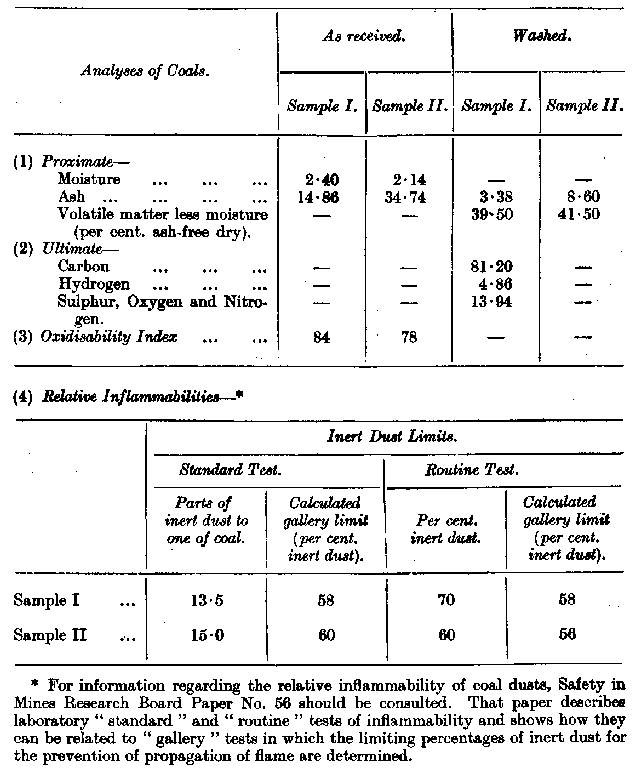
The Properties of the Coal.
The coal, "Wigan Four Foot," is of low rank, its reactivity towards oxygen* being high and its carbon content (81 -20 per rent.) low. The determination of its "rational" analysis showed a high proportion of fusain. The microscopic examination of the mine dusts also showed a high proportion of fusain particles in them.
The inflammability of the dust from the coal as determined was rather low for its reactivity. This unexpectedly low value of the inflammability is probably to be ascribed to the fusain in the coal. This inference is supported by the inflammabilities of the mine dusts which suggest an even lower figure for the inflammability of the coal dust than that determined. The fusain is likely to accumulate in the road dusts and to lower their inflammability correspondingly.
The Analyses of the Mine Dusts.
The inflammabilities of the dusts. — A few of the dusts were tested in the laboratory routine apparatus, such a weight of dust being taken that it contained approximately 0.5 gin. of coal dust. The results were briefly as follows :—
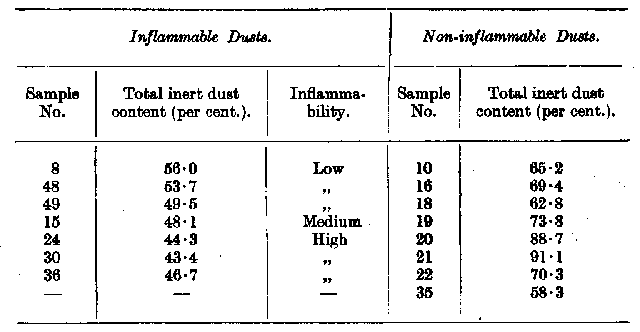
The dusts containing less than 58 per cent, mineral matter all inflamed with an intensity depending on their mineral matter content. Those containing more than 58 per cent, did not inflame. This "inert dust limit" is equivalent to one of between 45 and 50 per cent. as determined by gallery test and is appreciably lower than the gallery test limit calculated from the laboratory tests for the coal as mined. Presumably the lower inflammability of the coal dust in the road dusts is to be ascribed to the concentration in them of fusain which occurs in the seam in comparatively large proportions.
The ash end volatile matter contents of the road dusts. — The dust samples are listed in Table I in the order of their receipt and are arranged rather haphazardly with respect to their location in the pit. (See Plan No. 3 for the localities in which the samples were taken.)
The sieved fract ions passing the 28-mesh and lying on the 200-mesh sieve. — The inert dust in the samples was not distributed uniformly along the floor, roof and sides. Twenty-two of the samples analysed formed eleven pairs, one of each pair being from the floor and the other being a combined sample of the dust from the roof and sides.
Nine of the samples formed three groups of three, one sample from the floor, the second from the roof and the third from the floor. In two of the three groups the sample from the sides had the lowest mineral matter content. To show how indiscriminately these differences were found it may be stated that in the sixteen groups, either pairs or groups of three, in which a floor sample figured, the floor sample had the highest mineral matter content in eight groups and the lowest mineral matter content in the other eight.
The proportion of stone dust in the dust samples varied irregularly along the roads. Taking average figures to the nearest 10 per cent., there was between 30 and 50 per cent, inert dust near the point where the explosion was initiated. Following the course of the explosion outbye, the inert dust increased to about 60 per cent., then decressed to 50 per cent, and then increased again to between 60 and 80 per cent.
Along the face, the inert dust content increased from 24 per cent., to 38 per rent. (sample 15), the explosion dying out near where sample 15 was taken.
The volatile matter contents of the road dusts (calculated as percentages on the ash-tree, dry sample) did not, as a rule, vary appreciably from the volatile matter content of the coal as mined from the seam (about 40 per cent.).
Assuming that, if the dust onwhich the volatile matter content had been determined had a reasonably low ash content and contained less than about 35 per cent. of volatile matter, it had been subjected to heat to some extent, the following observations may be made.
Following the explosion outbye from the point of ignition, the 28-200-mesh fraction of the dusts had not been affected appreciably up to the junction of the Main Slant with the Conveyor Level.
Along the face, the sample near the point where the explosion died out showed a loss of volatile matter of about 15 per cent.
The dusts passing the 200-mesh sieve. — The mineral matter contents of the through 200-mesh dusts were similar to those of the 28 to 200-mesh dusts and varied in the same manner.
With a number of these fine dusts, the volatile matter contents showed appreciable differences from the volatile matter contents of the original coal. The volatile matter contents of the through 200-mesh dusts are more liable to error than those of the 28 to 200-mesh fractions because they could not readily be cleaned by flotation and the ash-contents of the samples on which the volatile matter was determined were therefore high (as a rule, 30 per cent, or more).
Again, following the track of the flame outbye from the point of ignition: there were evident signs of the dust having been subjected to heat near the point of ignition, one "roof and sides" sample (sample 4) having a volatile matter content of only 30 per cent., and two other samples (37 and 38) still lower volatile matter contents (25.0 and 238 per cent.). Farther outbye, the volatile matter contents of the dusts were low near the junction of the Main Slant with the Conveyor Level and again, still further outbye, near the air-crossing.
Along the face, the sample near the point where the explosion died out had a low volatile matter content of 18.7 per cent.
* See Safety in Mines Research Board Paper No. 56.





 Contains public sector information licensed under the

