


|

|

|

|
|
 |
 |
 |
||
Appendix IV.
Memorandum On Tests Of Coal Dusts. By R. V. Wheeler, D.Sc.
Early in December, 1929, I received through Mr. F. H. Wynne, H.M. Deputy Chief Inspector of Mines, a request from Mr. T. Ashley, H.M, Divisional Inspector of Mines, for information as to whether dust from the coal worked at Wernbwll Colliery, and in particular dust from the second top-hole from the face of No. 13 level, could be ignited by the flame of an acetylene lamp or by an explosion of acetylene gas arising from a defective acetylene lamp. A request for similar information was made by the Berthlwyd Colliery Company and by the South Wales Miners’ Federation.
In order to obtain such information, I asked for, and received from Mr. Ashley on December 15th, 1929, samples of coal: (1) From the faulted area in which the explosion occurred; and (2) from a normal part of the seam. Later (in January, 1930), in accordance with a request by the Colliery Company, I received samples of coal taken about 25 yards inbye of the point where the previous samples had been collected, together with samples of coal dust stated to contain dust emitted by "pounces." Examples of the acetylene lamps used at the Colliery were also sent to me.
Examination of the Coal Samples.
The samples examined are numbered and described as follows:—
No. 1. Lump coal. From faulted area in which the explosion occurred.
No. 2. Lump coal. From a normal part of the seam.
No. 3. Coal dust emitted from the coal face when "pounces" occur. Collected on a sheet at a working face about 25 yards inbye of samples Nos. 1 and 2.
No. 4. Lump coal from the face about 25 yards inbye of samples Nos. 1 and 2.
No. 5. Coal dust and small coal, containing dust from "pounces," collected on a sheet.
The samples of lump coal were analysed and tests were made of the relative inflammabilities of their dusts (obtained by pulverising the lump coal).
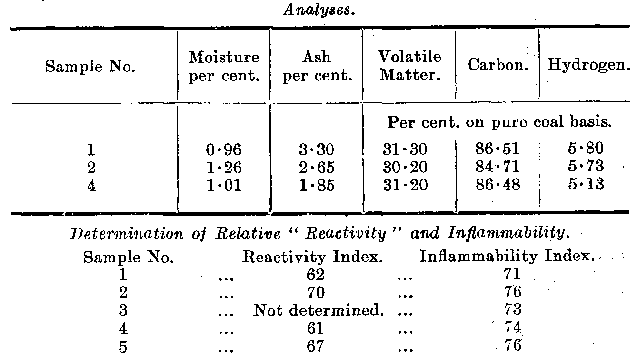
These determinations, the character of which is described in Safety in Mines Research Board Paper No. 56 ("The Relative Inflammability of Coal Dusts: A Laboratory Study," by A. L. Godbert and R. V. Wheeler), give information as to the degree of inflammability conferred on dust from the coal by reason of its chemical composition, i.e., apart from its degree of fineness.
The samples do not differ markedly one from another, either as regards analysis and reactivity of the coals or as regards inflammability of the dusts, whether they came from the "faulted" or the "normal" part of the seam or from "pounces." The dust from the pounces was rather less inflammable than that from the lump coal, but the difference is slight. As compared with coals from other seams, the samples do not show any abnormality, their "reactivity" and the degree of inflammability of the dusts being in keeping with their chemical compositions. The coals can be classed as a fairly high reactivity and the dusts as of fairly high inflammability. As a measure of the degree of inflammability of the dusts, it can be stated that, under the conditions of large-scale test at the Safety in Mines Research Station at Buxton (dust 85 per cent. of which passes through a 200 mesh, I.M.M. standard, sieve, ignited by a blown-out shot of blasting-powder), 60 per cent. of incombustible dust would be required to suppress inflammation.
Ignition of the Dust by Acetylene Flames.
One of the acetylene lamps supplied was placed on the floor of a wooden box 1 ft. 3 in. high, 10 in. wide and 7 in. deep. The front of the box had a glass window through which the lamp could be observed. The coal dust was injected into the box from a glass tube 1 in. in diameter and 12 in. long by a blast of air.
The dust used for the majority of the experiments was from No. 5 sample, artificially ground so as all to pass through a 120-mesh sieve, 75 per cent. passing through a 200-mesh sieve.
The flame of the acetylene lamp, which was placed centrally on the floor of the box, was 1-in, high. The results of one series of tests can be summarised as follows :—
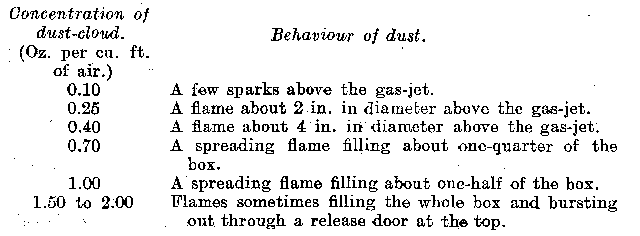
The concentrations of dust cloud recorded are not accurate. They are calculated on the assumption, known to be incorrect, that all the dust projected into the box was uniformly distributed throughout the air. They suffice to show that the minimum concentration of a cloud of this coal dust that can be ignited by the flame of an acetylene lamp is about 0.2 oz. per cu. ft. of air, the optimum concentration being about 1.5 oz. per cu. ft. of air.
Similar experiments made with through 100 mesh dust sifted from Sample No. 5 (not artificially ground) gave similar results.
Experiments of the same character (including some with an acetylene lamp fitted with a bat’s-wing burner) were made, with similar results, in the presence of representatives of the Colliery Company and the South Wales Miners’ Federation on Monday, February 3rd, 1930. Experiments were on that occasion made also with candle flames. Candle flames were found to be too unstable to ignite the dust clouds. Low concentrations (0.1 to 0.4 oz. per cu. ft.) were not ignited by three candle flames placed close together, and higher concentrations extinguished the flames.
The Acetylene Lamps.
In the type of acetylene lamp supplied to me (which is of similar size and design to that commonly used on bicycles), there is a water container above a carbide container, the two being screwed together with a rubber washer at the joint. Admission of water to the carbide is through a jet at the base of the water container, a needle sealing the jet being controlled by a rod passing vertically through the water container and terminating in a thumbscrew. The gas generated is led from the top of the carbide container through a short tube and burnt at a jet situated about 1-in, in front of the lamp, to which a reflector is attached. There is no glass, or other form of protection, around the flame.
Possible leakage of Acetylene.
The production of acetylene during normal burning is about 3 litres per hour. When the flame is "flaring" it is about 5 litres (about 1/5 cu. ft.) per hour. In one of the samples supplied (understood to be a new, unused, lamp), the screw rod controlling the water jet fitted badly, so that, even when the water container was full, acetylene leaked through it. When the water container was nearly empty, the amount of acetylene that leaked through it, the lamp being at full flame, was about 1 litre per hour.
A full charge of carbide for one of these lamps is about 200 grams. This can produce about 2.5 cu. ft. of acetylene. The lower limit of inflammability of acetylene is about 2.8 per cent., so that the 2.5 cu. ft. of acetylene, if suddenly liberated from a 200 gram charge of carbide, could form 90 cu. ft. of a mixture of acetylene and air that would be just explosive.
(Sgd.) R. V. Wheeler.
10th March, 1930.


A copy of this report was kindly donated by
West Cumbria Mines Research.




 Contains public sector information licensed under the

