


|

|

|

|
|
 |
 |
 |
||
Appendix II
Haulage Accident At Newcraighall Colliery
On 12th September, 1955
Report by A. E. McClelland, M.Sc., M.I.M.E., of the Safety in Mines Research Establishment, on the examination of samples of the East Side man-riding haulage rope (Rope No. 1444) at Newcraighall Colliery.
Following the breakage of this man-riding haulage rope, three samples of the rope were received at the Safety in Mines Research Establishment Laboratories on 20th September, 1955. The samples, which carried descriptive labels as quoted below, were given the following S.M.R.E. sample numbers :—
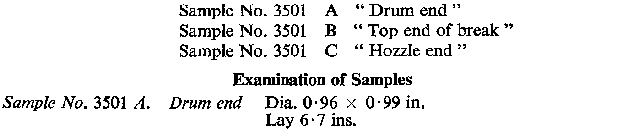
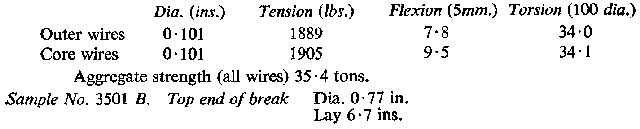
This was a 5 ft. in. length of rope, curved to a diameter of about 5 ft. throughout its length. The rope diameter measured 0.99 in. in the plane of this curve and 0.96 in. at right angles to that plane, whereas the smaller value of the rope diameter is usually found in the plane of the curve of a sample from the dead coils of a rope. The rope was found to be in langs lay and to consist of six round strands, each of 6-1 wire construction, on a main core of a hard fibre like hemp or sisal. The outer wires of the strands measured 0.101 in. over their zinc coatings and the strand core wires were of the same size. The wires were found to be of drawn-galvanised finish and appeared to have been pre-formed. The fibre main core consisted of three strands, each of eight yarns, and with a green thread or "spy mark" in one strand.
The sample had been well seized at each end with soft iron wire before leaving the colliery and was in a well laid-up condition as received. When tapped with a ropeman's light hammer a clear metallic note was obtained showing that the individual wires were in hard contact with each other. The outside of the sample (Figure 1, lower rope — facing page 8) held some dressing of rather crumbly consistency and the zinc coatings of the exposed wires were almost entirely bright, while the underlying steel was quite unaffected by corrosion. There was no external wear of a normal nature but, at mid-length in the sample, the wires of three adjacent strands had become damaged by somewhat heavy abrasion against a flat surface. This local damage may be seen in Figure 1 (lower rope, mid-length).
Internally the sample was in new condition. The fibre core held a good supply of black dressing and the interiors of the rope strands also held a sufficient supply. All wires were bright and internal wear was negligible. In short, the sample showed no deterioration affecting the steel, merely damage at one point.
Mechanical tests were carried out on the individual wires from an undamaged part of the sample and the following average results were obtained :—
This was a straight sample which had been cut at one end and broken at the other. The sample measured 6 ft. long from the cut end to the middle of the length of the fracture. The fracture extended over 12 ins, of rope length. The sample had been seized at the cut end and near the fracture with copper wire of 0.090 in. diameter. On receipt at the laboratory the strands were allotted recognition numbers in clockwise order around the rope when looking along the rope in the direction of the "hozzle" or capel.
This sample was so much reduced in diameter and was in such poor condition that, at first, it appeared to be from a different rope to that represented by Sample A. In Figure 1 a portion of the present sample is shown (at top) for comparison with a portion of Sample A (at bottom). Actually, the diameter of the present sample had been reduced to 0.77 in. except where loose wires were riding proud, at which points the rope diameter measured up to 0.80 in. Thus, compared with Sample A the present sample had suffered a loss in rope diameter of 21 per cent.
The outside of the sample was devoid of dressing and was moderately corroded at all parts, except along the axis of each worn crown where recent wear had kept the metal bright. It was noted that the small corrosion pits on the other parts of the worn crowns were somewhat elongated and had their major axes parallel to the axes of the wires. External wear was so heavy that no valleys remained between adjacent outer wires while little trace of valleys remained between adjacent strands. In fact, the sample was worn to an almost smooth cylinder in shape, except for the effect of the very loose outer wires. All outer wires were obviously loose, being in poor contact with one another and with their strand core wires, with the result that they could be moved laterally by inserting a knife blade between any two outer wires. In fact, as shown in Figure 1, a feeler gauge of 0.025 in. thickness could be inserted and forced underneath any outer wire. Some outer wires were so loose that daylight could be seen between them and the rope (see Figure 1). When the sample was tapped with a ropeman's hammer the dull, chattering sound of a bunch of loose wires was obtained instead of the "solid" metallic sound of a well laid-up rope as in Sample A. It was possible to see underneath the very loose wires and to note that internal deterioration had attacked the "undersides" of the worn crowns and had reduced the wires to a thin, tape-like section at the worn crowns. These observations applied to the whole length of the sample; deterioration did not appear to be appreciably more severe in the immediate vicinity of the fracture.
There were seven secondary fractures in outer wires (a secondary fracture in a wire being one which takes no part in the main fracture of the rope). Five distinct wires were broken in a length equal to two rope lays, a length over which rope fracture may well extend, and consequently these five wires contributed nothing to the strength of the rope at that position and may be omitted in calculating the aggregate strength at that position. The seven secondary fractures were distributed as follows :— 3 adjacent outer wire fractures in Strand No. 3 at 24 ins. from middle of rope fracture.
1 outer wire fracture in Strand No. 3 at 20 ins, from middle of rope fracture.
1 outer wire fracture in Strand No. 2 at 13 ins. from middle of rope fracture.
1 outer wire fracture in Strand No. 2 at 9 ins, from middle of rope fracture.
1 outer wire fracture in Strand No. 5 at 4 ins, from middle of rope fracture.
Total= 7 wire fractures.
The seven secondary fractures in wires produced 14 broken wire ends but five of these original wire ends had become wrenched off at relatively undamaged parts of the wire situated at strand contacts, apparently as a result of catching on obstructions while the rope was in motion. The remaining 11 original broken ends of wires were situated at crowns and were reduced to sharp "chisel ends", showing that the wires had been virtually severed by deterioration, in this case by external wear and internal corrosion.
When the sample was opened the fibre core was found to be of the same construction as in Sample A and to show the same "spy mark" confirming that Samples A and B were from the same length of rope. The rope was also of the same construction as in Sample A, but only faint and somewhat indefinite traces of the zinc coating were found on the wires. No dressing existed anywhere on or within the sample and all wires at all parts were rusty. Where the outer wires (0.101 in. dia.) contacted the fibre core they were roughened by corrosion but were less reduced than at other parts; they were reduced to 0.094 in. dia. on the average at the fibre core. Where contact was made between adjacent rope strands the outer wires were reduced by corroded nicks to a depth of 0.074 in. (depth being measured radially with respect to the strand). Within each strand corrosion and grooving reached maximum severity at parts approaching the rope exterior (i.e. at the undersides of the worn crowns) where external wear and internal corrosion had reduced the outer wires to depths varying between 0.025 in. and 0.035 in. while their widths measured 0.085 in. on average. The core wires (0.101 in. dia.) were reduced to 0.07l in. depth and 0.085 in. width on average.
At the fractured end of the rope 34 of the 36 outer wires displayed sharp chisel ends at crowns, rather than true fractured ends, showing that they had been virtually severed by external wear and internal deterioration. In the case of the remaining two outer wires the original broken ends had become wrenched off at strand contacts, suggesting that they had been broken before the accident and had lost their original ends while the rope was still in the laid-up condition (i.e. before the accident). The six core wires of the strands showed tensile fractures. Figure 2 (facing page 8) shows the broken ends of a reduced outer and core wire from the fractured end of the rope, together with a sound outer and core wire from Sample A for comparison. It will be noted that the reduction in section of the outer wire (Wire 2 in Figure 2) at its broken crown is not notably greater than that at the next (unbroken) crown, 3½ ins. distant in the illustration, showing that the serious deterioration was not confined to the point of fracture. In fact, the whole length of the sample was in much the same condition as at the point of fracture.
Mechanical tests were carried out at a part about 5 ft. from the fracture and also at a part as close as possible to the fracture. The results were as follows :—
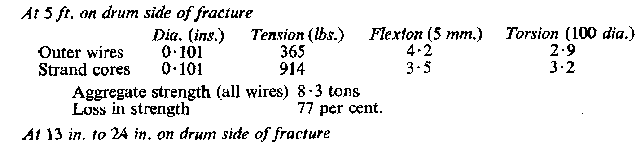
Employing the above tension test results and allowing for the presence of the five broken outer wires found within this length :—
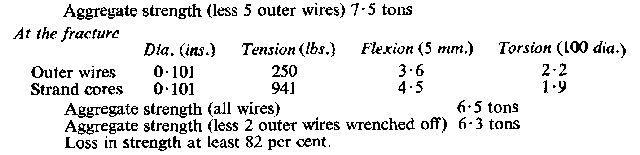
Thus, at no part of this 5 ft. 9 in. length was the loss in rope strength less than 77 per cent., while at the point of fracture the loss had reached at least 82 per cent. before the accident occurred.

This was a 6 ft. 5 ins, length which had been cut at one end and broken at the other. The fracture extended over some 12 ins, of rope length. The sample had been seized at the cut end and near the fracture with copper wire of 0.090 in. dia. However, the fractured end appeared to have been unlaid beyond its seizing at some time, for several wires were found to be in wrong positions within the seized length near the fractured end (i.e. some wires had been laid back into wrong strands). The sample had become distorted into a curve of about 30 ins, diameter at a part situated 39 ins. from the middle of the rope fracture but external wear was not definitely more pronounced along the outside of this curve and, thus, this distortion may well have occurred during or after the accident.
The sample was in much the same condition as Sample B, heavy external wear in conjunction with internal corrosion and wear having greatly reduced the outer wires at the sections of their crowns. Again the outer wires were so loose at their crowns. that, in many cases, daylight could be seen between them and the rope. No rope dressing was found on or in the sample.
Five secondary fractures in outer wires were observed, namely :—
1 outer wire fracture in Strand No. 3 at 15 ins, from middle of rope fracture.
1 outer wire fracture in Strand No. 2 at 15 ins, from middle of rope fracture.
1 outer wire fracture in Strand No. 4 at 35 ins, from middle of rope fracture.
1 outer wire fracture in Strand No. 3 at 43 ins, from middle of rope fracture.
1 outer wire fracture in Strand No. 3 at 48 ins, from middle of rope fracture.
Total= 5 wire fractures
These wires showed "chisel ends" at crowns, except in the case of the first wire which had had both its original broken ends wrenched off at strand contacts.
At the fractured end of the rope the broken ends of the wires were mainly similar to those in Sample B. Again 34 of the 36 outer wires showed chisel ends at worn crowns, but in several cases a lay length of wire was missing between the end of a particular wire in Sample A and that of the same wire in Sample B. No doubt short lengths of wire had broken off at greatly reduced crowns during the runaway or during handling of the rope after the accident. The remaining two outer wires had lost their original ends and showed wrenched off ends at strand contacts, but one of these was not one of the two wires which had lost its original end in this manner in Sample A. Thus, a total of three outer wires had had one or both of their original broken ends wrenched off at strand contacts and, therefore, these three wires, at least, would appear to have been broken before the accident at the point of rope fracture.
Mechanical tests were carried out at a part about 5 ft. from the fracture and yielded the following average results :—
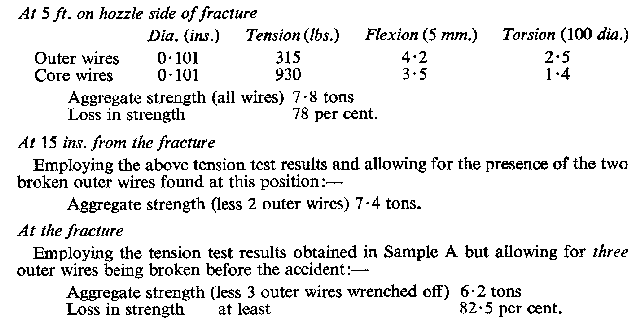
Thus, this sample confirmed that the rope had lost at least 77 per cent. of its strength over a length of about 6 ft. adjoining the fracture and that the loss had increased to at least 82.5 per cent. at the point of fracture before the accident occurred. The loss at the point of fracture, before the accident, may have been greater than 82.5 per cent., for some outer wires may have broken or been severed before the accident without subsequently having their broken ends wrenched off in service.
Conclusions
1. The cause of breakage of this rope was a loss in rope strength of at least 82.5 per cent. at the point of fracture. This loss in strength was due to excessive external wear in conjunction with severe internal corrosion of the wires where they approached the rope exterior.
2. Corrosion of milder severity was present at all parts of the rope section near the fracture and appeared to be of external origin. The rate of advance of external wear was, no doubt, aided by external corrosion.
3. Serious loss in strength as a result of the above forms of deterioration was not confined to the actual point of fracture. Over a length of about 6 ft. on each side of the fracture, as represented by Samples B and C, the loss in rope strength was never less than 77 per cent.


A copy of this report was kindly donated by
West Cumbria Mines Research.




 Contains public sector information licensed under the

