


|

|

|

|
|
 |
 |
 |
||
II. — The Sea Dook
The Sea Dook section of the colliery is served by three parallel roadways dipping inbye at varying gradients, and provides the coal haulage road and main intake, the secondary intake, and the return and man-riding haulage road for two production faces, each 100 feet in length, in the Nine Feet seam. The actual thickness of working is about 5 feet. Plan No. 1 shows the layout of the district together with a detailed section of the gradient at the top of the man haulage.
The man-riding road is equipped with a main rope haulage for conveying workmen in specially constructed carriages.
The Return Airway and Man-riding Haulage Installation
The roadway is the return airway and some 12,000 cubic feet of air per minute is passing. The dry and wet bulb thermometer readings are 61 degrees fahrenheit and 60 degrees fahrenheit, respectively. The total length of roadway is 7,800 feet with a cross section 10 feet wide and varying from 5 feet to 8 feet high. The gradient is variable and at the outbye end has a dip of 1 in 4 for 130 feet then 1 in 2.84 for 120 feet, after which the change is more or less gradual giving an overall average of 1 in 9. This is shown in detail on Plan 1.
The roof and sides are damp and the floor is damp to wet with water running along side channels in a few places. The water had a pH value of 7.6 to 8.2 and a high sodium chloride content.
The supports are steel arches or straight "H" section steel girders set on brick side walls.
The single track is laid to 2-feet gauge using fiat bottom rails of 35 lbs. per yard weight. Sleepers are mainly of wood spaced 3 feet apart but a few steel ones are in use.
The carriages are designed to seat eight persons and each set consists of eight carriages. All drawgear is made from 1.5 per cent, manganese steel.
Two sets are used on this haulage and each set is coupled to its rope by means of a capel (hozzle) and main chain with two safety chains to the auxiliary side drawbars of the leading carriage. There are three couplings connecting the carriages in such a way that the centre one carries the main load and the other two, which are attached to the auxiliary drawbars, are allowed a limited amount of slack. In addition, a safety rope passes through the body of all the carriages and is clamped to the haulage rope just above the capel. The roadway is 7,800 feet long and the haulage travels 7,200 feet of this length, and because of the favourable gradient direct rope haulage is used. The electrically-driven 70 horse power haulage is fitted with two drums and the ropes are so arranged that as one is wound on the other is paid out. In order to keep the drums down to a reasonable size, the sets are arranged so that each travels only half the full length of the road; thus the outbye set travels in to the mid terminus (shown as "meeting place" on Plan No. 1) while the inbye one is travelling out to the mid terminus. On reversal the outbye set travels out while the inbye one travels in. By this method the men are required to change sets at the mid terminus.
The signals are of the pull wire electric type.
Details of the Ropes
The outbye rope is 1,600 yards long to allow 1,230 yards for run of the train and 370 yards for dead coils on the drum and re-capping.
The inbye rope is 2,800 yards long to allow 1,230 yards for run, 1,270 yards for the length between the mid terminus and the haulage, and 300 yards for dead coils on the drum and re-capping.
Each rope was nominally inch diameter of the 6:7:1 langs lay construction and made from Best Plough rust resisting steel, the individual wires being galvanised during the drawing process. The breaking strain when new was 32.1 tons.
There is no record of the rope being lubricated during its life.
Load on the Rope
The maximum load was about 8 tons made up of carriages, drawgear and passengers as follows :—
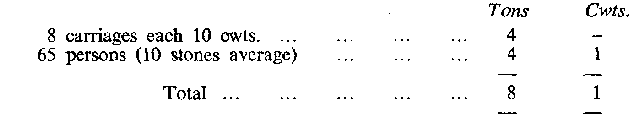
The static factor of safety of the rope at the capel when new was, therefore, 11.4 when the carriages were on the maximum gradient.
Rope Examination and Maintenance prior to 12th September, 1955
On 19th November, 1953, Robert King, a spare deputy, had been appointed in writing to examine and report on the ropes of this haulage installation and on 27th June, 1955, Andrew Walker, the colliery engineer, was authorised by the manager to "be responsible for the installation, maintenance and examination of all machinery, including headgear, winding ropes and haulage ropes."
The duties placed on Mr. Walker were onerous and some of the detailed day-to-day examinations were delegated to others. Obviously, the examinations of the man-haulage ropes should have been done by Mr. King, but owing to annual holidays and absenteeism he was required to perform the duties of a deputy. The rope examination was then undertaken by Mr. William G. Potts, nightshift overman, and he was assisted by Mr. A. Clabby and Mr. P. Stewart. These men were ropemen of experience and Mr. Stewart had attended a course for ropemen at the Sheffield Mechanisation Centre. This course was conducted by the National Coal Board and assistance was given by the Safety in Mines Research Establishment.
The rope, which had been in service for 22 months at the time of the accident, had earlier shown signs of wear near the capel end and on 9th May, Stewart cut off 240 feet of rope and re-capped it, then on 17/18th July, 1955, some 300 feet were cut off. On 9/10th August the rope was again re-capped and 40 feet were cut off. I am informed that these facts were recorded in a book but this book cannot be found. I will refer to this later.
In my opening paragraph dealing with the officials deemed to be in line of technical management, it will be seen that Mr. L. Thomson ceased to be Manager on 3rd September, 1955. It should be noted that on Sunday, 4th September, the day after Mr. Thomson left the colliery, the following entry appeared on the report (M. & Q. Form No. 42A)(a) by the District deputy, James Brown, "East side rope (man-haulage) requires renewal."
W. Harvey, the dayshift deputy, also reported on 5th, 6th and 7th September "Rope required on man-haulage."
M. & Q. Form No. 43(b) was being used for recording the examination of the Sea Dook installation, and on 5th and 6th September, 1955, J. Tweedie, the person appointed to be in control of the train (General Regulation 23)(c) entered "New rope required for East side rake, urgent."
The Safety Officer, Edmund Gray Coutts, was approached by Mr. D. Gilray, President of the local branch of the National Union of Mineworkers, on 6th September, who asked that the rope should be examined. Mr. Coutts made this examination on 7th September and as a result a new rope was ordered by the under-manager. After that date no more adverse reports were recorded.
Mr. Coutts also reported verbally to the manager (Mr. H. Nimmo) that he examined 100 feet of the rope next to the carriages and, while it was badly worn, no broken wires were found. It was suggested that this 100 feet should be cut off even if the men had to walk that distance extra.
In tabular form the re-cappings of the rope are as follows :—
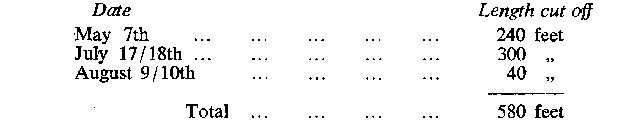
Previous records of re-capping are not available and the above particulars are verbal evidence from various witnesses.
Regulation 15 of the Coal Mines General Regulations (Winding and Haulage), 1937(c), states "There shall be recorded in a book kept at the mine dated reports and other information relating to the measures taken to comply with — (a) and (b) numbers 6, 7 and 10 of these regulations" and Number 10(d) of these regulations states "Before each re-capping a length, including the capping, of at least six feet shall be out off the rope each piece of rope cut off shall be opened up and its internal condition examined by a competent person approved by the manager."
For some years an ordinary foolscap book was used for entries under this regulation. It is known to the Inspectors that the book was in being when Mr. L. Thomson was appointed manager and he was advised to keep the entries up-to-date. Latterly, entries were made in this book by Mr. W. G. Potts, the nightshift overman, and he stated that the last entry was made by him of the re-capping done on the night of 9 / 10th August. When the book was required by the Investigating Inspector after the accident it could not be found. It has not turned up to this day.
It was known to be kept on the top of a cupboard in the manager's office and it was available at any time to any person who had reason to visit that office so that there must be doubt whether or not the loss of the book at this particular time was accidental.
Such records are vital to all parties and particularly to those investigating the accident, and I therefore take a very serious view of this matter.
Supply of New Ropes
It had been the practice to store at the mine 550 fathoms (1,100 yards) of new rope for this haulage and splice this length in, as and when required, but in the National Coal Board (Production) Codes and Rules, issued in 1954, dealing with man-riding underground by rope and locomotive haulage it is stated that spliced rope shall not be used on any direct rope haulage systems employed in man-riding. The two ropes in question being 1,600 and 2,800 yards in length, respectively, the spare rope at the colliery could no longer be used. It is unfortunate that in the meantime no one thought to order a rope of the correct length to be available if necessary. In an Area like the No. 2 Area (Lothians) it would have been economically possible — in fact desirable — to have at the central store a rope suitable for the longest main rope man-haulage in the Area.
On 7th September, 1955, tentative steps were taken to obtain a new rope and thereafter all adverse reports on the condition of the rope ceased although no alteration had been made to the rope in use.
A man is employed in the Area who spends his full time on ropes and I understand he is very competent. Before nationalisation he was employed by the Lothian Coal Company Limited and they had him specially trained. Unfortunately, he spent most of his time among the pits where he was well known and had little influence over managers at other pits. This may account for his services not being used to the full at Newcraighall.
(a) Now see M. & Q. Form No. 232.
(b) Now see M. & Q. Form No. 276.
(c) Now see Regulation 48 (1) of the Coal and Other Mines (Shafts, Outlets and Roads) Regulations, 1956.
(d) and (e) Now see Regulation 55 (1) and (2) of the Coal and Other Mines (Shafts, Outlets and Roads) Regulations, 1956.


A copy of this report was kindly donated by
West Cumbria Mines Research.




 Contains public sector information licensed under the

