


 |

|

|

|
|
 |
 |
|||
Volume 2 (II), 1853-1854, published 1854
Chapter XXV.
Concluding Observations.
 Mr. Clegg, in his work on Coal Gas, has shown so comprehensive and generally correct a view of the coal-fields of the world, that it is worthy of extracting in an abridged form, and also of being corrected in one or two particulars, with respect to which the author has fallen a little into error.
He remarks, that Great Britain takes the first rank, both in quantity and the quality of its coal, yet he greatly understates the annual produce of the island, which is (exclusive of Ireland) over 58,000,000 tons, not 82,000,000. A correction that equally applies to other authors, who have made estimates on the Northern Coal-Field.
America, the yield of which he gives at nearly 3,000,000 tons of anthracite, and 2,000,000 tons of bituminous coal, produces fully twenty per cent, over these quantities. There is reason to believe, however, that his statements of the produce of different countries of continental Europe may be more implicitly relied on. He says Belgium produces annually 6,000,000 tons; France, 4,200,000 tons; Prussia, 3,500,000 tons; and Austria, about 1,000,000 tons; and there is every prospect that in consequence of the construction of railways, the production will largely increase. The population not only requires it, but it will be necessary for their manufacturing purposes, which indeed, at the present time, are increasing rapidly, and prices are thirty per cent, higher than for years past.
Belgium is a coal producing country, second to Great Britain, traversed by a large zone of bituminous coal, and may be described under three divisions. The western or Hainault division, Charleroi or Liege district, and that of Namur. The area of these fields is about as follows
Being 1.22nd part of the superfices of Belgium. The eastern or Liege division, from the province of Namur, traverses that of Liege, extending towards Rhenish Prussia, where it communicates with other coal basins. It furnishes some coal of excellent quality. The whole being chiefly consumed in the many iron works of the district, In the Hainault most varieties of coal are met with, including the flaming, with a series of veins approaching to that of Newcastle-upon-Tyne, and adapted to gas making.
The production of France has advanced from 240,000 tons at the commencement of the First Revolution, to 4,200,000 tons (the quantity yielded at present). Notwithstanding this advance of 1700 per cent, upon her native production, her importations have also increased during the same period 792 per cent., the quantity of coal imported being still more than one-half of the entire amount produced at home. The general quality of the French coal is not to be compared with that of Northumberland and Durham, Yorkshire, Lancashire, Derbyshire, Staffordshire, Wales, &c., or Ireland, from the mines of which both the French Government and private companies obtain the best coal they use. Even America still continues to require large supplies from England.
Mining and manufacturing enterprise both suffer from the scarcity and dearness of coal and wood in France, although a change in their national habits, and the facilities afforded by railways will increase the produce and lower the prices. The distance which their coal-fields lie apart render it unlikely that the price of coal will ever become so low as it is in England, in consequence of the great expense of its inland transit to shipping ports.
America yields bituminous coal in abundance, and from her energetic advances in everything relating to trade will, doubtless, ore long, stand second as a coal producing country, and will also make rapid progress in gas-lighting. The railways will easily, cheaply, and yet profitably for themselves, connect the towns with the distant anthracite districts, and it is even possible that Canada may be supplied more certainly and economically than with sea-borne coal. Wood fuel is almost entirely used for railway locomotives and steam-boat engines, (alike in the distant villages and cities,) particularly on board the boats on the Ohio and the Mississippi. I have seen them, when the boats are racing against the stream, put in flitches of fat bacon, which can be had for two or three cents a pound, to assist the wooden fuel, raising the steam up to 150 and 200lbs. per square inch.
In the United States, hitherto, no anthracite coal, and only a small district of bituminous, has been found near to a shipping port or place with tidal water. This small portion is on the James river, Chesterfield county, near Richmond, Virginia, and is called the Blackheath, Mid-Lothian, and Clover-hill pit district. The produce is easy of transit, being only from ten to fifteen miles by public and private railway, or about the same distance if by canal, to the shipping place above Norfolk, on the James river. A considerable portion of the State of Virginia, and also the remainder of the coal districts of the States, twelve of which are not so favourably situated, are from 150 to 300 miles and upwards distant from tidal water and the place of shipment or principal depot for sale.
The following table exhibits the vast area of her coal-fields, according to S. A. Mitchell, who published them in 1836.
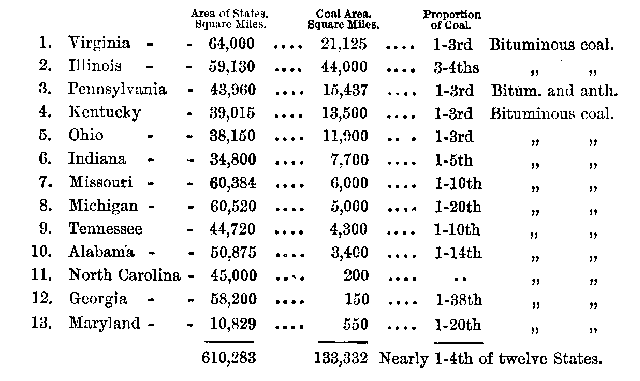
Cannel coal of good quality is found in Pennsylvania, Kentucky, Ohio, Illinois, Missouri, Indiana, and it is believed in Tennessee.
Even making certain deductions, the actual yielding area is enormous, and of its ultimate value no present estimate can be formed; but, if we consider that the American coal trade commenced in 1820 with 305 tons, and that its present production is 6,000,000 tons, we must feel certain that its influence will be felt at no distant period.
Canada, it is pretty clearly ascertained, contains no workable seams of coal, but in other provinces of British America, viz., New Brunswick and Nova Scotia, there are considerable fields of it; and Newfoundland is said to be rich in this mineral. In Cuba no coal is found; but a quality of limestone, trap rock, or greenstone chapote is found in fissures.
Many of the provinces of Prussia are rich in coal seams, lying at angles of from 1 in 2 and 3, in regular systematic but very curious positions, which promise to be very productive, In the Austrian coal-fields the like have been discovered in the neighbourhood of Berlin, and more particularly near the valuable port of Trieste, or between Trieste and Vienna.
Austria possesses extensive and valuable coal districts, and is rich in other minerals, although their productive qualities have hardly been brought into competition with the wood fuel procured from the immense forests, which cover 43,896,687 acres, one-third of the productive extent of the empire. This is the case in consequence of the want of good roads and public railways, but as the Government is now supplying both roads and railways to a large extent, the demand for wood will be much modified and coal brought into the market as a substitute.
Spain, Portugal, Lombardy, the Tyrol, and Hungary, all yield coal. In Bohemia coal is abundant. The bituminous coal of Western Bohemia is particularly good and plentiful. The basin of Rakonity is forty English miles from east to west, and ten or twelve miles from north to south.
Poland contains several coal areas, the working of which has been greatly neglected.
Sweden works mines of inferior bituminous coal to a very limited extent, owing to the easy importation of good coal from England.
In European Russia, to the northern shore of the Black Sea, bituminous coal has been found in abundance. This is said to be equal to the best English coal, and that it may be delivered at a port on the Dnieper or the Don for 4s. or 5s. per ton. Little is known of the carboniferous system of Northern Russia. St. Petersburg is lighted with gas produced from English coal. Norway and Holland exhibit no indications of coal. Coal, said to resemble that of Scotland, has been found in the Egyptian Deserts. It has long been stated to exist in Abyssinia and tropical Africa. There is reason to credit a report that there are level beds about 500 miles east of Cape Town, and in Madagascar, Mozambique, and Port Natal.
Asia is rich in her deposits of bitumen and other hydro-carbonaceous substances, and there is also good reason to believe that coal exists extensively, which may be worked with profit in due time. At Erikli, in Anatolia, about 150 miles east of Constantinople, on the southern shore of the Black Sea, a formation, according to good authority, of genuine. bituminous coal is said to be of considerable extent, of excellent quality, and situated so as to be easily transported. One hundred parts consist of
The Syrian coal abounds in sulphur, which unfits it for commercial purposes.
Sir Alexander Burnes states that large districts of bituminous coal exist in Cabul, situated favourably for transport.
Coal has long been known in Tartary, where its use is not only mentioned by Marco Polo, but by other early writers. Much coal is also worked in Japan, but no particulars have been published.
Indigenous coal of the bituminous species has already been discovered in more than one hundred localities in Hindostan, the best being that of the Marbudda and Burdevan districts, but no mines have been opened of sufficient importance to cause these districts to rank as coal-producing countries; but steam navigation must in process of time force them into work, for an enormous price may be afforded for the coal, since the freight of it from England is 40s. per ton, presuming always that there does exist a bed of coal, for until it is fairly worked, doubts must exist. In Bengal it appears that mining has been so sufficiently carried on as to render the existence of workable coal quite certain.
China, if we look far into the future, will unquestionably become a coal-producing country. We have evidence that amongst other varieties there exists tertiary or brown coal, bituminous coal of various kinds, cannel coal, and anthracite, all of which have for ages been in common use in that remarkable country.
Australia is rich in other mineral productions beside gold. At Newcastle and the Hunter region of New South Wales, bituminous coal is ascertained to be abundant. Sydney is (or may be) supplied with coal from Lake Macquarrie. The Australian Agricultural Company sold 27,000 tons from thence in 1840. In South Australia it has been reported that coal has been found, but it has not been verified. In Western Australia no coal has yet been found.
* There is no doubt of the existence of good coal at Erikli. Under the superintendence of European military engineers, coals are now being wrought for the use of the allied fleets in the Black Sea to the extent of 1,000 tons weekly.





 Contains public sector information licensed under the

