


 |

|

|

|
|
 |
 |
|||
Volume 2 (II), 1853-1854, published 1854
Chapter XXIII.
Duration Of The Coal-Field.
 [Which has been kindly communicated to me by Mr. G. C. Greenwell, with leave to use it as I pleased. I give it as received, with the addition of a few short remarks.]
The subject of the present chapter has frequently attracted attention, and very different results have been arrived at.
The following calculations probably assign to the coal-field of Northumberland and Durham a shorter period of duration than many are prepared to accede to, but it is the writer's most decided opinion that, notwithstanding its shortness, its limit has been rather deferred than hastened. If, for in stance, we take one of the largest class of royalties, and consider it to be worked in proportion to its extent, will not its endurance be a fair criterion of the duration of the whole? This is, of course, under the assumption of that state of things in which all royalties are at work; and it is tolerably evident, that unless coal be discovered beneath new districts (the new red sandstone suppose) the whole of the present known coal-field will, in the course of a very few years, be in active operation.
The consideration of the present subject naturally divides itself into two parts.
1. The portion of the coal-field already excavated.
2. The portion remaining unwrought, with the annual demand upon such portion.
1. Probably the chief difficulty in presenting anything like an accurate estimate of the quantity of coal which may reasonably be supposed to be at one time or another workable to advantage, arises from the necessary vague and uncertain state of our information with regard to the quantity of coal which has already been extracted, together with that which, in old workings, has been left in the mine in such a state as to be completely irrecoverable.
The following is an estimate of the quantity of coal which has been wrought from the coal-field. The information on which it is based being collected from various publications concerning this neighbourhood :—

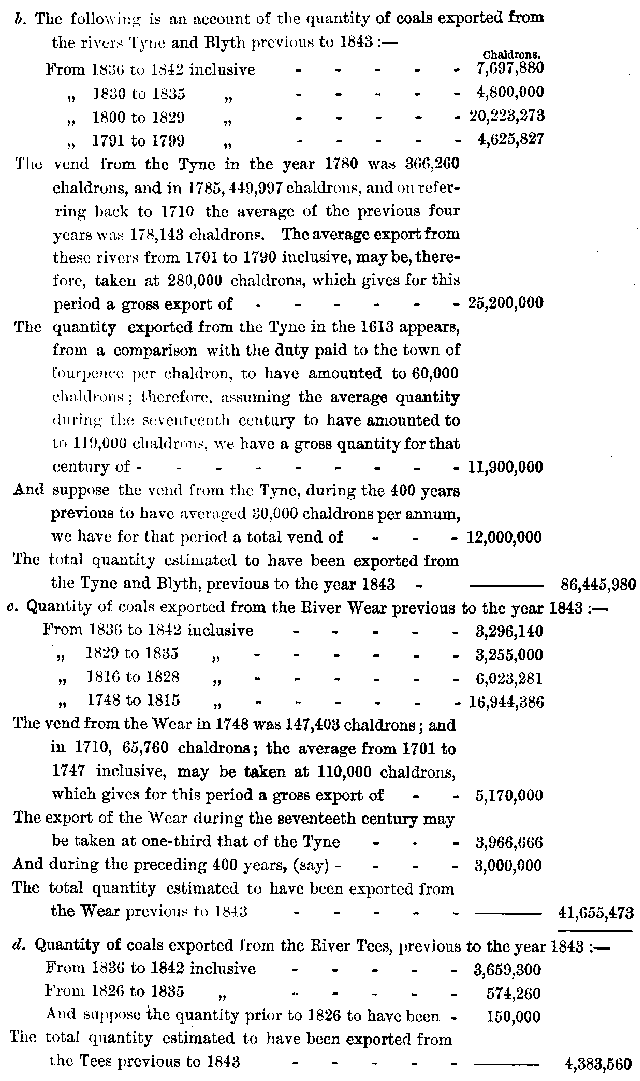
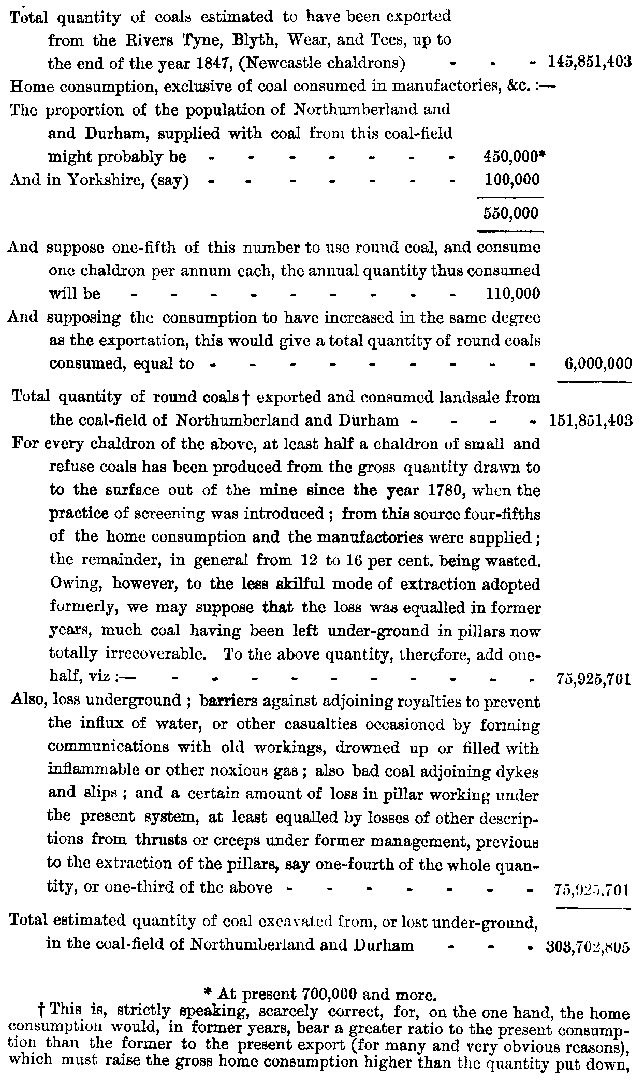
2. We are now brought to the consideration of the second division of this chapter, which consists in the attempt to calculate the quantity of coal remaining in the coal-field in an accessible and workable state; this we shall effect by deducting the quantity of coal estimated above to have been exhausted or rendered valueless, from the quantity supposed to have been contained in the coal-field in its original and unbroken condition.
Instead of assuming, as has generally been done, the gross area of coal-field, and the average thickness of workable coal therein contained, it is preferred, in the present instance, to estimate the workable area of each seam in order, that, by so proceeding, a little more accuracy of result may reasonably be expected to be attained. At the same time it must be admitted that whatever such result may be, it must be viewed in a very qualified light, as certainly being, to say the least, but an approximation.
We shall, therefore, take each seam in order, commencing with
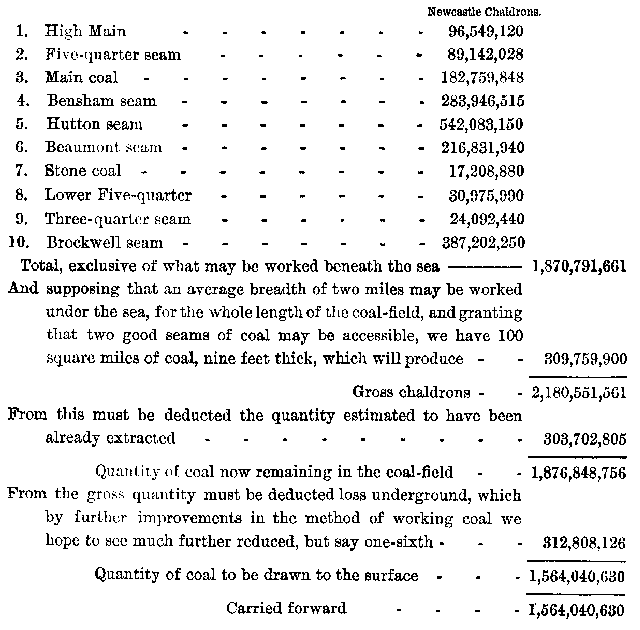
1. THE HIGH MAIN SEAM. — The boundary of workable High Main may be said to extend as follows :— From North Shields to Earsdon and Hartley, thence a little to the north of Burradon, north of Wideopen and Fawdon, west of Kenton, and across the west part of Newcastle Town Moor to Newcastle, from Newcastle to Benwell, and across the Tyne to Gateshead, thence to Gateshead Fell, south of Heworth and Hebburn, then returning to North Shields. The above comprises an extent of fifty-one square miles of coal, the average thickness of which may be taken at five and a half feet, and calculating three cubic yards of solid coal to weigh one chaldron, the gross quantity of coal contained in the High Main seam will be equal to 96,549,120 Newcastle chaldrons.
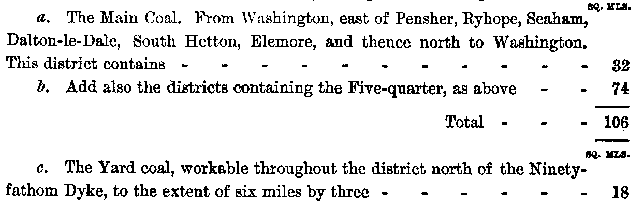
2. THE FIVE-QUARTER SEAM. — The boundaries of this seam in its workable state are more difficult of definition. It may be stated to exist in a fairly workable state, as regards thickness and quality, under the following districts.
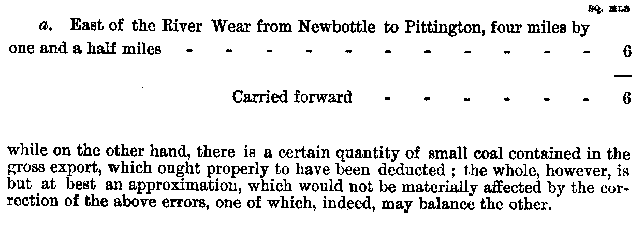
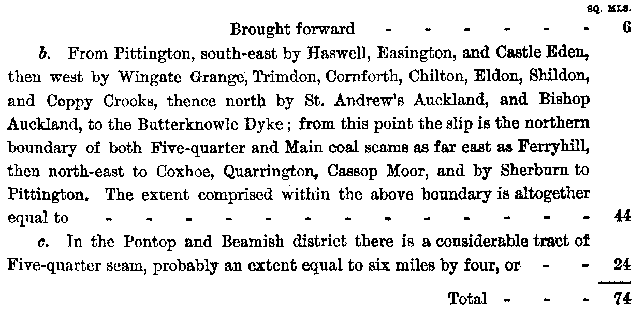
The average thickness is three feet six inches, exclusive of splint, which is so generally left underground that it is not considered worthy of a place in this estimate. The gross quantity of coal contained in seventy-four square miles of a coal seam, the thickness of which is three feet six inches, is 89,142,028 chaldrons.
3. THE MAIN COAL SEAM — (Yard seam of the Tyne) — is more extensively distributed, the following being its boundary
4. THE BENSHAW OR MAUDLIN SEAM. — Also Low Main seam of Wear Collieries, and Hutton seam of the Pontop district.
The boundary of the Bensham, in a workable state, is from North Shields to Sunderland on the east, from Sunderland to Pensher on the south, and thence across the country to Wallsend, and east to Shields; contents, forty-five square miles.
The Low Main exists under a large portion of the coal-field in the county of Durham, in fact, with the exception of the district from Gateshead to the south-west, under almost the whole. The area of Low Main or Pontop Hutton seam may probably be two hundred square miles, of which, however, the thickness is exceedingly variable, being found in large tracts of little more than the thickness considered barely workable. The gross quantity contained in the Bensham Low Main, or Pontop Hutton seam may therefore be equal to
5. THE HUTTON SEAM OF THE WEAR OR TYNE Low MAIN. — This seam exists in a workable state throughout a great part of the coal-field: its boundary may be thus defined :—
The east coast from Warkworth to Castle Eden, thence to Thornley, and west along the Hett Dyke to the Stockton and Durham turnpike, then north-west to Heugh Hall and west of Durham to Plawsworth, thence to Lanchester, and from Lanchester by an irregular line to Warkworth. The extent thus inclosed is equal to 350 square miles of coal, 4½ feet thick, neglecting the coarse coal at the bottom, which is chiefly left in the mine, and the quantity of coal contained therein is equal to 542,083,150 chaldrons. 6. THE BEAUMONT OR HARVEY SEAM. — Has not been discovered in a good state below Newcastle Bridge, and cannot perhaps be calculated on existing over a greater extent of country than the following (some of this even being doubtful), from Newcastle to Sheriff Hill, direct south to Durham and thence to Coxhoe, from Coxhoe west to Evenwood, north to Walbottle and back to Newcastle, comprising an area of .. 120
Also a tract from West Auckland to the east sea, of an average breadth of 3 miles 60
Square miles.. 180
And the average thickness being taken at three feet six inches, the quantity of coal contained in the above area of 180 square miles is equal to 216,831,940 Newcastle chaldrons.
The extent of the next seams is very uncertain, as the localities where they may be chiefly expected to be met with have not been much explored; none of them having yet been discovered east of the turnpike road from Newcastle to Bishop Auckland.
7. THE STONE COAL — This may perhaps exist in the neighbourhood of Ryton, under an area of 20 miles, in a barely workable state, 2½ feet thick. The quantity of coal contained in the seam will therefore be 17,208,880 chaldrons.
8. THE LOWER FIVE-QUARTER SEAM. — Say under an area of 40 square miles, three feet thick, will contain 30,975,990 Newcastle chaldrons.
9. THE THREE-QUARTER SEAM. — May exist under an extent of 20 square miles, 3½ feet thick, and contain 24,092,440 chaldrons.
10. THE BROCKWELL SEAM. — The extent of this seam is very doubtful; it may, at a hazard, be said to exist beneath the whole of the district west of the Newcastle and London road, between Newcastle and Rushyford, a distance of 24 miles, to the western boundary of the coalfield; this would give an area of 250 square miles, the coal averaging 4½ feet in thickness, the quantity of coal will therefore be 387,202,250.*
The gross quantity of coal estimated to be the produce of the seams of coal found in the coal-field is then as follows :—
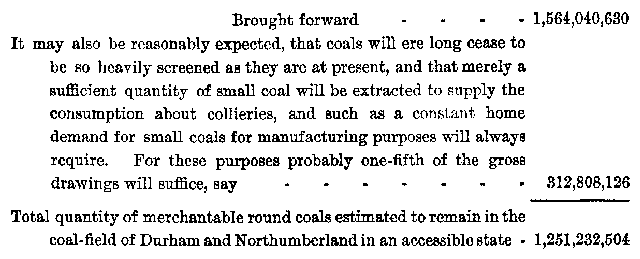
If the annual demand should be equal to 10,000,000 tons or 3,773,585 Newcastle chaldrons of round coal, a quantity which it is exceedingly probable will within a few years be realised, the above will be exhausted in 331 years. Should the demand exceed this (a circumstance considered worthy of notice by a good authority in the coal trade**), the duration of the coal-field will of course be proportionably less.
In the above calculations no notice whatever is taken of the thinner seams which have occasionally been estimated at great prospective value, because, unless their quality is of a very first-rate and peculiar description they will never be worked except for home use, for when compared with coal from other districts their cost of extraction will be found to be too great.
It must be obvious, that if it be really the case that the duration of our coal-field is limited to the extent above calculated, every means should be adopted whereby our resources should be husbanded to their utmost, so that, of a non-productive article such as coal, none should be suffered to go to waste.
The existing mines will beyond doubt require, at no very distant period, to be worked to their fullest extent to supply the demand which is now increasing at so rapid a rate; and since the gross quantity of coal left in the coal-field is by no means equally distributed, it must necessarily follow that, long prior to the limit assigned by the present method of producing round coals, many mines, by working an unnecessarily large quantity, must, even before their legitimate time, have ceased working altogether.
It should, therefore, be an object to all deriving their supply of coal from this district, with even no other view than the postponing of future monopoly, to insist upon as great a produce as possible of a description of coal less heavily screened than the round coals produced at present, but which would reach the consumer in a state equally free from dead small, and be no doubt as intrinsically valuable. To screen the coal less heavily should also be the best policy of the coalowners themselves, especially those having limited tracts of valuable descriptions of coal.
I am aware that anything like a restriction will be viewed with great distrust, and that it is liable to many objections. In truth, the matter is not very easily disposed of, for if the landlord of the mine and the owner of the wrought coal both agree upon the subject of the waste in question, whose province does it become to interfere?
At the same time, though all waste should be as much as possible provided against, there are no reasonable grounds for restriction of sales of any description, even were it the fact that the duration of the coal-field were limited to half the extent estimated; for the only result of the complete exhaustion of the coal-field of this district would be the removal of the seat of certain manufactures from this to another locality, the country at large being totally unaffected; and farther, regard being had solely to the advantage of this neighbourhood, if it be admitted that the greater the trade the greater the prosperity, it must be evident that the free use of our resources must be most beneficial, for the present worth of even one flourishing century is of far more consequence than that of a thousand years where trade is harassed by restriction, and checked by the exercise of groundless fears.
* If, however, the Auckland Bitchburn seam corresponds with the Busty Bank seam instead of the Brockwell, the quantity of coal contained in the Brockwell will he diminished, and that in the Stone coal and Lower Five-quarter increased in the same proportion, the aggregate continuing the same.
* "Observations addressed to the Coalowners of Northumberland and Durham," by T. John Taylor, Esq., 1846.
The Author's Remarks On The Opinions Of Mr. Greenwell And Other Writers On The Duration Of The Northern Coal-Field.
Mr. Greenwell takes the width of coal obtainable along the coast, under the sea, at two miles; I however, prefer, taking only half that width, giving an area of fifty square miles, and I would select only that portion where the seams are in the greatest perfection, and very deep under the sea.
I shall only make a few remarks upon the probable duration of the coal-field, as estimated by Mr. G. C. Greenwell. In 1846, with a yearly consumption of 10,000,000 of tons of round coals, Mr. Greenwell fixed the period of 331 years as the time in which the whole area of the coal would be worked out. In this calculation is included 100 square miles of coal beneath the sea. But the yearly sales having now increased to 13,250,000, a proportionate alteration must he made in the period of duration; therefore, assuming the correctness of the previous statement, 324 years may be taken as the full extent of the time the coal-field will last. I may farther add, that various methods of calculation, by sections of different districts, have been tried both by Mr. Greenwell and myself, unknown to each other, and the results, which it was impossible to anticipate, have been found to he perfectly similar.
I intended here to have shown that the information given by Mr. Hugh Taylor and other writers does not differ much from mine, either as to the extent of area, or the thickness of the coal seams; hut, having got Mr. G. C. Greenwell's opinion, I prefer giving it. Although many districts have been proved since 1829 or 1846, there are still many seams found of workable thickness, which have not proved profitable to work at present prices. One most important fact is clearly demonstrated, viz. :— that nearly treble the quantity of coal is wrought since Mr. Hugh Taylor's opinion was made public, and increased demand or the opposite, will render all statements on this point liable to error.
It may be necessary to remark, that Mr. Greenwell's statistics were made in 1846, at which period he assumed one-fifth of the whole extracted to he small coal. At that time, and formerly, the great bulk of the small coal was consumed by fiery pit heaps, and stored away underground as waste. On account of the great demand for coal at present, and the enhanced value of labour, the one-fifth that he calculated as small, independent of the 10,000,000 tons of round, has become saleable coal; I therefore consider Mr. Greenwell's estimate of the duration of the coalfield equally as probable as my own.
It will be unnecessary to increase the length of this treatise by alluding to the statements of Mr. H. C. Taylor, of America, who has written on the subject. This will be admitted when it is known that, although the information given in his valuable work is generally correct, he never visited or made himself personally acquainted with our coal districts, when he estimated the duration of the coal -field at upwards of 1,700 years.





 Contains public sector information licensed under the

