


 |

|

|

|
|
 |
 |
|||
Volume 2 (II), 1853-1854, published 1854
Chapter XX.
Comparison Of Collieries, Pits, And Under-Ground Establishments In Durham And Northumberland, With Other Places.
 Joseph Dickinson, Esq., Inspector of Coal Mines, states that the number of collieries in the districts of Lancashire, Cheshire, Anglesea, Flintshire, and Denbighshire, are 423, viz.
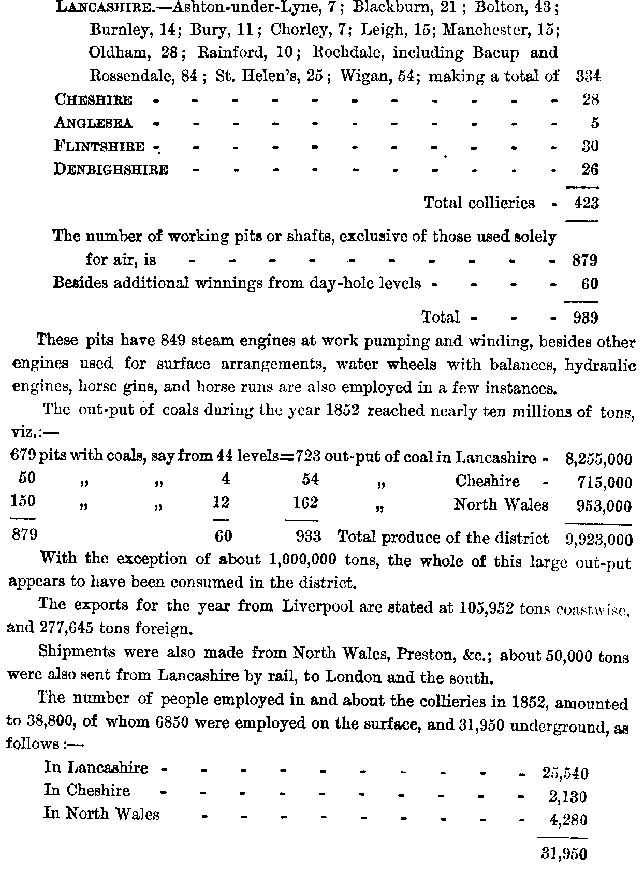
The total number of 428 collieries produced, in 1852, 9,923,000 tons, and employed under-ground, 31,950 workmen, which is nearly seventy-five and a half to each; and each colliery produced 23,460 tons as a yearly average. Taking the number of working days to be 270 annually the working for each colliery would be about eighty-seven tons. The number of pits being 939, gives thirty-four workmen on an average to each colliery per day, making thirty-nine tons per day in each pit, which gives a yearly produce of 10,568 tons, being 311 tons yearly to each under-ground workman, or 1.15 parts to each. To each collier there will have to be added an assistant, called a "putter," who trains the coal to the horse-way or shaft foot, which reduces the stated quantity produced by the "hewer" in his day's work; there are also other under-ground workmen, as sinkers, pony drivers, road men, incline men, trap-door boys, off-hand men, waste men, deputies and over-lookers, all tending, with the limited number of working days, to reduce the produce of the "hewer" to what is stated above, although his real quantity on the average would be about four tons daily.
Mr. Dickinson in his "Statistics of Collieries," states that the total "out-put" of coals in Great Britain is not correctly known, but it may be stated at not less than 54,000,000 tons yearly*
I find that in chapter XVII., page 195, that I have overrated the number of under-ground workmen in Durham and Northumberland for the quantity of 13,333,333 tons yearly. The number being stated as 35,140, which, in consequence of so large a quantity of the more tender coal being wrought for coke making, the aforesaid numbers may include the under-ground workmen for say seventeen collieries in Cumberland, or 2500 persons employed there, making the produce 14,333,333 yearly from the 136 collieries, now 153, equal to 93,681 tons on an average, also 230 persons yearly for each colliery; but, taking the number of pits at 247 instead of 230, as stated heretofore, the produce will be for 143 persons in each, and 58,000 tons on the average yearly. That is, taking 270 working days, which gives us 408 tons for each underground workman in Durham, Northumberland, and Cumberland, equal to more than one and a half tons per day, although a "hewer" might average in cutting coal about four tons daily, yet it is reduced to what is above stated by the numerous other persons required under-ground to assist the production, which are independent of the persons employed on the surface at the pit's mouth and sundry other places about the colliery.
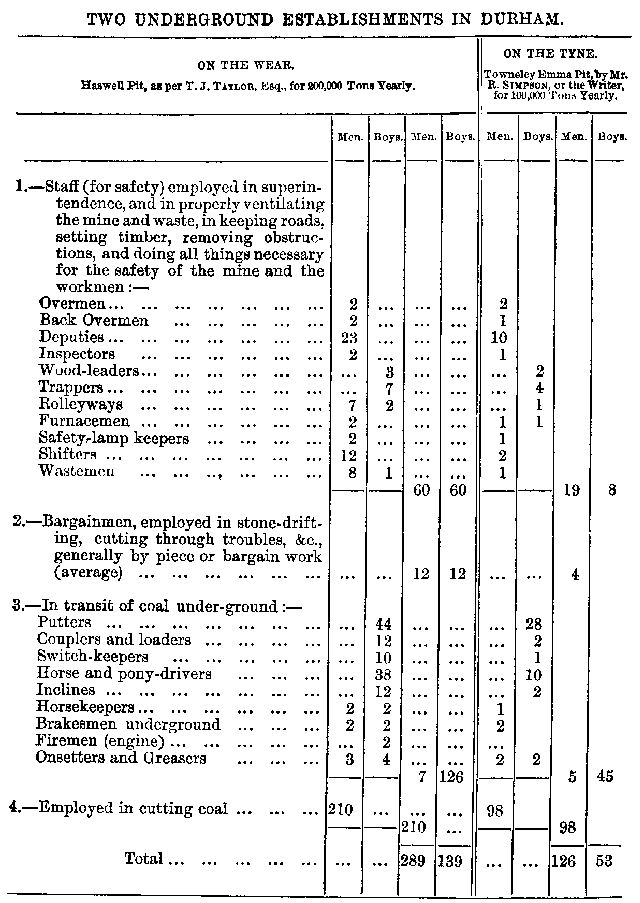
As above-ground requirements alter so much, according to circumstances, I have only taken the underground working establishments at Haswell Pit on the Wear, and Emma Pit Towneley Colliery on the Tyne, as my guide to make comparisons, the coal seams being different in thickness and hardness in different places, which increases or diminishes the hewing price. I, however, give the amount of manual labour required for two pits' underground staff, one with two coal drawing engines and 428 men and boys for 200,000 tons, the other with one coal drawing engine and 179 men and boys for 100,000 tons yearly; the latter paying the highest price for hewing the coal, although it is of a more tender and finer nature.
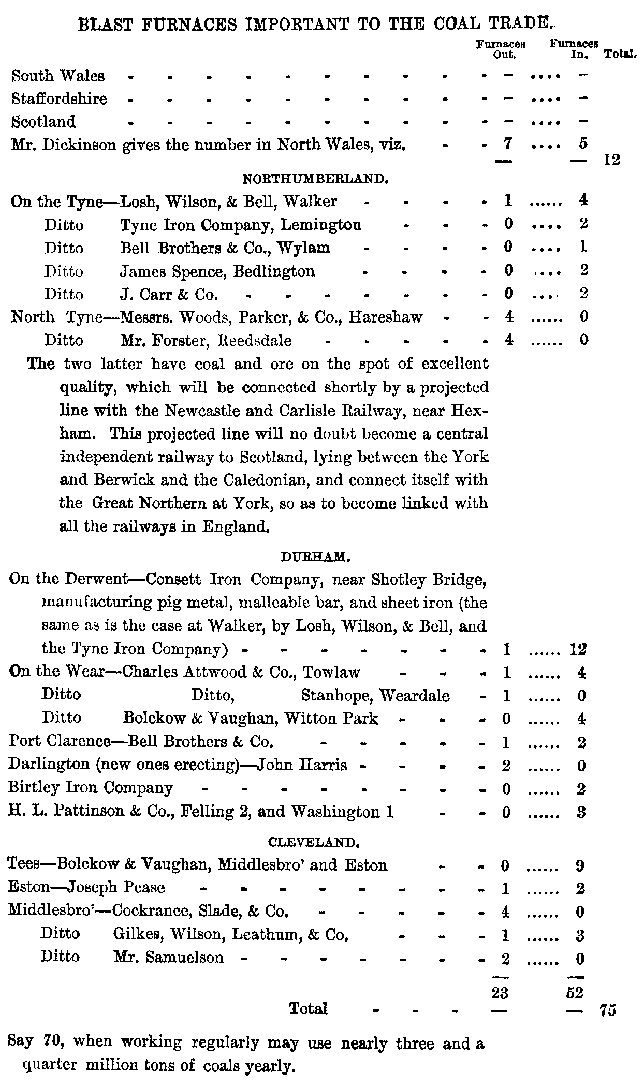
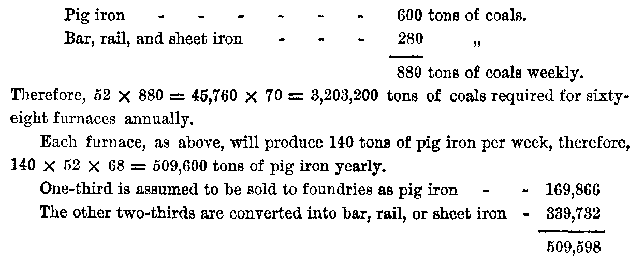
In Northumberland and Durham, including Middlesbro', there are 70 blast furnaces, in blast and building. Each furnace requires 600 tons of coals weekly for making 140 tons of pig iron, and for that portion of it which is converted into bar, rail, and sheet, which may be two-thirds of the whole quantity, the coals required will be three tons additional on ninety-three tons of pig iron, or say,
Looking at the coke and gas trade, which is increasing daily, it may fairly be presumed that at this time the consumption will not fall short of 13,500,000 tons annually, the increase being henceforth more rapid than heretofore in the two counties, and that notwithstanding at present certain powers of production are limited. These, however, will soon be increased, and the production, ten or twelve years hence, cannot be assumed at less (provided they can be produced) than 20,000,000 tons annually. On this subject the reader is left to form his own opinions and conclusions, taking the datum we have previously given — say, 14,000,000 tons yearly.
* I find that he has taken the produce of Durham and Northumberland at 11,000,000 instead of 13,338,333, as stated in the preceding pages, where it makes Great Britain produce, exclusive of Ireland, 56,500,000.





 Contains public sector information licensed under the

