


 |

|

|

|
|
 |
 |
|||
Volume 2 (II), 1853-1854, published 1854
Chapter XVII.
Number Of Collieries, Pits, And Work-People Employed.
 It may be now necessary to estimate and show the present amount of manual labour with the past (taken a few years ago,) and the progressive increase of the coal trade in the counties of Durham and Northumberland. We have the past, as to quantity, at various periods, from a pamphlet, entitled "Remarks on the State of the Coal Trade," 1843. It is therein stated that in the years
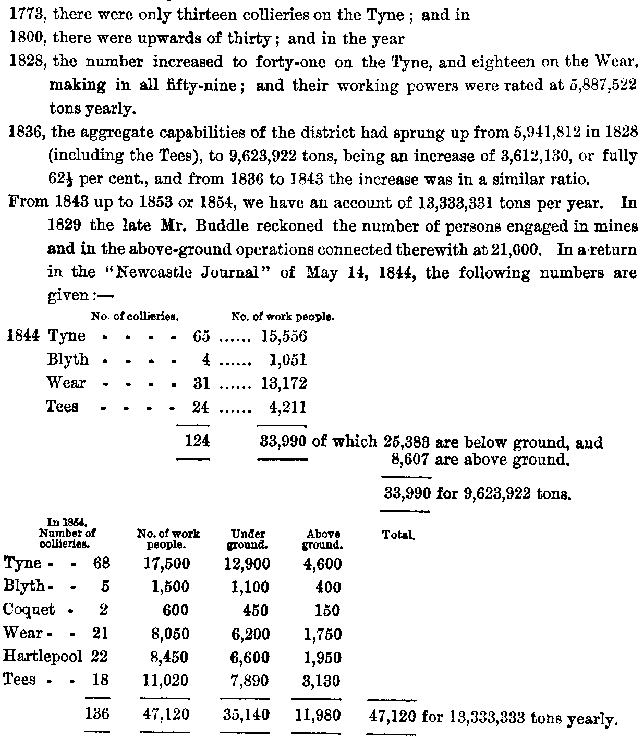
As there has been no regular account taken of the number of work people employed in 1854, the foregoing may only be taken as all approximation.
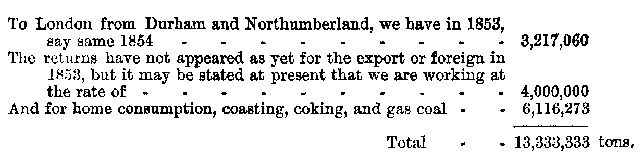
Therefore, taking the foregoing statement as a data, it appears that for every million of tons of coal raised in the two counties, 2600 persons are required for under-ground work, and 910 for above-ground, showing tile number in 1854 to be 47,120, while working at the rate of 18,833,833 tons yearly; and farther, showing the increase over ten years to be 13,130, viz. :— 9755 extra for under-ground, and 3375 above, making 13,130 additional in the above time; and as there has been an alteration of late, in favour of the workmen, by increasing their prices in piece work and daily wages, and they at the same time doing a less quantity of work for the same amount of money as heretofore, therefore, we cannot reckon on any less number for each million of tons wrought, although great improvements are making daily to assist and cheapen manual labour.
Taking the present area of our coal-field to cover 700 square miles in the two counties, the greater portion of the population (say nine-tenths) will be found employed in the coal works and the manufactories situated near the same, leaving only a small portion of the remainder for the lead and iron mines, and a smaller portion still for the farming and landed interest. The population, as taken a few years ago, was :—
The number estimated as required to work in and about the pits is 47,120, viz. :— under-ground 35,140, above-ground 11,989, for producing 13,333,333 tons yearly, the number of collieries being about 136, showing each colliery to be working at the rate of 100,000 tons yearly. For the past ten years there have been ten additional collieries, making an increase of one new colliery on an average yearly, with a farther annual increase of 1300 working people; some collieries with more than three pits, many with two, and a large portion only one each, making 230 pits at work. The aforesaid quantity, taking 270 working days as the yearly average, gives 222 tons each daily, although the power, as far as the machinery goes, at all our best collieries, is now equal to from 400 to 500 tons daily at each pit. Since guides and cages have been introduced into our collieries more work than what has been stated above has been done, for at South Hetton Colliery, where "shafts" or pits nearly 1100 feet deep, designed under my care, and which were constructed with guides, one engine of 60-horse power produced 110 or 113 scores of coal daily, each score being equal to six and a third tons, making 700 tons per day from the above depth, besides the men and boys, stone, materials, &c., for several weeks, so as to show the owners what might be done with one engine at each of their pits (there being then two in work, and two so far sunk), with a 60-horse power engine each, which was the greatest quantity that had been produced at any one pit, either at this depth or any less depth, either before that time (1833) or since,* which, with the introduction of "edge rails" to tramways, superseded the old plates for the same purpose. Cages, with tubs containing coal, guided in shafts, also superseded the old use of wicker corves, by being much safer and better, besides running them at greater speed with less risk in the shaft, bat which, when first introduced, were thought to be of no practical utility, in consequence of the great depth of our north country collieries where the production of such a great quantity of work was required from each pit. However, by perseverance, both at Hetton and Towneley, they fully answered, and my then newly introduced system has since been universally adopted, not only throughout the great Northern Coal-field, but also, I believe, in the whole of the coal producing countries where pits are established. The advantages of this method, which has been already alluded to and discussed in this Institute, proved to be a saving to tile coalowners of Durham and Northumberland of upwards of £1,000,000 sterling, on their produced quantity of 13,500,000 tons of coal yearly in these two counties, which important trade is daily increasing with nearly all parts of the globe. Independent of the extensive and newly wrought district of iron ore in Cleveland, and ore from other counties coming here, we have still others of very great importance in the counties of Durham and Northumberland, both as to quantity, and more particularly as to the quality, of the ores, which will require an immense quantity of extra coal being raised.
Great Britain alone, exclusive of Ireland, produces 56½ millions of tons annually, on which large amount I intend to detail more particularly in Chapter XIX. It, therefore, would appear something curious, while we have such an increasing demand for coals, if an estimate was formed at the present period, of the probable time it would require to work out, or see what would remain in each royalty or district now under lease for tile unexpired time in Durham and Northumberland, say for twenty, thirty, or forty years to come.
* See page 22.





 Contains public sector information licensed under the

