


 |

|

|

|
|
 |
 |
|||
Volume 2 (II), 1853-1854, published 1854
Chapter XII.
General Remarks On The Districts.
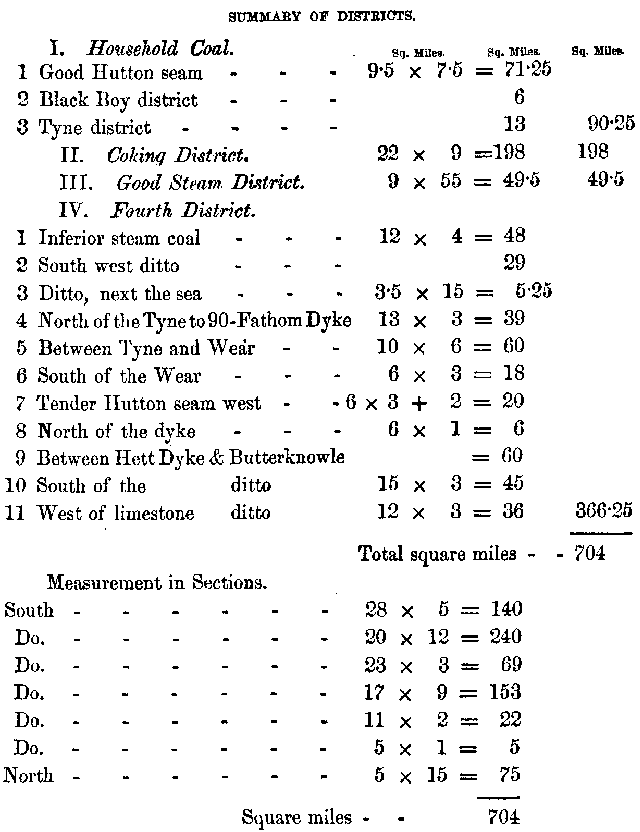
 Total length 47 miles, and width (average) 15 miles = 705 miles.
Taking the extreme length of the coal-field from the Tees, on a line
from Stockton to Port Clarence or Middlesbro', to the entrance of the
Coquet at Warkworth, as fifty-two miles, and the average width at fifteen miles, the admeasurement adopted by Mr. R. C. Taylor in his American work, gives an area of 780 square miles,
Taking a section from the same line at the Tees, northward twenty-seven miles, and westward from the sea to the outcrop twenty, gives
Taking the length from a point on a line drawn north and south from the outcrop at Middridge Grange, where the coal dips under the limestone to the sea northward to Warkworth, at the mouth of the Coquet, gives the length forty-eight miles — the admeasurement of Mr. Hugh Taylor. Then taking the average width at fifteen miles, we have 48 x 15 = 750 square miles,
Taking a line from the same point at Middridge to West Hartlepool, and measuring direct north, gives forty-seven miles. Then, as before, 47 x 15 = 705 square miles — the author's admeasurement.
To be added — Hutton seam of good coal under the sea :—
Which is all I would fairly estimate to be under the sea.
Being the total of saleable coal in the Northern Coal-field, as determined by superficial measurement.
The estimated average stands thus :—
It is not known to what extent the first two estimates embrace the quantity of coal under the sea.
Before attempting to determine the probable duration of the coal-field, it is necessary not only to ascertain the area of the coal seams and their cubical contents of coal supposed to be unworked, but the several conditions under which the process of excavation must proceed.
A certain amount of capital has been expended in opening out pits in the several districts of the coal-field, In the Hutton or household district only a very few more pits than those at present sunk may be required, in order to excavate the whole of the good seams. These additional pits, perhaps 80 or 100 years after, will or ought to be paid for gradually out of the profits, as was done at Wallsend Colliery, by including all charges whatever each year as working charges, over a period of about seventy years. This would not require any great sacrifice or outlay on the part of the present owners, who already have the royalties on lease for long periods, which could not be abandoned except at a considerable sacrifice. There is, consequently, but little room left for new speculators; and were any disposed to enter the field where there is a chance left, they would find the expense large, indeed almost insurmountable. Besides, the length of time required to reach the coal has, in several cases, been from ten to twenty years, during which the expenditure referred to is in progress. This of itself is sufficient to deter wealthy speculators from embarking in such undertakings, so that competition with the older proprietors, where capital is already invested, has little prospect of being successful.
The great depth to which the pits in this district require to be sunk operates as a check against the opening out of new mines, and more especially when the coal can be obtained by extending the workings of pits already in existence at an easy expense. This, then, is the district of large underground operations, and as the process of exhaustion proceeds, the greater will be the inducement to coalowners to abstain from any outlay of capital that can be possibly avoided.
There is no doubt that so long as the supply of the best household coal from this district can be obtained, it will find a preference, and bring the highest price in the market. As the coal is in comparatively few hands, the supply of the market may be easily and advantageously regulated, not only for the benefit of the coalowner, but that of the public generally, who seldom derive any advantage from low prices, when recurring at intervals of violent fluctuation from the opposite extreme.
What would be the consequence if the whole of the coal in this district of the coal-field, though the inquiry is equally applicable to all, were now dug from the bowels of the earth, and pressed upon the market? Speculating capitalists would hover round the mineral treasure like vultures round a putrid carcase, eager to engross the profit and devour the spoil. A general scramble would effect its distribution on terms ruinous to the original proprietors; and new holders would speculate not on present, but on future wants, and the impossibility of meeting them with supplies from a source thus improvidently exhausted.
The invention and introduction of mechanical excavators will have a tendency to increase the quantities wrought, and economise labour, and lower wages in some departments of mining. So far, they will have a tendency to diminish the cost, and, at the same time, extend the capabilities of production; so that diminished cost will be contemporaneous with increased quantity. If the price to the public be lowered in consequence of mechanical facilities in production, the general rule in such cases would imply a corresponding extension of consumption. Should that effect follow, and production keep pace with the increased demand, the more rapidly will the exhaustion of our coal seams proceed; but the public would be directly benefitted, as they have always been, by the introduction of machinery, while labour continues in as great, or becomes in greater, demand than ever. Should prices, by any arrangement among the proprietors of coal or otherwise, be maintained, matters will go on much as they have hitherto done, in so far as the supply of the market is concerned; and the saving effected by any new and more economical mode of working will, it is to be hoped, augment the general profits of each mining establishment, besides benefit ting the public. These remarks in regard to more economically working the best or household coal district, apply with equal force to the steam coal and the coking coal districts, leaving the fourth, or precarious district as it may be termed, open to speculators for centuries to come; for it would be absurd to conclude that the entire coal-field will ever be completely exhausted, for, independent of the inferior coal districts, no doubt there will be left a great quantity of good coal buried up, by inundation with water, in places unknown; to work which the probable expense would overbalance the value four hundred years hence, when coal may be more abundantly opened out elsewhere, so as to undersell such partially exhausted patches, which have been left on account of difficulties. The process of exhaustion will have been completed, for all practical purposes, when profitable excavation ceases. When such is the case, our now flourishing coal districts will fall into a state of decadence, and the immense population which they now sustain will look for new localities, probably in distant countries. Such periodic changes have occurred every few centuries since the world began, or since history afforded authentic records.
With this view, therefore, in estimating the present extent of remaining available coal, and the probable period of its exhaustion, a most serious error would be committed were we to assume that as being determined by, or coinciding with, the cubical admeasurement of the mineral unworked. The question is, what is the extent of coal available under the existing powers?
Then, assuming these powers to remain unchanged, how long will it be till that available supply is exhausted?
Again, to what influence and to what extent is it probable that the present powers will undergo modification; and, under such assumed or determined modification, at what period may we calculate upon the production for practical and beneficial purposes ceasing? These are complicated questions, only to be solved by careful observation and details, and not by general estimates, such as appear to have formed the basis of calculation adopted by preceding writers on the subject; which, from the appearance, when such estimates were given, only ten or twenty years ago, a longer duration might have been expected than can now be calculated upon, in my opinion, by even more than a thousand years, as will be hereafter shown.
Commencing, then, with what is termed the household or good coal districts, we shall endeavour to ascertain, with as great an approximation to accuracy as the materials in our possession enable us to do, by showing the quantity available under existing circumstances.
From the general observations introduced in the preceding chapters, when assigning to each description of coal its separate locality in the sub-division of the coal-field, it may be concluded that we have almost complete proof that at least two-thirds of the best seams under the limestone, at considerable depth, even where the best coal measures are found, will scarcely turn out to be worth looking after for nearly a century to come, and, therefore, for sale are of no value at present. Even when wrought they will have to come into competition with numerous coal districts elsewhere, with a multiplicity of pits now working to the rise in our own district, which may be in a great measure worked off before that period, and probably become filled with water, which will render the working of the inferior seams to the dip more precarious than ever, even if they can be wrought with profit. To work any of these deep pits, where they may extend under the sea, for coal where it may be found, for it is attended with much danger, not only to the pit or pits but to the workmen who may attempt to do it, and also to many others to the rise in the seam, for if once a mishap, by cutting a trouble, a gullet, or slip dyke, should happen to set the sea into the workings, the mischief that may be done, the water being at so great a pressure, will overbalance the good by a thousand-fold. It is supposed that the water which was at the Birtley Salt Works, six miles from the sea, came by a dyke from the sea. Two or three attempts have been made to obtain coal near the sea in the northern coal-field, and on the west coast there have been two trials — — one by the Earl of Lonsdale, at Whitehaven, has so far succeeded, but his neighbour, a coalowner at Workington, a short distance from him, did not do so, for his workings were drowned out and a fortune lost; and as far as we have seen coal seams in pits being wrought towards the sea, as at St. Hilda's, Whitley, and Radcliffe Collieries, the result offers very little encouragement.
Therefore, the district shaded black being only a portion of what has been estimated by previous writers as being good coal, in the Hutton seam, lying under the limestone, when the deficiency in extent, as now seen, and quality is deducted, so much of the portions south of the Hett Dyke, and at places where the Hutton and other seams are not in, or so thin as not to be workable with profit, I have no hesitation in saying, that the remainder, which has been taken into account as a good district for the best seams of coal, is of much less extent than has been estimated by previous writers on the coal-fields, not only in the district alluded to, but even in the best steam coal districts, as seen by the map, in three sections, and the best part is about the same size as that of the whole coal left in the good Hutton seam district. After the whole of the seams producing the best Wallsend coal have been wrought off, which probably may be only 100 years hence, the inferior or doubtful districts will be brought into action, provided the remunerative prices at that period warrant the outlay, greater risk, and more expensive working. When these two, and the coking coal districts already in operation are taken into account, it will be seen that the immense capital now employed in the best districts, where nearly all the coal may be obtained, will bring the whole of it into the market at such a low price as may comparatively keep the inferior coal from being resorted to until the others are exhausted, unless there be a very large demand, with good remunerative prices leaving larger profits than can be reasonably anticipated. The present profit and loss, by experience, for the last twenty years, do not warrant such anticipations; and during the last few years other coals by railway from more southern counties have been coming into competition with those from this district, and even foreign coal-fields will do so in foreign markets.
The same observation may be applied, pari possu, to other parts producing steam, coking, and household coal, as Wales, Staffordshire, &c., and stimulate the coalowners in our district to follow up all new inventions as they have for a long period done, so that these calculations of the estimated duration of our coal-field will be increased for household and other descriptions of coal from the counties of Durham and Northumberland, and by the opening out iron ore districts in localities contiguous to these two counties.
About one-half of the Hutton seam, producing the best household coal in the county of Durham, lies beneath the magnesian limestone. At the northern extremity of the limestone the St. Hilda's pits, formerly belonging to the late Messrs. Brandling, Davy Pit and Manor Wallsend, near the Brandling drops, at South Shields, each now laid in, Harton being now substituted by a new company instead, the shaft being sunk to a great depth, working towards Jarrow (which is also laid in), but now taken, like St. Hilda's and Manor Wallsend, by the same Harton Company, which are also extending their workings towards Jarrow Pit, for an air-pit, and progressing towards Monkwearmouth, in the same royalty. The St. Hilda's was sunk at South Shields, but it had not the good fortune to be wrought of late to advantage to the late owners. The same may be said of its neighbour, Jarrow Colliery, which has shared a like fate, as also Whitley and Percy Main on the northern side of the river. Each of these border on the outset of the limestone, and each, like St. Hilda's, have not proved remunerative, and have ceased working.
Harton, a new colliery, also sunk on the edge of the limestone, in the vicinity of Jarrow, after largely expending money for some years to open it out, are about trying what can be done in an extensive maiden district, by going southwards and approaching Monkwearmouth Pit on the Wear. The prices during the last half-year, up to the beginning of January, 1854, have been much in their favour, being one-fourth more per ton than previously. This is now a good colliery, showing the wisdom of the spirited proprietors in persevering over so long a period, for with the low prices that prevailed at the commencement, this was considered to be a very doubtful district, even from the time when Messrs. Brandling had to do with it, at the commencement in the year 1828, and the formation of the railway to Sunderland, even up to a late period, July 1853, and to January 1854, when better prices were obtained. Since the latter period, until the present month of May, 1854, prices have been again much the same and better than for twenty years past. There is not at present encouragement to capitalists, when the southern coalfields are delivering coal, by railway, in London, to the depots of the consumers at low prices, although the quality may in general be not so good. As a proof, all sent to London by them, and from the Scotch and Welsh Collieries, by rail and otherwise, is only 806,087 tons, while the counties of Durham and Northumberland sent 3,217,069 tons last year to the London market from the northern coal-field. The outcrop of the limestone ranges from three to four miles from the sea between the Tyne and the Wear, and no pits have been sunk, except at St. Hilda's, Jarrow, Harton, and the Davy Pit, Manor Wallsend, on the borders of that district, till you come to Pemberton's Monkwearmouth Pit, one mile from the sea, or about a quarter of the way between the sea and the outcrop of the limestone. In Pemberton's Monkwearmouth Pit the Hutton seam, which was reached at a considerable depth, with an enormous outlay of money and years of incessant labour, has not been so profitable as was anticipated, being of a tender quality. The Maudlin seam above it was tried in that pit for a short time and relinquished. But the proprietors had royalties taken south of the river Wear, towards Tunstall, near Ryhope, a part of which is marked as the second good coal district at near that point, The coal is tender at Monkwearmouth, and continues so till it becomes a little stronger towards Ryhope, Tunstall, Silksworth, New Seaham, and Seaton to Dalton, The two latter places are sunk still farther south-east in the good Hutton seam district, although the coal seam there is not so strong as the Hutton seam at Hetton, Elemore, Haswell, Pittington, Little Town, Sherburn, Ludworth, and Cassop Collieries, which is the farthest west, the good hard Hutton seam being at these places.
From Sunderland towards Pensher, about six miles from the sea where the limestone crops out, we have Biddick, Chatershaugh, and even a portion of Pensher itself, with inferior coal. The two former collieries, as well as Oxclose in the same neighbourhood, have been abandoned as unprofitable. When we look at this fact, and Monkwearmouth, six miles east, being tender, there is every reason to conclude that on the line of the Wear, from Monkwearmouth to Pensher, and from Pensher to Ryhope, there is an angle in the Hutton seam southwards, next to and including Sunderland Town Moor, of a less valuable nature, particularly as none of the upper seams at Monkwearmouth and towards Ryhope and Tunstall have been found of sufficient strength to be as valuable as the Hutton seam at Hetton, Haswell, Pittington and Little Town Pits. Similar observations may be made with respect to another angular area of coal under the limestone, situated on the north-side of the Wear, from Monkwearmouth to Chatershaugh opposite Pensher, by way of Biddick and Usworth to St. Hilda's and the German Ocean on the east, from Shields to Sunderland. Again, at Houghton, a pit belonging to the Earl of Durham, sunk near the edge of the limestone to the Hutton seam, lies at a depth of 1300 feet. That was also an expensive concern, and for some years after it was sunk it stopped working, (although it had as good a Hutton seam as any colliery), I suppose in consequence of its working charges being more in the Main coal and Hutton seams than at the Lumley, Sherburn, and Little Town Hill Pits in that district, belonging to the same proprietor; but this Houghton pit is now wrought extensively in the good Hutton seam towards Hetton and Dalton.
The Downs Pit, Hetton and Haswell, Moorsley, Elemore, Pittington, Little Town, Sherburn, Shadforth, and Cassop Collieries, and it may be said Ludworth, are all sunk on the verge of the limestone to the Hutton seam, which continues towards the sea under the limestone in a state of great perfection, but nevertheless there is plenty of room for changes to occur between these pits and the sea, since they have not wrought the seam much more than about a mile in that direction at any of them, except Seaton, Dalton, and Monkwearmouth; and we have proof of such an occurrence as coals thrown unexpectedly thinner as at Seaton Delaval Colliery, Northumberland.
Southward of the Hett Dyke the quality is good in the Five-quarter seam, which is worked at Cassop, Heugh Hall, Crowtrees, Kelloe, West Hetton, Coxhoe, Bowburn, and Clarence Hetton, all which are situated between the Hett Dyke and the edge of, or bordering upon, the limestone, including Thornley, three miles to the east of the outcrop, and Shotton, about other three miles to the eastward, all as first household coal. The coal becomes precarious and all the seams thinner on the south side of the Hett Dyke, except this district of good Five-quarter, which keeps its thickness for a distance of several miles from the sea to a few miles westward between these dykes. At Shotton Colliery a drift was made from that pit north through the Whinstone Dyke, some hundreds of yards, in order to prove the Hutton seam, where it was found hard and of good workable thickness. Instead of working it at the Shotton Pits, they are working the Five-quarter seam, which is found an expensive coal to work, although good. South of the dyke the Hutton seam was found, after drifting through the Hett Dyke, to be good, being, in fact, the same as was worked by the same parties at Haswell, and the Thornley Coal Company at Ludworth. From this point, on the Hett Dyke, the Hutton scam continues excellent and hard, northward to Elemore and Moorsley, and also eastward to South Hetton, Hetton, and Houghton-le-Spring, thence east to Dalton, belonging partly to the same owners, at South Hetton and eastward to Seaham and Seaton new pits (close together), the first belonging to Lady Frances Anne Vane Tempest, representative of the late Marquis of Londonderry, the other Seaton Pit to part of the Lyon's Hetton Coal Company and the Earl of Durham. The Hutton scam becomes a little more tender as it approaches the sea. The seams above it at Dalton, Seaham, and Seaton, in the eastern district, are not to be depended upon or looked forward to as at Hetton, Haswell, Elemore, Pittington, and Little Town, yet they are of great importance, having so short a distance to lead their coal to the shipping port.
The enormous amount of capital frequently expended in sinking a single pit, forms a serious obstacle to speculative undertakings, as may be illustrated by one or two examples. The sinking at Dalton, through a considerable thickness of limestone and watery quicksand cost its owners, it is said, £300,000. The pits at Seaton and Seaham, taking all expenses into account, will probably cost the same sum before they are got into full work; and these large amounts have been expended without the parties having to construct more than half a mile of railway, in each case to join their own private lines of railway.
The first attempt made to sink a pit at Haswell, was in Lady, or Sir George Shea's property, where the limestone was comparatively thin, being only about thirty-six fathoms in thickness, then a depth of twenty fathoms of quicksand was so great and abounding in gullets filled with feeders of water, which came in with great pressure, that it greatly impeded the operations of the sinkers, and could only be kept under by the employment of strong engine power, for twelve months or more. The difficulties at length proved to be so great, that it became necessary to abandon the sinking after an expenditure of about £60,000, less the value of the materials removed, in a period extending over about two years, and afterwards enabled them to work the coal under the abandoned pits. The new sinking pits alluded to, are the present pits at Haswell, which were sunk in a field of coal, which belonged to the South Hetton Company, given in exchange for the same area of coal belonging the Haswell Company, near South Hetton Pit. It may be worthy of remark, that after the Haswell sinking pit was abandoned, three bore-holes were begun, and one where the present pit is had no quicksand whatever, while the other, not far from it, was left off after boring into twenty-six fathoms of quicksand. The third, nearer to Shotton, was found, while boring, to have sixteen fathoms quicksand, and was abandoned like the other that had twenty-six. The present Shotton pits were then put down a little farther from this place, having only six fathoms of sand.
The Hutton seam extends south-eastward to the Hett Dyke, near the Shotton Pit, where the sand was six fathoms in thickness, on which the pit was laid out double the diameter, so as to provide for various cases of tubbing if found necessary, which, afterwards, was found to have been a wise precaution. Here, as at other places at this dyke, the Hutton seam is of less account.
In sinking South Hetton Colliery pits, which are considerably deeper than Old Haswell Pit, which was abandoned, the owners were more fortunate, and they opened out a large and valuable district. Both sinkings were commenced about the same period. The Hutton seam in the South Hetton Pit was reached before the Haswell sinking was abandoned, in consequence of not being able to get through the sand and water. Both these pits are situated in favourable positions, and the Hutton seam in them is of the finest quality, producing the best household coal, the owners having large and valuable royalties, all taken from different parties for nearly forty years to come. It may, therefore, be stated generally, that this district of the Hutton seam in the county of Durham has been proved to be hard and good; but there is a portion beyond the outcrop of the limestone, and at a short distance within it, of good quality, but which has been wrought out. There is also a large district of Hutton seam, west of Durham, that may be considered very precarious.
Eastward, and to the south of the Hett Dyke, towards the sea, the Hutton seam becomes tender in the Wear district. North of the Wear, from Pensher to the Tyne at Shields, it is coarse and inferior in quality; and South of the Hett Dyke it is thin but hard in places, as at Castle Eden, where it is worked about two miles from the sea. The district includes the following collieries :— Hartbushes, South Wingate, Wingate Grange, Castle Eden, Thornley, Shotton, and Whitwell, at those places the seam is in. The Hutton seam continues good to a point marked black upon the plan, under the Cathedral at Durham, which may be unwrought, although Mr. Crawford has had two pits within 200 yards of it working the Hutton seam for the last thirty years, which affected the foundation of the church near to it. But the Hutton seam is not, or if so hardly to be distinguished at Garmondsway Moor, Kelloe, Coxhoe, Clayhole, Whitworth, Mainsforth, Cornforth, Ferry Hill, Merrington, Westerton, Little and Mason's Chilton, Black Boy, Adelaide, Eldon, St. Helen's Auckland, Woodhouse Close, West Auckland, Byers Green, Old Park, Etherly, Cockfield Fell, Bitchburn, Butterknowle, Hunwick, and Pease's West Pits.
North of the above-named collieries there is a district where only one seam can be considered workable. It may be the Hutton seam in some places, and it is of so fine a nature, like the coking seams, as to become a coking coal. The Hutton seam, where in, crops out at the western pits and other places thereabout, at Langley Mill, near Durham, and below. Marley Hill, north of Lintz Hall Colliery, where a new pit is sinking by a London Company, in a district formerly partly wrought, with one or more pits to the top seams in every field. The like was the case in other districts adjoining that hundreds of years ago, below Pontop Pike, and on the banks of the Team, the Tyne, and the Derwent, putting in again at Towneley, twenty fathoms above the Towneley or Beaumont seam, and is there called the "Ruler seam," where it is two feet six inches thick, of excellent quality, but not much worked, in consequence of its hardness. In my opinion, this seam is identical with the Hutton seam on the Wear, as proved by sinkings and borings, showing a similarity of character, both before and after it is burnt to a cinder. This is also the opinion of another mining engineer, Thomas John Taylor, Esq.
Nearly the whole of the district towards Hartlepool and the Tees, under the new or upper red sandstone, has not been proved; but there is little reason, from what we have seen where it is proved, to believe that any considerable extent of it consists of the best description of workable coal, or will it be speculated in, until better known districts are wrought off, perhaps years to come.
The Hutton seam from Whitwell to Croxdale, Burn Hall, and Langley, where it crops out, or nearly so, is inferior; and likewise eastward, where it lies at no great depth at Biddick, and irregular at Framwellgate Moor, near Durham (Edmondsley, Hedley's Crag Head Pit), close towards Burnhope Flat, where it becomes more of a coking coal district.
Taking the total area of our coal-field at 750 square miles, viz.
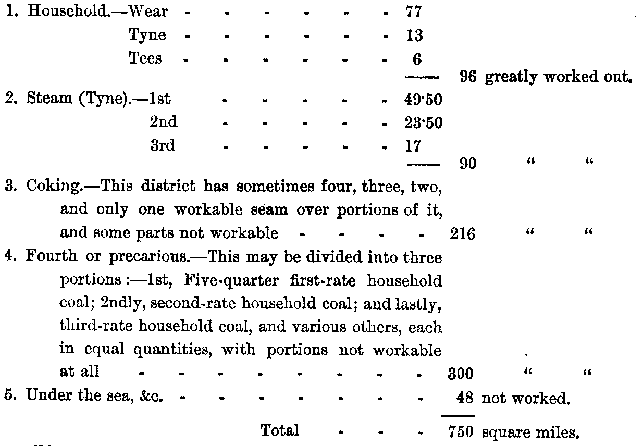
This is including part coal district under the upper red sandstone towards Hartlepool, and about one mile in width under the sea along the coast; each district doubtful and precarious to work.
In estimating the quantity of coking coal available at the present time, we shall proceed exactly upon the same plan as has been pursued with respect to the other districts. We shall first take a defined limit of acres for average good coal, manufacturing large quantities of coke on the spot to cheapen the carriage when the distance of transit is great, and where operations wilt most likely be carried on till resort must necessarily be had to more doubtful or inferior portions. This, with the number and average thickness of seams will give the cubical contents of the coal, which may be estimated as capable of being obtained after making allowances for practical difficulties. The coking coal district is in many respects different from any of the others. The seams lie comparatively nearer the surface, so that it is often found cheaper to sink a shaft than to extend the underground workings beyond a certain limit. This facility of sinking shafts, with the use of public railroads, affords likewise better opportunity to speculators to embark in the trade than where the seams are deep, and expensive sinkings are required. But, at the same time, the coal royalties over a large portion of this district are so taken up that very few openings are presented, and these are, in my opinion, by no means of an inviting character. It may be remarked, that if the annual produce of the entire coal field be taken at 13,000,000 of tons, as at present, half of that quantity is yielded by the coking coal and the fourth district, leaving the other half for the two remaining portions, the former and the latter two increasing yearly.
This description of coal being extensively used in the manufacture of iron, gas, coke, and for other purposes, as the demand for these articles increases so will the demand for this coal be extended. Every additional ton of pig metal manufactured, will alone create an extra demand of nearly five tons of coal, and if pig-metal be re-manufactured into malleable iron, two tons wore will be wanted, therefore one million of manufactured iron might require six millions of tons of coal.
The steam coal district may be divided into two or three portions, the best of which is situated to the south of Morpeth. The number of pits already sunk and in course of sinking, as at Cramlington, Hartford, and Bebside Collieries in that district is, I consider, nearly sufficient to work the whole of the coal within it, and there is no reason to apprehend that any farther attempt will be made to sink shafts there, although there may be two or three more made hereafter, and also in the second district north of the Wansbeck. Several of the first steam collieries, as already stated, were not sunk for the purpose of working that description of coal, which they now yield in such perfection and to such an extent, but in the expectation of finding in that district, coal of the nature of good house coal, similar to the wrought out coal seams at Wallsend. There was not at that period so extensive a demand for steam coal as in the present day; but tlie development of this branch of industry and enterprise was rapid and extraordinary, and the coal in this district was found to be admirably suited for that purpose, and hence its marketable value. This demand for steam coal will go on increasing for many years to come, so as to work off this now circumscribed, cheap, and good district more quickly than was ever expected.
But at the same time, other parts of the country are coming into operation, and already supply coal by sea, for steam purposes, to a certain extent. In Wales there are many patches of excellent steam coal, and Yorkshire, Lancashire, Derbyshire, and Staffordshire afford a constant supply to the manufacturing establishments in those counties or localities near the same. In Scotland, besides supplying the local demand, there are part sent by ships, particularly from Troon, a good harbour belonging to the Portland family.
The duration of the steam coal district will be included in the chapter on that head.
This northern steam coal district, which is called the third section of this coal-field, will yield, for many years to come, (when prices warrant,) and has yielded a small quantity worked in two or three pits; so that although operations are carried on at three or four places, the concerns have held out little inducement for others to do the same. The number of pits in this portion of the steam coal district is not therefore likely to be increased in competition in the less valuable coal seams until all the good steam coal is wrought out in the southern portion, and other coal districts failing to meet the present and increasing demand which may be expected to arise. For it is clear where a good district, having pits and machinery already planted over it, and the like below, will always have the advantage over those of less value and more expensive to work and take to market, and when prices are low and profits small (if any) a little reduction in price might make one unprofitable, while the other may be just clearing its way.
NOTE — An Appendix will be annexed explaining the different average thickness of the various workable coal seams in the different coal districts alluded to heretofore.





 Contains public sector information licensed under the

