


 |

|

|

|
|
 |
 |
|||
Volume 2 (II), 1853-1854, published 1854
Chapter VIII.
Districts Distinguished By The Nature Of The Coal They Chiefly Produce.
 By generalizing the differences in the quality and character of the coal described in the preceding chapter, we are enabled to introduce a subdivision of districts, based thereupon, which will be found convenient and important in a consideration of the coal trade. This sub-division will comprise
I. — Collieries producing Household coal. These are situated principally in the south-eastern district of the coal-field from Haswell, Hettons, Houghton, to Port Seaham.
II. — Collieries producing Coking coal. The best of which are found in the western district, from the river Tyne, above Newcastle, to the river Wear, near Brancepeth.
III. — Collieries producing coal of a quality suitable for Steam purposes. The principal of these are situated in the north-eastern division of the coal-field, along the sea coast from Blyth to Widdrington Castle.
IV. — The fourth division includes all those collieries that are not embraced in the other three divisions, places that have not been proved, but where the coal is doubtful or supposed not to be workable hitherto at a remunerative price; or which have been proved and abandoned, or where the workings are being carried on in many places with little profit.
This division is not limited to any particular locality, but lies scattered in considerable patches over the entire coal-field. Some of the districts or collieries have been worked off in the best seams of coal in former times with profit.
It is not affirmed that the whole of the coal found in the localities thus specially indicated is used exclusively for the respective purposes which have furnished the characteristic terms applied to each division, but that these distinctive features of the Northern Coal-field are so prominently marked that we are justified in adopting them as the basis of an arrangement upon which to found our observations.
The best household district lies south of the Wear, and a patch of it, about a mile or two in width, runs along the Ninety-fathom Dyke, and lies at a great inclination towards and up to this dyke from near the sea till it joins the coking district, after crossing the Tyne at Stella, between Blaydon and Newburn.
The coking coal occupies nearly the whole of the western district, and the steam coal is found in the greatest perfection a little northward of the Ninety-fathom Dyke, beyond the limit of the household coal district. It may be desirable to consider each district separately.
Household District.
The best household coal, as already stated, is worked principally in the county of Durham, south of the river Wear. A line from Seaham Harbour, by Easington, Shotton, Thornley, Ludworth, Shincliffe, Cassop, Lord Londonderry's Pit at Elvet, near Old Durham, and thence by the river Wear to Pensher, and then on to the sea south of the entrance of the Wear, will circumscribe the principal portion of the household district. There is a small portion on the west side of the Wear, at Auburn House and Waldridge Fell, near Pelton, where it joins the coking coal district. Household coal is worked in the Main and Hutton seams, and it is somewhat remarkable that wherever the Hutton seam and the Main and Low Main seams are found to be good, the Upper Five-quarter is almost invariably inferior (Pittington being, I believe, the only exception), and often it is not in the coal series at all, as at Moorsley, North Hetton, South Hetton, Elemore, and Lord Durham's Houghton Pit, and many other places.
On the contrary, where the Upper Five-quarter seam is good in the Wear or Hartlepool districts, south of the Hett Dyke, the Hutton Low Main and Main coal seams are in most cases thin, and unmarketable with profit, and whenever the Upper Five-quarter and Upper Main coal seams are good between the Wear and the Tees, the Lower Five-quarter, the Lower Main, and the Hutton seams are not good, as for instance at Black Boy, Tees Wallsend, Eldon, Adelaide, Coundon, Leasingthorne, and part towards Ferry Hill, The Upper Five-quarter and Main seams in the collieries just named are of a quality which is suitable for the best household coal.
The Lower Five-quarter, which is found at Trimdon, Wingate, Thornley, Cassop, Coxhoe, Bowburn, Crowtrees, Pittington, and some other collieries, yield also good household coal; at Byers Green, Whitworth, and Old Park, not so good where the coking district puts in. At a few places in the same neighbourhood, the coal marketable as household is worked in the Five-quarter seam so called. Those parts of it lying between the Butterknowle and the Hett Dyke, yielded household coal before they were abandoned. Again, where the Hutton seam is turning inferior from the Londonderry Pit at Pensher, where the Hutton seam is only thin, and towards the sea, a distance of about six miles, the seams of coal, although thicker, are tender, as is proved where worked to the south side of the Wear from Monkwearmouth Pit towards Tunstall, and Ryhope, and Seaton, which are at so great a depth along the sea coast towards Seaham, and so tender, both near the sea and approaching the Hett Dyke, as to prevent their being won and worked except at comparatively great expense and risk, for when the Hutton seam is tender it brings a much less price. The limestone being so very thick, which is proved at Seaton, Dalton, and Monkwearmouth Pits, there is at present less necessity to incur that expense, since the same quality of coal may be obtained by sinking further inland, where the seams lie near the surface, and may be worked to the dip. underground by means of steam power. Yet in the estimate of our coal-field I have, in two places, calculated for about nine miles in width, one opposite the best Hutton seam coal district, the other under that portion of the best steam coal district, next the sea coast at each place, as there may be a possibility of some parties attempting to work coal under the sea at these points. I have,. therefore, in my estimate, allowed such enterprising persons an extent of coal that may dip, and get to a great depth under the sea at the distance of two miles, which I have taken into account. The writer considers that there is abundance of risk and plenty of room in going half a mile under the sea to deter the more cautious speculators from doing so, until the good coal elsewhere is worked off. The best Hutton seam where sunk to below the Main coal is generally free from water, and, consequently, requires little or no draining. The Hutton seam also extends westward to near Whitwell and Croxdale, where it becomes so very inferior and thin as to be unprofitable to work, and so it continues till it joins next above the coking coal districts of Brancepeth, Brandon, Willington, Byers Green, Bowden Close, and over the Derwent to Towneley on the Tyne, where it is found thin, but of hard, good quality. The best description of household coal was formerly wrought on the banks of the Tyne, in the High Main seam at Wallsend, where the quality was good, and it brought a higher price in the market than any obtained at that time at other places in the same neighbourhood. Its reputation continued as long as the coal lasted in the pit, as well as several others from the same seam, which obtained the same name.
In consequence of the repute the seam had obtained, many parties applied the name to very inferior coal seams, sunk in the same district, and even continued to do so for a very long period in new districts, but time and trial proved that the name alone would not do when the quality was wanting, consequently when the late Mr. Buddle found that the Wear districts were full of good coal, principally the produce of the Five-quarter and Main seams, which were then being worked under the name of Ducks and Eden Main, and suited the London market well, he very properly gave the name of Wallsend to and began to bring the Hutton seam into the market, calling it by the name of Stewart's Wallsend. That established the name of Wallsend as a general designation for coal so excellent as this was, The coal south of the Wear shortly before that was unexplored and but little known, only having been wrought by the Tempest family, the Lambtons, and Neshams, and the opinion generally entertained by the mining engineers of that day was that no good coal existed to any extent under the magnesian limestone, but that it was of very inferior quality and thinner.
The opening out of the Wear district took place almost simultaneously with the exhaustion of the best seams on the Tyne. The pits were first sunk westward of the outcrop of the limestone, and were worked in the Main and Five-quarter seams, but soon afterwards, when Mr. Buddle succeeded Mr. Arthur Mowbray as manager for the late Marquis of Londonderry, then Lord Stewart, it was soon found that at Lyon's the Hutton seam was good under the outcrop of the limestone, it having been approached from Moorsley. Lyons Hetton and the North Hetton Company also sprung up, and at Moorsley followed the example set by Mr. Mowbray in sinking and working the Hutton seam, and their example was followed at South Hetton, Dalton, Seaton, Haswell, and other places at greater depth, where the Hutton seam under the edge of the limestone was found to exist in great perfection, and that, years after7 led to sinkings through the limestone at Monkwearmouth, Dalton, Seaton, and other places.
As the best seams of coal on the Tyne became exhausted or nearly so, inferior seams, worked at greater expense and less valuable, were resorted to, the produce of which was brought to market, sold for one-half the price the best coal formerly did, while the best coals were worked at a cheaper rate.
But to take a much later period let us go back to about a little more than ten years ago when prices were nearly double what they have been up to July 1853. The Hutton seam in the household district along with the Main coal and Five-quarter seam, were worked to considerable profit, but during the last ten years it is very doubtful whether much profit has been derived, if so, very limited, from the sale of coal worked out of the seams above mentioned, and which have been more extensively worked by Lord Londonderry, the Earl of Durham, the Lyon's Hetton, the Haswell, North and South Hetton, Belmont and Thornley, the Seaton, Seaham, and Dalton companies, who are the largest colliery proprietors, and who work the great bulk of household coal, having large capitals employed from which they ought to derive a good annual revenue, especially under the existing large demand for this sort of coal, and the present increasing rate of labour for working it, and considering the fact that the product may only last a comparatively short period. The duration of the Northern Coal-field may be estimated at under 400 years, but hereafter it will be shown that according to the present demand all the most valuable will be exhausted long before that time shall have elapsed, and should the estimated yearly quantity be increased accordingly it will be a still shorter period.
In former times the best coals on the Tyne were wrought at Whitley, Percy Main, Walker, Wallsend, Heaton, Bigge's Main and the several pits, Killingworth and other pits belonging to the Grand Allies, the title of an association or company formed by Lords Ravensworth, Wharncliffe, and Strathmore; afterwards Mr. Bowes, M.P., became a partner, as heir of the late Earl of Strathmore. This firm has lately sub-leased their interest to Nich. Wood, Chas. Palmer, and Co., who are now working good household coal, next the root of the Main Dyke, at Killingworth Pit, which lies at a very great angle, 1 in 4, 3 and 2 per yard, and also at as great a depth under the surface as any pit.
Those collieries that produce the best of the household coal of the present day, namely, Lyon's Hetton, Eppleton, Elemore, South Hetton, Dalton, North Hetton, Kelloe, Haswell, Shotton, Thornley, Ludworth, Cassop, Crowtrees, and the collieries of the Earl of Durham and the late Marquis of Londonderry, are situated on an average from eight to ten miles from good shipping berths or stations where the coal is delivered with facilities for supplying the markets.
We have already alluded to the large quantities of the best coal formerly destroyed as waste, or allowed to accumulate near the mouth of the pits and burnt.
This practice continued up to a few years ago, and the extent of coal thus destroyed amounted, on a moderate calculation, to nearly one-fifth of the whole produce. It was found cheaper to destroy them than pay rent and leading charges. There was, in fact, no sufficient demand for the coal dust, as it may be termed, there being at that time very little coke required, and even what were called nuts were sold very sparingly. The general supply of coals at that period exceeded the demand, and consequently it was deemed advisable to dispose only of the most profitable; those which retained their best form were hence usually denominated large. The small coals, in many districts where the Hutton seams were worked, were found mixed with pyrites, sulphur, and other ingredients, which rendered them unfit for manufacturing or coking purposes. A machine for cleaning them by washing has been patented and introduced into this district by Mr. Morrison, and coke of good quality is made from them in the Wear district. Small coals were formerly destroyed in even the best districts of the Tyne, although the pits whence they were obtained were only a mile or two from the place of shipment or delivery.
The following is a statement of the vend of coals from this district for the years 1851 and 1852 respectively, as furnished in a report of the Coal Trade Committee, at a meeting of the representatives of collieries held in the Assembly Rooms, Newcastle-upon-Tyne, on the 16th of August, 1853 :—

A review of the vend for the past ten years gives the following results,. taking the quantity in each fifth year
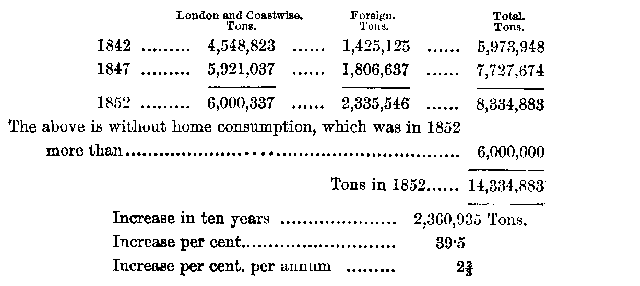
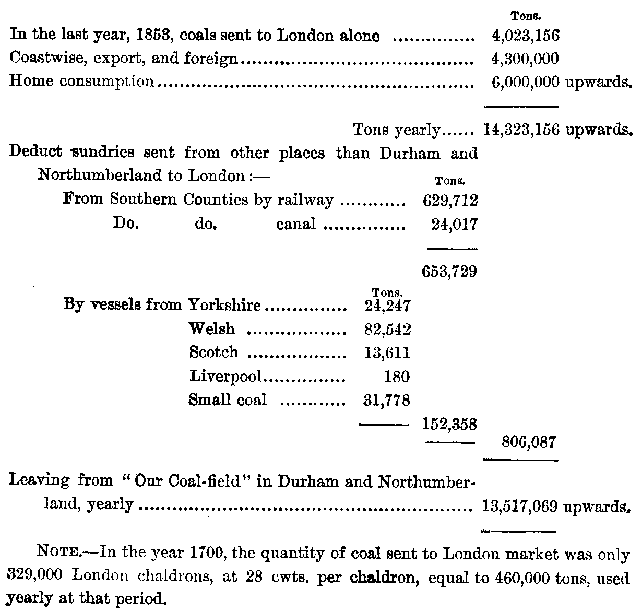
This great increase is irrespective of the large quantity of coals now converted into coke for inland consumption, and of the augmented home consumption arising from the local manufactories, in reference to which it may be remarked that the price of small coals has lately been raised, but only in what is considered a fair advance.
It is somewhat singular that the coal south of the Wear should formerly have been worked in the Main coal seam, when the Hutton coal seam lay only 250 feet below, exceedingly fine in quality, about four feet eight inches in thickness, nearly free of extra feeders of water, and approachable at a cost for further sinking of about £500. The Main coal seam is more expensive to work than the Hutton, and the produce does not sell for so good a price. The Low Main coal seam, below the Main coal, is like the Five-quarter above it, and more expensive to work. During the last few years, when prices were low, it was doubtful whether the trade of the district could Isave gone on if the Hutton seam, so good to sell, had not been easily wrought. The formation of a public railway company within the last few years, has brought other large coal-fields into the market, and competition has been further extended by speculators adventuring money in hazardous undertakings, which injuriously interfered with legitimate colliery concerns.
The Great Northern Railway doing the like unto London, and delivering to consumers at a low price, in consequence of the quality not being generally so good as our Northern Coal-field, Wallsend coal, which, when sent by the Great Northern Railroad, has a longer distance to travel, consequently our northern coal owners take the advantage of sending to London and coastwise from ports on the east coast.
At Black Boy, Tees Wallsend, Eldon, Coundon, and Adelaide, the coal was worked in the Upper Five-quarter seam till about the year 1830, and was generally considered better than the Main coal, which is now proved to be better and finer there than that of the Hutton seam.
The Main coal seam was easily approachable without extra water power from the Five-quarter, like the Hutton seam under the Main coal on the Wear; yet, when it was sunk to at Black Boy, in 1829, and tried, it was rejected by the fitters at Stockton, who gave preference to the more tender coal of the Five-quarter seam. There was not a shipping place at Middlesbro' at that period. The Etherley seams, which is a good durable coal, free from sulphur, the Beaumont, the Five-quarter, and the Stone coal, either combination of which or the Brockwell seam (forming the Main coal), which is from forty to forty-five fathoms lower, lie considerably under the Main coal of the district, where the seams are separated, crop out westward of Witton-le-Wear, from which circumstance it may be assumed that they are to the eastward, though dipping low towards Ferry Hill and Thornley, and under the red sandstone at Hartbushes, Hessleton Dean, and south towards Hartlepool. At none of these places have the seams been proved of good thickness or quality where sunk or bored to.
In the large district east of Black Boy, south of the Butterknowle and Hett Dykes, to a line running towards Wynyard or Newton Parks, and towards the mouth of the Tees, the upper seam, as far as has been proved, is found to be of inferior quality; and no Hutton seam, or any other, has been found to be good, so far as this district is proved south.
It is probable that the lower seams exist at their greater depth, notwithstanding the limestone and the red sandstone lie at considerable thickness above them; but the depth of these lower seams must be both great and uncertain, so that few speculators will be induced to incur the expense of approaching them, at least not until the pits sunk west of the red sandstone and on the borders of the limestone have been worked out in the seams to which they now afford access, and also until the patches are occupied and worked where the seams are known of sufficient thickness in the doubtful districts.
It may be remarked that there are very few pits even sunk in the limestone, most of them being upon the border of it, as East Thickley, Eldon, Black Boy, Coundon, Westerton, Ferryhill, Cornforth, Coxhoe, Cassop, West Hetton, Crowtrees, Heughall, Cassop, Shadforth, Sherburn Little Town, Haswell, Pittington, Moorsley, Hetton, Eppleton, Downs, Houghton, Newbottle, East Harrington, Pensher, Manor Wallsend, St. Hilda, Jarrow, and Harton, the latter working extensively near St. Hilda, in the county of Durham. Whitley and several others in the county of Northumberland are now laid in.
The only pits that may be said to be sunk in the limestone are at Haswell, Ludworth, South Hetton, Dalton, Seaham, and Seaton in the Hutton seam district; Thornley, Shotton, Castle Eden, Wingate Grange, South Wingate, Trimdon Grange and Trimdon Bishop Middlelham, Chilton and Ferryhill new pit in the Five-quarter seam, south of the Hett Dyke, are all in an expensive and more precarious district, as regards the Hutton Seam.
Castle Eden, South Wingate, and Hartbushes are perhaps the worst of all, so far justifying the inference that the coal under the limestone approaching the red sandstone and the sea towards Hartlepool is very far from satisfactory. The pit at Castle Eden and Hartbushes is about fifteen miles east from the west outcrop of limestone at Thickley, bordering on the outburst of new upper red sandstone. At Haswell New Pit the coal is under the limestone for about two miles in a direct course eastward from the outcrop at Sherburn Hill, which is about two and a half miles from the city of Durham, but that is not the old Haswell village visited by Mr. Smith, whose opinion that good coal would be found in all places under the limestone has been so often quoted in contrast with the more cautious expression of opinions by other eminent colliery viewers in connection with the district. If Mr. Smith had taken the course from Durham through Whitwell, about two and a half miles, and put pits down there, or at the outcrop of limestone about three miles, he would have found the Hutton seam inferior, and none of it good under the limestone, or in the workings even north of the Hett Dyke. Then, if he had taken the line from Durham, through by Pittington Hallgarth, and Little Town to Elemore Hall, and farther on to Low Old Haswell, a distance from Durham of about five miles, he would have found between Pittington Hallgarth, one mile east of Belmont Station, and near Sherburn Station, a narrow strip of land extending, uncovered with limestone, for about two or three miles to Old Haswell, which is probably the place to which he applied his conjectural opinion, where the limestone puts in eastward.
In fact, the good Hutton seam really found under the limestone in the county of Durham is of very small extent, not more than a few miles square, or less than one-fifth or one-sixth of the area of the limestone in the county of Durham, under which the coal has been estimated; and the remaining five-sixths is precarious as to profit, and so thin in many places as to be unworkable.
This verifies to a great extent, the opinion expressed by the late Mr. Buddle; and in my opinion a very different result would not be arrived at, even taking into account the small portion of good coal that may be got under the sea. After Mr. Buddle, in the year 1818, succeeded Mr. Arthur Mowbray, in the management of the extensive concerns of the late Marquis of Londonderry, the Hutton seam then became, although at greater depth, more extensively worked, and its qualities better known. The coal from that seam sold for many years at the place of shipment at 36s. 6d. per chaldron, equal to 13s. 9d. per ton; and that price continued up to 1827, when the price of best coals was reduced 4s. per chaldron, making 32s. 6d. per chaldron, or 12s. per ton.
The Main coal seam was formerly, and about that time, called "Ducks," (I believe, after an individual of that name, who was in humble circumstances when a boy, near Durham, but afterwards acquired great wealth, and became Sir John Ducks), and the second quality, Eden Main, at the colliery of Lord Londonderry, then Sir Harry Vane Tempest's; but at Lyon's North and South Hetton, when opened out there, it went under the name of Lyon's Main, the late John Lyon of Hetton Hall, being one of the principal lessors of these collieries. The lessees of Lyon's Hetton Colliery hold largely of him, both of this Main coal and Hutton seams, as well as others in that district.
Hutton Seam. — This district comprises the following collieries Ryhope, Silksworth, Murton, Dalton, Seaham, Seaton, Pensher, Houghton, Elemore, Pittington, Brasside, Heughhall, Shincliffe, Rainton's Hazard, Dunwell, Moorsley, North and South Hetton, Newbottle, Ludworth, Broomside, Whitfield, Lumley, Kepier, Shadforth, Cassop, Easington, Hetton, Down's Elemore, Little Town, Belmont, Whitehouse, Crowtrees, Grange, Arbour House, Old Durham, Alexandra, Adventure, Meadows, and Revolution pits — the estimated area being 55.25 square miles — which are greatly worked westward.
Black Boy, Or Tees Wallsend District. — This is a small patch of good house coal in the seam at the south-western portion of the coalfield, on the outcrop of the magnesian limestone. It is irregular in shape, and contains an area of about six miles. It includes Black Boy, Tees Wallsend, Leasingthorne, Westerton, Coundon, Eldon, Copy Crook, Shildon, and Adelaide Deanery, greatly worked out.
Tyne District. — This, a piece of good coal running along the north side of the Ninety-fathom Dyke from Earsdon to Stella, Greenside, and Kyo, thirteen miles, averaging about one mile in breadth. It includes Earsdon, Holywell, Gosforth, Backworth, Killingworth, Coxlodge, Walbottle, Stella, and Towneley Pits. At Stargate, near to the main dyke at Stephen's Hall, and C Pit at the Folly, this is also greatly worked off in the narrow scribe alluded to, which lies near to the main dyke at a great angle, dipping to it at the rate of 5, 4, 3, and even 2 per yard, making it difficult to get in the underground working places where there is a large quantity of water made in workings, when workable at so great an angle to the dip. These are the causes why there is still a small portion of this good coal left in a workable state, which is now being worked at Killingworth, four miles north, and at Towneley, six miles west of Newcastle, and shipped in the river Tyne.





 Contains public sector information licensed under the

