


|

|

|

|
|
 |
 |
|||
Wheatley Hill Accident
Extracted from the Annual Mines Inspectors Report for 1871
Report of James Willis (page 26)
Irruptions of Water.
Under this head three casualties have occurred, causing the loss of eight lives, and it is not too much to say that not one of them should have taken place.
No. 5 accident caused the deaths of five persons. The Wheatley Hill Colliery had recently reached the coal at the "dip" portion of the royalties belonging to the Original Hartlepool Collieries Company, who are also the owners of the Thornley Collieries, which are considerably to the "rise" part of the royalties. Holings had been effected between the workings of the two collieries, principally for the purpose of freeing portions of the Thornley Colliery from water. These holings did not free (nor were they intended) a certain somewhat detached part of the Thornley workings ; and to effect this another place was being driven to join a pair of headways shown by the sketch below.
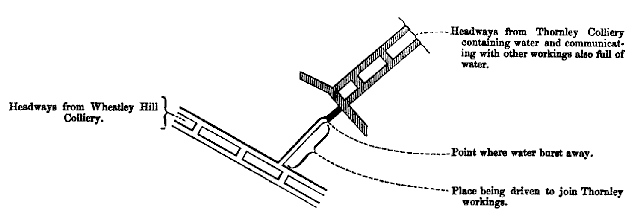
The plan of the Thornley workings showed the headways to have been left in the position shown above by the shaded portion of the sketch, whereas in reality the part marked black (about 16 yards) had been driven before abandoning (for the time) these workings. It will thus be seen that so far as was known to the then management, there was a face of about 80 yards nearly at a right angle to the advancing place to be driven against. Had such been the actual position a "front" bore hole kept a few yards ahead would undoubtedly have been a sufficient protection. Whilst the place was being driven bore holes were kept in advance, — front holes of three yards and flank holes of two yards at an angle of 45°, — it being considered from the hardness and compactness of the seam and from the known "head" of water in the drowned workings that holes of such length would allow a sufficient amount of coal to be between the workman and any place tapped by the bore holes to keep him safe. There had been great irregularity in boring these flank holes ; sometimes they had been bored and at other times only the front hole had been kept going. On the night before the accident a flank hole on the left side only had been put in and none on the right side. It is beyond doubt that with the lengths of holes and the angle of the flank holes already mentioned, neither of them would have struck the headways against which the place was being driven ; at the same time, although such lengths would have ensured sufficient intervening coal, this should not have been the only consideration in determining the lengths of the holes. The area of ground covered by the advancing holes and the consequent greater certainty of holing into workings ahead or on either side of the place being driven is of great importance. Under the supposition of the 80 yards' face, which was expected according to the plan, there is some excuse for having the flank holes only two yards in length. Bore holes of this kind should not be less than six to eight yards in length, the flank holes at not more than five yards distance from each other, and probably a less angle than 45°, would be of greater certainty, but there is often some difficulty in commencing holes at a less angle on account of the cleavages in the coal. Where there is any doubt as to the accuracy of the plans, or where there are no plans of old workings, these lengths should be increased to not less than 10 yards and the flank holes three yards apart. This case is also important from the fact of the coroner's jury finding a verdict of "manslaughter" against William Spencer (chief viewer), William Hay (resident viewer), and Thomas Watson (overman), who were bound over to appear at the Durham assizes.
The case came on for hearing at the March Assizes before Baron Martin, who in charging the grand jury observed that, he did not think any bill would be preferred as the only evidence which the coroner's jury seemed to have had to give colour of warrant to their proceedings was that of the three persons themselves against whom their verdict had been found. The bill was, however, preferred and was thrown out. Counsel for the prosecution wished the case to proceed on the coroner's warrant, to which the judge consented.
After hearing a few witnesses his Lordship remarked that "at present there was not a shadow of a case," upon which the prosecution was withdrawn, the learned judge observing, "after an experience of 20 years on the bench, he had never known a case carried on on the coroner's inquisition after the grand jury had thrown out the bill," and ordering "the costs of the case" to be stopped.





 Contains public sector information licensed under the

