


|

|

|

|
|
 |
 |
|||
Seaham Colliery Disaster
Extracted from the Annual Mines Inspectors Report for 1871
Report of Joseph Dickinson (page 53)
Seaham Colliery Explosion.
South Bank, Pendleton, Manchester,
26th January 1872.
Sir,
In obedience to your instructions of the 13th instant I, on the 17th, accompanied by my brother inspector Mr. Willis, the resident viewer Mr. Wm. Dakers, and the under-viewer Mr. Jos. Thompson, made a preparatory inspection of the Seaham Colliery ; and on the 18th and 19th attended the adjourned inquests held at Seaham Harbour by Mr. Maynard, coroner, on the bodies of the 26 persons who lost their lives consequent upon an explosion of firedamp, which occurred in this Colliery on the 25th October 1871.
The Colliery consists of extensive workings won by two shafts formerly known as Seaham and Seaton, but which are now united under the ownership of Lord Vane. One of the shafts, which is the downcast, is divided by a brattice, and is called No. 1 and No. 2 pit, one half of which is used for working the Hutton seam at 256 fathoms, and the other half for the same seam at the opposite side of a fault 28 fathoms deeper. The other shaft is called No. 3, and is the upcast for the workings at both sides of the fault. There are also workings in the Maudlin seam, which lies next above the Hutton seam, and some in the main coal above that, all worked by the same shafts ; but there is a staple pit below-ground by which air goes from the Hutton seam into these two seams, and the return air currents from the Hutton seam workings at both sides of the fault are taken up in separate staple pits to the main coal before entering the No. 3 shaft.
It is only the workings in the Hutton seam at the high side of the fault which appear to be connected with this explosion. These workings consist of a long narrow and nearly rectangular strip, at the far end of which, about 3,200 yards from the downcast shaft, the pillars are being worked, with the goaves of former workings behind and on each side, as shown on the annexed sketch.
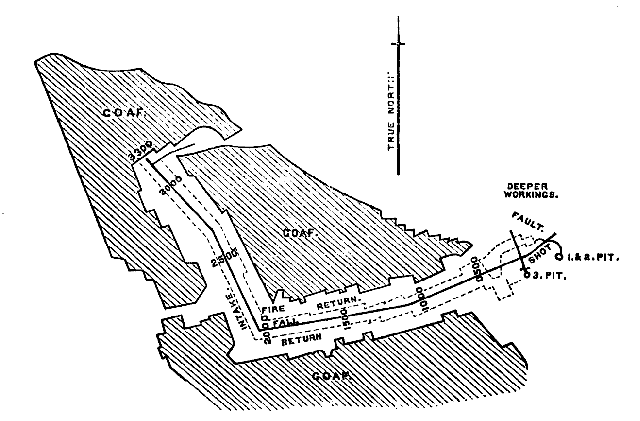
The air for these Hutton seam workings consisted of about 27,000 cubic feet per minute, which went in by one main in-take and came back by two return air-courses, with the in-take between them. The air from the two returns ultimately united with another return of about 6,000 cubic feet p.m., and after running together in a mixing drift for about 100 yards, passed through the furnace.
A change it may be stated had taken place in the chief viewership about two years previously, but the objectionable leaving of the present pillar workings to be got between goaves had been done before that time ; therefore, in this inquiry nothing turned upon these points.
The circumstances elicited at the Inquest were at follows :—
The explosion took place at 11.30 p.m. on the 25th of October; and immediately after the occurrence, on explorers descending, the ventilation was found disarranged, with much after-damp in the workings. As speedily as possible such of the survivors and of the dead bodies as could be reached were sent out, and the work of repair was commenced to get to the other 22 at the far end. By noon next day (the 26th) the main in-take had been penetrated to a distance of 2,200 yards from the downcast shaft. The stoppings and other partitions up to this distance being, however, but imperfectly repaired, the air was scarcely respirable, and the after-damp had to be driven forward by moving a tarpaulin screen like a piston along the in-take.
Having got to some stables it was found, on taking a look over the tarpaulin, that fire was burning. The party consisted of four officials, namely, two back overmen, a master shifter and another, with about 20 miners. No firedamp had been met with up to this time, but it was known that the surrounding goaves where the coal had been worked out were likely to contain firedamp. So soon therefore as the fire was discovered, the miners, apparently fearing another explosion, speedily retreated. The officials, finding the fire too large to deal with alone, or rather despairing of dealing with it at all, put up a screen to keep what little current of air there might be off the fire, and retired also. The miners, running out, met the under-viewer accompanied by two neighbouring viewers coming in, but they passed on without stopping. The officials came next, and told what they had discovered and done. They appear to have been collected in their minds, and turned back to accompany the three to make further examination. On the way, however, from the description which the officials gave of the fire and the situation appearing so alarming and the chance of saving life beyond so hopeless, other council prevailed, and the party turned back to report and consult as to what was best to be done. They found all the men had gone out of the pit. A panic had set in. No one volunteered to make further examination of the fire, and no one would take the responsibility of issuing an order to that effect. The fire, therefore, was not seen a second time.
A conference thereupon took place over the plan in the Colliery office, the principal viewer Mr. V. W. Corbett, Mr. John Taylor, Mr. R. F. Matthews, Mr. Lindsay Wood, Mr. Hepplewhite, and Mr. Turnbull being present ; and, after hearing the statements of the officials who had seen the fire, and like them despairing of rescuing alive any of the 22 persons who remained in the pit, it was unanimously resolved that, to avoid as much risk as possible, the workings should be shut off by stoppings near the shaft to extinguish the fire. This decision, it is proper to state, was approved of by Mr. T. E. Forster, the veteran viewer of the district, by Mr. Willis, Her Majesty's inspector of mines for the district, and by his colleague Mr. Southern, before being carried into effect. The shutting off was set about at 10 p.m. on the 26th, and by 5.10 p.m. next day (with a safety valve to let off the pressure that might ensue) the pipe in each stopping was plugged.
The re-opening commenced on the 17th of December. The plug of a stopping in one of the return air courses was drawn first, and afterwards that of the one in the in-take. Finding the indications satisfactory this was followed by making a hole, and ultimately the far end was reached on the 20th of December.
The fire was found extinguished. It had consisted of nine bundles of hay, and of the solid coal adjoining which was burned for about two feet deep, and extending beyond at a gradually lessening depth for 13 yards along the side of the in-take, also a "chock," composed of pieces of timber for supporting the roof opposite the hay, and a hay-rack 31 yards beyond the nine bundles.
Of the 22 deceased who had been shut up in the mine, one was found sadly mutilated under a large fall at 1,900 yards over which the explorers had passed before the pit was shut ; but the others were all found beyond the fire. Three of them who had been coming out when the explosion occurred, were found slightly burned at 2,300 yards, being a little beyond the burnt hay-rack. The other 18 were all unburned, and had survived the explosion. A memorandum written with chalk at 10 a.m., on the 26th, and signed by David Ballantine, recorded that at that time one man (whose body was found outermost) had died. There was also a figure 6 close to what was supposed to be Ballantine's hand. The deceased's footsteps were plainly discernible on the newly settled dust ; and apparently they had unavailingly made every effort to escape. Two air-doors at an entrance into one of the returns were found propped open, as though the men, having tried for an outlet that way and finding the air irrespirable, had set the doors open to let the after-damp and smoke from the fire get away without coming to them inbye. Six others had apparently died in making a last effort. They were found at 2,900 yards with a tarpaulin, which it was supposed they had been carrying in front to force back the after-damp. Eight others were found at 3,100 yards. And the last (an experienced old miner, who had survived one if not two similarly dreadful emergencies,) was found with a grease pot and a scuttle of grease behind an air-door at 3,200 yards with the door closed and the crevices greased up ; doubtless done by him to keep out the after-damp and smoke. He is supposed to have been the last survivor. His drinking bottle was empty, but some of his food remained. There was nothing to show the exact time when death ensued, but suffocation had in all probability done that work before the pit was closed.
The circumstances altogether were such as to arouse public sympathy, and to demand a searching investigation. Hence, together with the fact that the neighbouring colleague of the inspector for the district took an active part during the emergencies, and prior to his appointment of inspector had acted in the management of the Colliery, applications were made for entirely distinct assistance to the district inspector, which occasioned my being sent down.
At the time of the explosion a shot was being fired in the main in-take, within 300 yards of the downcast shaft. On the opposite side of the in-take there was an entrance with a wall across it and a pipe through to the water standage, and further inbye there were other entrances. Parts of the standage, together with some adjoining drifts, were ventilated by return air ; parts by a leakage allowed through a stopping, and part was stowed with rubbish and inaccessible. Two men had been working in the standage that day, but the other parts had not been examined since the preceding day. A short level at the opposite side of the standage was found with the coal and roof much charred, and with props that had nearly been set on fire. The horses in a stable near were killed, the one next the level being burned. The return air crossed twice over this burned level, and one of two partitions forming air-crossings was found blown upwards from the level. Further in, at the side of the north return air-course, at 600 yards from the shaft, some old stables were found burned. The appearances in the main in-take showed that the principal pressure of the blast had been in it ; with slight traces of burning from near the downcast to 2,300 yards inbye, where it apparently tailed out. The man Hutchinson who fired the shot near the standage was much burned, and his son, who was near him, was burned and blown to death. The former stated that the flame of the explosion came when the shot went off, but not before. Two other men who were out of the range stated that on hearing the shot they said "There's Hutchinson's shot gone," and then the rush of the explosion arrived ; and one of them described that in four or five minutes a second distinct explosion followed, all three men at the time of the occurrence saying that the shot had done it.
The shot was immediately over a gas pipe 1¼ inches in diameter by which that part of the mine was lighted with gas from the surface. Before firing the shot, two or three stays had been hammered up against this pipe to protect it, and as after the explosion, the pipe was found broken a little outbye, it was supposed possible that the hammering might have broken it. But as the whole of the 27,000 c. feet of fresh air per minute was passing the spot, besides all the air that went to the staple pit for the Maudlin and Main coal workings, it was considered impossible that leakings from the broken pipe could have occasioned the explosion, but rather that either the shot or the explosion had broken the pipe.
The fall at 1,900 yards was at what is called the bank top, or head of the second plane, where the workings are 50 fathoms higher than at the shafts. Inbye from this fall the markings of the blast on the props faced outwards, and outbye they faced inwards, indicating that the main blast had radiated from the fall. The roof there had fallen about a dozen years previously, and was timbered in such a way as to leave a space above, called a lofting, about 132 feet long by 10 feet broad and 6 feet high. Had this space been filled with firedamp the main explosion as indicated by the blast would be explainable from that source alone, but scarcely the keen burning near the water standage 1,500 yards away. This lofting was all found down after the explosion and fresh stone fallen from above. An hypothesis was therefore started to the effect that an outburst of firedamp, assumed at 100 cubic yards, had forced the roof down, and that this gas mixing with air fired at the open light which was there allowed. The hypothesis went to the extent of supposing that had it been a Davy lamp instead of an open light the result would have been all the same, as the gauze heats and passes flame at a velocity of eight feet per second, which would be more than attained by the current and outburst. The 100 cubic yards having been assumed, the remainder was a matter of figures. The addition of 800 of air made 900 of explosive mixture, and according to Marriot's law, the volume on being exploded would expand l/459th part for each degree of Fahrenheit, and taking the temperature of exploded gas at 15,000°
15,000/459 = 32 X 900, a volume of 28,800 cubic yards was obtained, the sudden entry of which it was explained would force everything before it.
This plausible idea involved some anomalies. The roof according to the under-viewer's evidence had not been known to give off firedamp, and it left both the second explosion deposed to and the simultaneity of the firing of the shot unaccounted for.
I suggested in cross-examination that the shot might either have lighted gas from the pipe, or in the standage or adjacent workings, or have wafted out gas to an open light ; and that this occurrence either blew gas out of the lofting on to the open light allowed there, or that it blew up the air crossing into the return, and admitted pressure which drove gas from the goaves into the in-take, where it would travel to the open light at the lofting, thus fixing the main explosion at the fall whence the blast radiated, and accounting also for the second explosion, as well as the simultaneous occurrence of the first with the firing of the shot.
The hypothesis as to the outburst was, however, supported by too many influential witnesses to be invalidated. The resident viewer hinted at it in his evidence at the outset, and the idea was supported by the under-viewer. Later on it was effectively introduced by Mr. Wm. Armstrong, and corroborated by Mr. E. F. Boyd, Mr. R. F. Matthews, Mr. John Taylor, Mr. Lindsay Wood, and Mr. T. E. Forster, all viewers of experience and high standing. It was also concurred in by Mr. Willis, who, although he saw a difficulty, could come to no other conclusion.
The jury, therefore, upon the evidence returned a verdict accordingly, and exonerated all from blame.
The circumstances under which blasting should in future be allowed, and the limit for open lights, with goaves at each side of the workings, are questions for the viewers, and have, it appears been considered by them and Mr. Willis.
I have, &c.
Joseph Dickinson,
Inspector of Coal Mines.
The Right Hon. Henry Austin Bruce, M.P.,
Principal Secretary of State,
Whitehall.





 Contains public sector information licensed under the

