


|

|

|

|
|
 |
 |
|||
V. — Conclusions And Recommendations.
The conclusions which I think may justify be drawn from the facts, which I have done my best to put forward as fairly as possible to all concerned, are the following :—
(1) Originating point and cause of the explosion. — I am perfectly satisfied, both from the evidence of witnesses and from personal inspection of the mine, that the explosion originated near the working face up the No. 1 brake of the 3rd North district, that it was initiated by the ignition of firedamp, and that the explosion was carried on by means of coal dust. There is, however, no evidence to enable me definitely to locate any one precise spot as the originating point, and, although there is every probability that it is attributable to a safety lamp — which may have been either in perfect or defective condition — there is not sufficient evidence to enable any one safety lamp to be indicated.
No precautions seem to have been taken in case of the "weighting" of the goaf — a feature which presages a fall of roof, and which, with such a roof as that in question, would be an incident fraught with very great danger to those in the neighbourhood of the goaf. In similar circumstances the men in the neighbourhood should be cautioned and told to withdraw in the event of pronounced weighting, and I would suggest that it is most desirable that those working in the neighbourhood of similar goaves (i.e., goaves where the roof consists of a thick bed of hard rock which does not readily fall or bend), should be provided with electric lamps* in place of oil safety lamps.
(2) Attempted rescue operations. — Three alternative methods of getting past the site of the fire at the "friction-gear," and of so rescuing the entombed miners of the 5th and 6th North districts have been considered (see pages 17 and 18), and I am of the opinion that when Henry, the under-manager, arrived at the "fan-site" the scheme which he adopted was the one which offered the best prospect of success. I am also of the opinion that the subsequent proceedings were in every respect properly and most energetically carried on at very great risk to the lives of those concerned in them. In my view Graham's scheme, as it has come to be called, of reaching the fire by the Back South Dip did not at any time offer any better prospect of success than that which was, after due consideration, adopted, subject, however, to the proviso that either scheme might have been successfully carried out before and up to the time that the men Wear and Kenmare passed the fire, and for a very short time thereafter. I consider it most unfortunate that Henry was accompanied inbye by so few helpers (see pages 13 and 14), and that so much time was lost on the way inbye — chiefly, it must in fairness be said, to the efforts made, happily successful, in restoring Walker and Gregory at Benks' Turn. Had he and his fellow rescuers proceeded straight inbye I believe that the incipient fire at the "friction-gear" would have been successfully combated, and the whole of the men in the 5th and 6th North rescued.
(3) The necessity for trained rescue brigades. — The almost total failure of the rescue operations constitutes a convincing argument in favour of the provision at every colliery of trained rescue brigades and means of summoning them at short notice. The summoning could easily be effected by some form of agreed upon signal such as blowing the colliery steam whistle ("horn," "hooter," or "buzzer") a certain number of times or continuously until sufficient help arrived.
(4) Provision of second intakes. — Had there been a second main intake air road into the mine, at a sufficient distance from the main haulage road would in all probability have been available as a means as a means of access to the entombed miners. The Back South Dip was too near to the Main Haulage road to serve this purpose. At some large collieries a separate intake road is provided as a travelling road and is a wise provision.
(5) Precautions in respect of coal dust. — The precautions against the accumulation of coal dust were of a haphazard and unsystematic character. No doubt the fact that shots were not fired in getting the coal bred in the minds of the management a sense of security in this respect, but had the haulage road of the 3rd North been systematically cleared of dust and damped with water the explosive blast would not have traversed this road — at any rate to the extent it did — and so would not have reached the "friction gear." I can only repeat here what was said by Mr. R. D. Bain and myself in our report on the explosion at West Stanley Colliery (February 16th, 1909)** :—
"We are anxious to emphasise the impression made upon us in investigating this and other explosions that unless the grave danger which exists at many collieries owing to the presence of coal dust is attacked with much greater earnestness in the future than it has been in the past, disasters of a similar nature will occur from time to time."
(6) Provision of water mains on haulage roads. — Had water mains been in use along the main road — as should be the case in all dry and dusty mines in those cases where watering does not disastrously affect the floor — there is a great probability that the spread of the conflagration might have been prevented — even when Henry reached the scene of the disaster — and the fire ultimately extinguished. Wear and Kenmare could certainly have extinguished it when they came past it had water been available in this manner, but the probability is that the explosive force at the "friction-gear" would have sufficed to have broken the pipes and prevented the initiation of the fire.
(7) The ventilation of the mine. — I am of the opinion that the ventilation of the working face was inadequate for the needs of the mine, having in view the gassy nature of the coal. I think that this inadequacy was largely due to the excessive leakage from the air current in its course from the shaft to the working face, and not to any want of ventilating power at the surface, any increase of which would not have materially affected the face ventilation. Further, that this leakage was due to errors on the part of a former management, and that the present management had made considerable efforts to improve matters, which efforts were being continued at the time of the explosion.*** This inadequacy cannot in my view, therefore, be wholly attributed to the existing management. Nevertheless the system of ventilating the 5th North district with 6th North air was an instance of bad mining practice and pointed to a want of proper appreciation of the dangers attendant on such a practice. The present management, in my opinion, also committed an error of judgement in erecting the stoppings on the rise side of the 3rd North district at the points A, B on the plan, before the auxiliary ventilation scheme was complete. An alteration in the ventilation of such an important character should have been carried into effect at one time, and when the pit was not at work.
The Act at present requires that "the quantity of air in the respective splits or currents shall at least once in every month be measured and entered in a book to be kept for the purpose at the mine (see General Rule 1), but it does not indicate the place of measurement. There may be as at the Wellington pit, a great distance between the place of measurement and the place where the air current reaches the face, and consequently the volume of the air current as measured at the "split" may give no indication of the quantity arriving at the workings, owing to the loss by leakage. The adequacy or otherwise of the ventilation of a district can, to a great extent, be determined from the air — in respect of quantity and condition — in the district return near the face.
As to the bearing or otherwise of the inadequacy of the ventilation on the occurrence of the explosion — this question is not very easy to answer. With a goaf of the character of that in question, where the roof was composed of a bed of strong rock and the waste likely to remain open for a long period, gas was bound to collect therein unless the waste or "goaf" was swept by a sufficient ventilating current or drained by "ascentional ventilation," and, when the roof fell, to be driven out with great force on those working the coal in the neighbourhood.
(8) Inspection of working places, reporting the presence of gas, withdrawal of persons from places which where dangerous, and system of reporting. — Some of these matters have been dealt with in detail by Mr. Pope, and I agree with his conclusions (see Mr. Pope's Report), viz., that there were contraventions of General Rule 4 by the overmen and deputies, and of those of the Special Rules relating to gas.
And again, in so far as all "withdrawals" strictly regarded, were not recorded and in so far as the entries "in the General Report Book" required a verbal explanation to explain that they were reports of withdrawals under General Rule 7, and not reports under General Rule 4, the act has not been complied with.
The whole of the official staff entered their reports in one book, a copy of a page from which is given in Appendix D. Although the form of these Reports agrees with the statutory requirements, they are not in accord with what one expects to find at a well-managed colliery. There appears to me to be a very strong argument in favour of the whole of the forms for official reports at collieries being of a uniform character such as shall be prescribed by the Secretary of State.
(9) The right to search persons entering a mine. — Considering the dangerous nature of mining, and the liability to ignitions of gas and coal dust, and in view of General Rule 10 (iv.) of the Coal Mines Regulation Act, which prohibits anyone having matches in his possession in a mine or part of a mine in which safety lamps are used, it should, in my opinion be made compulsory on the part of the management to search all persons entering such a mine, for matches.
In Scotland the manager is empowered by Special Rule to search persons "when and as often as he may think proper," but here the search is voluntary on the part of the management. In Cumberland the search is to be made only "if there be any ground for suspicion." In Yorkshire and Lincolnshire "men may be searched for tobacco, pipes, and matches, but the person making such search shall be first examined by two of the workmen of the mine." In North and East Lancashire "if there be any ground for suspicion he shall be subject to be personally searched," and soon, in several other of the districts. In no case is compulsory searching enacted.
(10) Safety lamps. — In addition to what I have stated in respect of safety lamps under conclusion (1) page 26. I am of the opinion that it is desirable that the mines where these are in use a record should be kept daily at the mine specifying the number of lamp which is out, the name of the person to whom it has been delivered, when delivered and when returned and any injury it has received during use.
In Concluding this Report I wish to acknowledge the courtesy of the management in readily providing me with all information which I desired. The same acknowledgement should be extended to Counsel and other legal representatives who appeared on behalf of the owners and management, who, together with Messrs. Richards and Smith — the two latter acting for the Miner's Federation — conducted their representative cases with conspicuous ability.
 I have the honour to be
Sir,
Your obedient Servant.
R. A. S. Redmayne.
The Right Honourable Winston Leonard Spencer Churchill, M.P.,
His Majesty's Principal Secretary of State
For the Home Department.
* At my request Mr. Nelson, the Electrical Inspector of Mines, has compiled the following note on electric lamps for use in mines.
The main disadvantages of electric lamps is that they will not without a cumbrous and delicate attachment detect the presence of explosive gas. They have also some minor disadvantages, none of which have however their origin in principal — they are mainly constructional defects.
One difficulty must be got over before electric safety lamps can be considered properly constructed for mining use is the switching difficulty. Some electric lamps have an external switch which may spark in making or breaking — a possibility which should be removed. There are several ways of doing this :—
(i.) To use a lamp with a liquid battery, so designed that the light is switched on and off by simply turning the lamp over. Such a lamp may be made cylindrical in shape so that if held or placed with one end uppermost it lights, but if held with the other end uppermost it is dark. Lamps working on this principle are made by the Float Lamp Company.
(ii.) The battery may be of the ordinary dry "primary" type — it would be easy to arrange a pair of contacts fixed inside on the bottom of the lamp, with a corresponding pair of contacts on a loose dry cell. Then again when the lamp is upright it will be light, placed bottom uppermost it will be dark.
With either of the above lamps the possibility of igniting gas would only occur if a lamp bulb got broken in an explosive mixture. But an ordinary oil-lamp with its exposed glass stands an even greater chance of getting broken because the glass may be subjected to unusual heat, local or general, to which an electric lamp is not liable. With the battery cracking breaking the outer glass alone is not immediately dangerous.
(iii.) The switch contact may be made inside the lamp by some means such as indicated by the following sketch :—
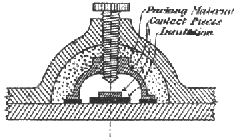
A second difficulty is that most electric safety lamps give a sort of search light effect but a rather worse general lighting effect than an ordinary oil safety lamp. This also is an effect of construction which it is desirable should be removed.
The disadvantage of electric safety lamps named above remains, however, and so far as I am aware it can only be minimized at present, not removed. An apparatus on the same principal as that of the Holmes-Alderson electrical firedamp detector (which is automatic in its action) might be utilized in each district worked by electric safety lamps. A few of the electric safety lamps in use, those in the hands of deputies, might as a means of occasionally testing for gas be fitted with firedamp detectors.
** Report on the Explosion which occurred at West Stanley Colliery on the 16th February, 1909, by R. A. S. Redmayne, H.M. Chief Inspector of Mines, and R. Donald Bain, H.M. Inspector of Mines, London, 1909. Price 2s. 3d. [Cd 4788]
*** By measures to prevent leakage, and by placing an auxiliary fan underground in the main return at the "fan-site."





 Contains public sector information licensed under the

