


|

|

|

|
|
 |
 |
|||
STATE OF THE VENTILATION.
The return airways in the Towneley Seam were all travelled during the week prior to the explosion, and those in the Tilley, Busty, and Brockwell Seams during the week ending January 22nd, 1909, so it is to be presumed that no heavy falls obstructed the airways of the mine.
The presence of "gas" had only been reported once during the present year, viz., on January 13th, in the Straight South District of the Towneley Seam. That the seams did not give off gas in any quantity is proved, we think, by the fact that, although temporary stoppings of brattice cloth were the only means of keeping the intake air in its proper channel in the workings during the work of restoring the ventilation after the explosion, it was possible to travel the workings a day or two after the accident.
ATMOSPHERIC CONDITIONS ON DAY OF EXPLOSION.
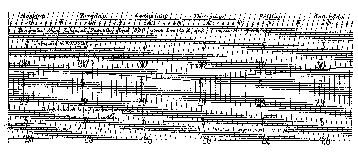
There was nothing abnormal or unusual in the atmospheric conditions on the day of the explosion. Below are tables giving the hygrometrical observations taken at the Observatory, Durham, from the 10th February to the 16th February, and a barograph chart taken at Sacriston which is distant only a few miles from the West Stanley Colliery.
HYGROMETRICAL OBSERVATIONS MADE AT THE OBSERVATORY, DURHAM.
| Dry bulb |
Wet bulb |
Dew point |
Vapour pressure |
Relative humidity |
Vapour in cubic foot of air |
Vapour required to saturate cubic foot of air |
|
| ° | ° | ° | Inches. | Per cent. | Grains. | Grains. | |
| 33.3 | 33.0 | 32.5 | .184 | 97 | 2.1 | 0.1 | |
| 38.1 | 37.3 | 36.2 | .213 | 93 | 2.5 | 0.2 | |
| 35.5 | 34.5 | 32.9 | .189 | 90 | 2.2 | 0.1 | |
| 34.0 | 32.2 | 29.0 | .160 | 81 | 1.9 | 0.4 | |
| 33.3 | 30.4 | 24.8 | .134 | 70 | 1.6 | 0.7 | |
| 35.0 | 33.0 | 29.8 | .164 | 80 | 1.9 | 0.5 | |
| 36.9 | 34.6 | 31.3 | .179 | 81 | 2.0 | 0.5 | |
| 30.4 | 29.2 | 25.7 | .139 | 81 | 1.6 | 0.4 | |
| 39.0 | 37.7 | 35.0 | .212 | 90 | 2.4 | 0.4 | |
| 45.5 | 44.1 | 42.4 | .272 | 89 | 3.1 | 0.5 | |
| 40.5 | 38.0 | 34.8 | .202 | 80 | 2.3 | 0.6 | |
| 35.8 | 34.0 | 31.3 | .177 | 84 | 2.0 | 0.5 | |
| 36.2 | 33.7 | 30.0 | .169 | 79 | 1.9 | 0.6 | |
| 37.2 | 35.1 | 32.1 | .182 | 82 | 2.4 | 0.5 | |
| 35.3 | 32.9 | 31.7 | .179 | 89 | 2.1 | 0.4 | |
| 35.5 | 34.2 | 32.2 | .183 | 88 | 2.1 | 0.4 | |
| 40.2 | 37.9 | 35.0 | .203 | 82 | 2.4 | 0.6 | |
| 35.7 | 34.5 | 32.6 | .187 | 89 | 2.1 | 0.4 | |
(click on image to see larger picture)





 Contains public sector information licensed under the

