


|

|

|

|
|
 |
 |
|||
Two hewers worked from 4 p.m. to 10 p.m. followed by other two from 10 p.m. to 4 a.m. usually in the winning places.
At night the main shift consisted of stonemen and repairers who occupied the seam from 6 p.m. to 2 a.m. and it was during this shift that the explosion occurred.
As there was not much work for the two deputies in the seam their shifts were arranged as follows :–
One descending the shaft at 6 a.m. and remaining until 4.30 p.m. met the back shift hewers and the hewers in the fore shift of the night shift at the station, which was the bottom of the upcast shaft. The other deputy descended at 8 p.m. and remained until 4.30 a.m., he examined for and met the back shift hewers in the night shift and the fore shift hewers of the day shift.
The stonemen's places were examined by the deputy leaving the pit at 4.30 p.m. but as he had usually got round the places before 4 p.m. and they did not come down until 6 p.m. there was more than the two hours interval which, while it is specified in the Special Rules as regards hewers in compliance with the term of General Rule IV., is not specified for other workmen. Attention has already been called to this defect in the Special Rules in connection with the explosion at Woodhorn and North Seaton Collieries in Northumberland.
There was nothing abnormal in the atmospheric conditions on the day of the explosion. The movement of the barometer is shown on the barograph chart given below and taken at the colliery.
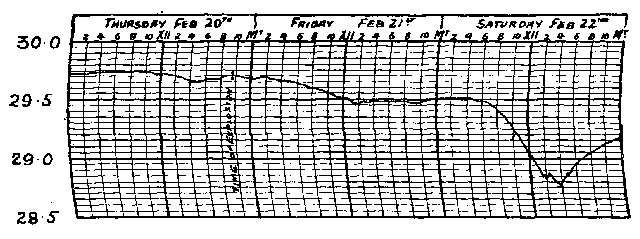
The workmen of the colliery regularly inspected the mine under General Rule 38, and the following is a copy of their last report relating to the Low Main Seam
"The undersigned being practical working miners, appointed by the persons employed in the above-named colliery to inspect the mine, in accordance with General Rule 38, report that such inspection was made on the 18th day of December, 1907, and the following is a true report of the result thereof :—
"We have examined the Low Main and South Side of Main Coal, find the same in a satisfactory condition."
THOMAS LAVERY.
The Low Main seam had been occupied by the two day shifts of hewers and the haulage shift on the day of the explosion, two night shift hewers had descended at 4 p.m., Wood and Dixon, two of the stonemen, had gone in earlier with them, the usual night shift of stonemen had descended at 6 p.m, Ashman the night shift deputy at 8 p.m., and all went well until the moment of the explosion ; there were then 108 persons underground in the Glebe Pit, 51 in the Main Coal, 42 in the Maudlin, and 15 in the Low Main seam.
None of the persons in the upper seams were injured by the explosion.
In the porch at the top of the upcast shaft there were the two hewers on the 10 p.m. shift about to descend to the Low Main seam, and the waiter-on, who had opened the door next the shaft to allow two shaftmen, who had just come up in the cage from the Low Main seam, to get off. One of the shaftmen was in the act of stepping off the cage and his mate was in the cage behind him when the explosion occurred ; these men heard a report, but felt no heat, and saw no flame, nor did they observe any dust, nor were their lamps extinguished; the outer door of the enclosure was blown open and they all ran out, and looking back to the pit saw what appeared to be smoke ascending.
The upper part of the enclosure was slightly damaged. A skylight near the fan was broken, and the doors leading into the fan drift were slightly damaged, but the fan itself was not injured.
The cage in the upcast shaft was run down empty immediately after the explosion m response to a signal probably caused by some material moved by the explosion striking the signal wire, but it was not able to reach the seam, owing to the disturbance of the framework near the shaft bottom.
The downcast shaft was not damaged, and the cages in it were available for the descent of the first explorers, who went to the Maudlin by that route, and then climbed down the ladders to the Low Main. They found the ventilation disarranged there and the air short-circuited, and evident signs of an explosion. One of the victims of the explosion, Oswald, was found near the up-cast shaft alive, but he soon succumbed. Yeardsley, found near him, survives.
It was early decided to take the fresh air along the centre winning or haulage road; the speed of the fan had been increased to 80 revolutions, and considerable progress was being made, notwithstanding falls of stone and stoppings blown out, when word came that there was a fire near the foot of the stone drift, and all were withdrawn until the manager and others, returning to the Maudlin by the ladders, had descended the drift, and found a loose prop and a standing prop smouldering at the point marked F2 on the plan on Plate I. (Fig. 1). The fire was extinguished without difficulty, and the party then passed forward along the main road in the Low Main seam to the shafts, and then resumed exploration further in. A canary had in the meantime been brought underground, and was used for testing the air. The face was nearly reached and some of the bodies on the main road had been passed, and smouldering timber observed, and extinguished at the point marked F1. In addition to these fires found burning or smouldering, there was evidence found later that the brattice had been on fire in several of the culs-de-sac, and in one timber had been burning. When the face was nearly reached some of the party, including the manager, found themselves affected by the after-damp and a retreat was made to the shafts. Before returning to the district where the men had been working the temporarily abandoned workings lying to north and west of the shafts were examined, and found to be free from after-damp, but some fire-damp was present.
Messrs. Philip Kirkup and W. C. Blackett now joined the explorers, and the whole party returned to the face, and all the bodies were located, and arrangements made for removing them to the surface, which was effected by 8 a.m. on the 21st February.
I was engaged in Cumberland on the day of the explosion, and had not returned home at night, but on receipt of a telegram on the morning of the 21st February I proceeded to the colliery and made an inspection in the afternoon.
In this inspection I was accompanied by the manager and under-manager, by Messrs. A. D. Nicholson and H. A. Abbott, assistant inspectors in the district, who had arrived before mc and had already been underground, by Mr. John Cadman, who had arrived at the colliery with Mr. Simon Tate early in the day and both of whom had also already been underground, by Mr. Philip Kirkup, and several other mining engineers, and we met underground Alderman House, Mr. T. H. Cann, and Mr. Thos. Richardson, of the Durham Miners' Association.
No change had been made beyond removing the bodies, securing bad stone, and restoring the ventilation in the main roads.
I was able to satisfy myself as to the probable cause of the explosion, and was confirmed in the view by subsequent inspections of the mine on the 22nd, 24th, and 28th February, 13th and 23rd April, and 4th May.
Owing to a scarcity of men work was not resumed in the seam for some months after the accident, so that continued observations free from the disturbance that would have been caused by a resumption of work were possible.
As the subject of rescue apparatus for mines is attracting attention at the present time it may be of interest to state that such apparatus if available would have been of no service in this explosion.
It was found that the explosion bad extended with force and flame over the roads indicated by dotted lines on the plan Fig. 1, Plate I. ; beyond the area of actual explosion some small manifestations of force extended for a short distance.
The indications of the direction of force are also shown on the plan, but some of these indications, confined to the movement of light material such as brattice cloth, were clearly due to a movement of the air in the reverse direction succeeding the movement directly due to the explosion and a movement during which the coked coal dust was principally deposited.
The force exerted was not so great as I have seen in some other explosions, but it was considerable, blowing out brick stoppings and timber supporting the roof, and it was due to the displacement of these supports on the main road that caused the falls of stone there.
The passage of flame was indicated by the fires found burning after the explosion, by the remains of fires, by the burning of some of the victims, by the burning of the two ponies in use on the main road, by the burning of the brattice cloth and clothes of the workmen, and by the coked coal dust deposited on the props and in some cases on the floor, roof and sides.
There was less coked coal dust deposited on the props, &c., than has been observed in some other explosions, but it was present more or less over the entire area covered by the explosion, and the deposition had taken place in nearly every case in a direction contrary to the initial direction in which the explosion had travelled.
The places where the victims of the explosion had probably been working at the moment of the explosion are shown on the plan by the figures 1, 2, &c. (corresponding with the numbers in the list on page 3), and the places where their bodies were found by the numbers 1, 2, &c. Their safety lamps were all found near where they had probably been working with the exceptions hereafter noted. These particulars are given as correctly as I have been able to ascertain, but as I did not see the bodies before they were removed from the mine and as most of the safety lamps had been brought out or moved by the explorers some error is probable.
Oswald and Yeardsley were found near their usual posts at the bottom of the upcast shaft where they had been left a minute or two before the explosion by the two shaftmen. Both were alive when reached about 15 minutes after the explosion, but Oswald expired half an hour later, while Yeardsley survives. They were both burned. Their lamps were found near, and in addition a spare lamp belonging to each of them as well as a spare lamp belonging to Ashman; the condition of these lamps as well as of the others in the seam is described in Appendix III.
Rollin had been coming outbye with a tram laden with drilling gear on his way to drill a hole in a place in the 1st South district when the explosion overtook him. He was burned and his skull injured. His lamp was not found and probably lay under a fall of stone near.
Wood and Dixon had been engaged within a few feet of each other drilling holes in stone which was to be shot down on the right side of the main road where an engine landing was to be situated, the heaps of drillings lay on the pavement below the holes blackened by coal dust. They had finished drilling and were probably engaged somewhere near. They were burned, but had probably moved outbye and were found 16 yards from the holes. Their lamps were found near the point where they had been working. Beyond where the stoneman had been drilling and through the canvas door Chivers and Errington had been driving two ponies outbye, each drawing a tub loaded with coal. Their bodies were found a few yards inbye of the ponies and tubs. Both men and ponies were burned. Their safety lamps were found near their bodies, and probably at the moment of the explosion they had been sitting on the limbers and carried them in their hands.
A few yards further in Madden had been taking coal off the right side. He was burned, and his body was found a few yards inbye of the point where he worked; his lamp was found near his body.
Clarke was hewing at the face of a stenton going from the centre to the right winning; he was not burned, and had run out 50 yards on to the main road where his body was found; his safety lamp was found lying on the floor about half way out of the stenton from the face. Wake and McNally had been ridding a shot at the face of the right hand winning. They were not burned. They had run out into the last holed stenton, a distance of 40 yards. One of their lamps was found where they had been working, and one had been brought out. Applegarth and Glendinning had been ridding a shot at the face of the place proceeding at an angle to the right of the right main winning. The doctor ascribed both of their deaths to carbon monoxide poisoning, but in the case of Applegarth stated "there was slight singeing and incrustation of coal dust on the exposed parts of the body due to hot gases." With the exception of the slight singeing of Applegarth, which the doctor thought might be caused by his running into a heated atmosphere, these men were not burned; their lamps were found at the place where they had been working.
The three ponies in the stable in the intake airway near the shafts were probably killed by after-damp; they were not burned. A sample of the blood of these ponies was sent to Mr. John Cadman, but he reported that it showed no trace of carbon monoxide.
The body of Ashman, the only authorised shot-firer in the seam, was found at the point marked 1 on the large scale plan on Plate I., and on Figs. 1 and 2 on Plate 2, and the body of Cowen, one of the stonemen, was found near at the point marked
Their safety lamps were found, one standing on its bottom and one overturned, near a shot-firing battery, about 30 yards from the face of the place in which Cowen worked. The outer end of the cable was disconnected from the battery and lay about 7 feet inbye of it, and the cable, 30 yards long, extended inwards and past the left side of a loaded coal tub, standing at the turn, to within a few feet of the bottom canch in the bord turned away to the left; the inner end of the cable was wrapped round a pick shaft, as shown in the view on Plate 3.
A shot had been fired in the pavement of the seam, and the stone lifted had not been otherwise disturbed, and no tools were near. It was clear that the shot had been fired at the time of the explosion, and all the witnesses agreed that it was its point of origin. The bodies of both Ashman and Cowen were burned, and the doctor ascribed their death to the shock of the explosion. Attached to Ashman's belt was a leather case containing 20 detonators fitted with electric wires. He usually brought from 26 to 30 with him.
Cowen's jacket, hanging on a prop at the entrance to the place, contained in one of its pockets two 8-oz. cartridges of Bellite No. 1.
Cowen and Rollin, who, as already stated, was on his way at the time of the explosion to the 1st South district to drill a hole, were marrows. A shot box containing three 8-oz. cartridges of Bellite No. 1 was found somewhat damaged near Rollin's body, and could only have held one more, so that at least two of the three cartridges in Cowen's possession, i.e. the cartridge in the shot hole and the two cartridges in his jacket pocket, could not have come from Rollin's box, and as no shot box was found belonging to Cowen the presumption is that he had brought explosives into the mine otherwise than "in a secure case or canister," in contravention of General Rule 12 (b).
Details of the place in which the explosion originated are shown on the plans on Plate 2.
The headways or wall, 10 feet wide, was driven 50 yards from the south of the left main winning, and at that distance a bord, 11 feet wide, had been driven at right angles for 8 yards.
The brattice was carried past the turn for 2 feet and to within 7 yards of the coal face. The brattice cloth used was not tarred and was of a somewhat porous character, and was not carried forward by being nailed to continuous running planks next the roof, but was nailed to props a few feet apart. The open nature of the brattice cloth used might seriously diminish the quantity of air arriving at its termination, where, as in this case, the distance was considerable. The air entered the place by the wide or tramroad side and returned behind the brattice in a somewhat restricted area. Up to a fortnight before the explosion the brattice had been carried in on the left side of the place.
In the headways a bottom canch, about 16 inches thick, had been shot up on the right side and the stone stowed on the left side. In the bord this canch had been continued in the centre of the place for 3 yards, or to within 5 yards of the coal face, the stone being stowed on each side, and the shot was fired to extend this bottom canch.
The shot hole was drilled by a machine drill next the bottom and in the centre of the canch, and was 2 inches diameter and nearly horizontal, dipping slightly; it seemed to have followed a parting for its whole length of 3 feet 10 inches, and its lower part could be traced for the full distance. The thickness of stone to be shot up was about 17 inches.
The shot had done its work well, but no stemming remained in the hole the position of which could be seen after the explosion and before the stone was cleared away.
There was evidence that it had been stemmed with surface clay, and clay used for stemming was found close to the shot after the explosion.
A loose prop lying in the line of the hole and the tub standing at the turn appeared to be bespattered with clay from the stemming.
The shot had done good work, the stone being lifted and fractured along its entire length.
In the trench and on the canch there was a considerable amount of coal debris lying, and samples were taken, and the result of their examination is shown in Appendix II., along with samples from other places.
The fringe at the end of the brattice was scorched, and the brattice in a line with the shot was riddled with several irregular holes, the edges of which were scorched. The tub interposed between the shot and these holes, and whether they had been caused in some way by the explosion itself, by the shot fired at the moment of the explosion, or by some previous shot, could not be ascertained.
Scorched newspaper was found under the tub standing at the turn.
The place was blackened nearly to the face by the dust raised, and coked coal dust was observed on the inbyeside of the props and crowns, beginning 7 yards from the turn where the bord commenced, or within 10 yards of the shot; the battery was slightly incrusted with coked coal dust.
The place had not been occupied by a hewer in the fore shift, but the back shift hewer had worked his shift in it, and two shots had been fired by the deputy for him.
After the explosion on the first four occasions when I visited the place where the shot was fired there was always some fire-damp observed on the flame of the safety lamp, but it was not sufficient in quantity to prevent the lamp being taken forward to the face, but 31 yards of the 50 yards of brattice was then down and no current of air was circulating. After the brattice was restored the place was clean.





 Contains public sector information licensed under the

