|
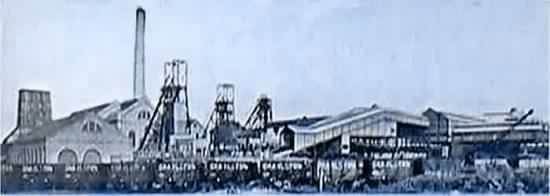
Walton Colliery Disaster.
Explosion 22nd. April 1959.
I'm indebted to Joe Stocks for sending me the Mines Department report by
Report by T.A. Rogers, C.B.E.
H.M. Chief Inspector of Mines And Quarries.
It is the only source of information used on this web page.
Contents
The Accident.
An explosion of firedamp, initiated by an electric arc from the damaged trailing cable of a coal-cutting machine.
The explosion was propagated to some extent by coal dust.
Five men were killed.
Lawrence Coe, aged 38, Overman.
William Hudson, aged 46, Machine man.
Jack Rothery, aged 54, Belt maintenance man.
Charles Ray, aged 53, Belt maintenance man.
Wilfred Wardle, aged 38, Machine man.
Injured.
Jack Williams, aged 43, Drifter.
Inquiry.
At Wakefield Town Hall, from 29th. June 1959, to 3rd. July 1959. Then again from 4th. To 12th. August.
52 witnesses gave evidence.
Parties present included: -
The Ministry of Power by Mr. H.J. Perrins, O.B.E., H.M Divisional Inspector of Mines and Quarries.
The National Coal Board, by Mr. C.M.H. Glover, solicitor.
The National Union of Mineworkers by Mr. J.R.A. Machen, President, Yorkshire Area.
The National Association of Colliery Overmen, Deputies and Shotfirers by Mr. E. Lockett, Secretary, Yorkshire Area.
The National Association of Colliery Managers and the British Association of Colliery Management by Mr. A. Maurice Smith, Solicitor.
Contents
Walton Colliery Description.
Formerly known as Sharlston West, a safety lamp mine situated near Wakefield in the West Riding of Yorkshire.
Colliery Employed.
1,285 men underground.
298 on the surface.
Daily output 2,200 tons.
About half of the output was from the Top Haigh Moor Seam.
Seams.
Top Haigh Moor.
Low Haigh Moor.
Kent Thick.
Birkwood or Lidgett.
The colliery owned by the National Coal Board and situated in the No. 7 (Wakefield) Area of the Boards North Eastern Division.
Manager was Mr. G.S. Senior.
Under-managers, two. One Mr. H.H. Gregg had responsibilities that included the Top Haigh Moor seam were the explosion occurred.
Group Manager was Mr. T. Dodd.
Area General Manager was Mr. H. Saul.
The 10 East District was in the Top Haigh Moor seam on the East side of the South West haulage road connecting the No.2 shaft to the Haw Park shaft.
The Haigh Moor seam appears as two leaves, about 3 feet thick each.
Only the upper, or Top Haigh Moor seam was worked in the 10 East District.
A 7 feet thick band of hard fireclay separates the two coals.
A thick bed of strong sandstone overlies the Top Hard Moor seam.
The depth from the surface where the accident occurred was about 460 yards.
Faults had been encountered in 10 East District in 1955. Further development there was by way of driving two roads 22 yards apart through the faulted area.
A Longwall face, 10 East 1's, was then developed, it was 40 yards long. It advanced to the boundary; it stopped on the 23rd. July 1958 leaving solid coal on each side.
Then two faces were worked, north and south, from this development. 10 East 2's, the first face, was stopped at faults in February 1959. At the time of the accident its old loader gate was being continued as a stone drift, known as 2's Drift, through the faults.
The drift was intended to form part of a new main return airway for 10 East District.
Coal to the south of 10 East Trunk Conveyor Road was intended to be worked by a double unit Longwall face about 280 yards long, advancing to the south.
The second face worked from 1's development was taken about 20 yards wide for a distance of about 40 yards to the south.
The western side of the new development was then to be worked as a face 40 yards wide and advanced for about 100 yards to the west to connect with a heading known as 5' New Loader Gate, which was simultaneously driven to the south from a point further outbye on 10 East Trunk Conveyor Road.
At the time of the explosion the 40 yards face, 5's Unit, had advanced about 97 yards.
A small further advance would have been made in a few days but for the explosion. This would have brought it to a position where it could have been stopped to await the connection with the New Loader Gate.
At the right (north) end of the working face the roof was ripped to form a road 12 wide by 8 feet high supported by steel arch girders.
This road, 5's Intake Gate was intended to become the return airway for the right (western) unit of the 280-yard face when it was finally developed.
It was connected to 10 East Trunk Conveyor Road by 5's Intake Slit, a passage about 37 feet long.
At the left (south) end of the 40-yard face, a passageway (5's Ribside), of seam height and about 12 feet wide was being left so it could eventually become the left side of the main Longwall face to the south. The passageway was formed by the coal and by a pack about 12 feet wide; at the outbye end of this pack a gap of about 9 yards long was left, affording access to the waste, which had not been closed but in which thin slabs of stone had fallen from time to time.
A bottom loading belt conveyor carried coal from 5's Face to a conveyor on 5's Belt (or return) Gate. This conveyor loaded on to the 10 East Trunk Conveyor at the same transfer point as the stone loading conveyor from 2's Drift.
Ventilation.
Air entered 10 East District from the South West Haulage Road; partly along 10 East Main Haulage Road and partly from a second source some 400 yards nearer to the Haw Park Shaft.
These two air currents joined inbye at the Loading Point and then took the course to and from 5's Unit.
This course was on conventional lines, but because of heavy leakage losses beyond the Loading Point only a small proportion of the 12,000 to 16,000 cubic feet per of air per minute available there reached the face of 5's Unit.
A few days before the accident, a direct connection had been made by means of a scour driven through the waste between 5's Intake and 5's Return but sheets had been erected to prevent short circuit of the ventilation there.
Contents
The Day of the Explosion.
The coal on 5's Unit was undercut by an electrically driven coal cutting machine, blasted and hand loaded on to the face conveyor.
Coal was filled on the morning and afternoon shifts; The Intake gate ripping was advanced on the afternoon and night shifts. The stone pack on the Ribside was advanced on the night shift with stone from the Intake ripping.
It had been difficult to achieve two cuts in 24 hours, in order to maintain work in the break of 12.30 to 1.30p.m. (between the day and afternoon shifts), two coal cutting machine men and an overman worked a supplementary shift from 8.00a.m. to 3.30a.m.
On the afternoon shift of 21st. April 1959, the day before the explosion, coal was filled and 5's Intake Gate ripping was advanced.
On the night shift some colliers were employed in squaring out the right hand corner of the face. The Intake Gate rippers were deployed to the new connection where about 12 shots were fired in the stone, thus enlarging the holing.
On the day of the explosion, the morning shift filled loose coal left by the afternoon shift and from shots fired in each corner of the face.
Three men spent their shift transporting stone in a small tub from the new connection to the intake roadhead where it was put into the roadside pack.
At about 10.a.m. the coal cutting machine operators of the supplementary shift (W. Hudson and W. Wardle) arrived and began to turn the machine round at the left corner of the face.
While doing this the machine struck and displaced the tension end of the Ribside conveyor, so it had to be stopped.
The driving head of the face conveyor was advanced and the tension end of the Ribside conveyor moved but the coal cutting machine could still not be worked because its jib had become fast in the undercut.
A shot was fired (between 11.0 and 11.30a.m.) over the jib to release it. The machine was turned, jibbed in and cut about 10 feet to a stump of coal that required to be filled off.
The tension end of the Ribside conveyor was placed in its proper position. Both conveyors were re-started and the coal cutting machine trailing cable was disconnected and rethreaded into the new cutter track.
No electrical trouble was experienced with the face equipment during the day shift.
By 12.30 p.m. the day shift had left the face, two conveyor attendants, J. Rothery and C.E. Ray remained to assist the men on the supplementary shift.
On his way out the day shift deputy, F. Canham, saw J. Williams, a drifter employed in 2's Drift, eating his snap at 2's transfer point. He asked Williams to keep an eye on the two conveyors until the afternoon shift arrived.
Five men were actually left in 5's Unit, L.E. Coe (overman), W. Hudson, W. Wardle, J. Rothery and C.E. Ray; J. Williams was just outside it.
There were no eye witnesses to say what happened during the next half hour.
The five men in 5's Unit were killed and J. Williams remembered little.
Contents
The Explosion.
At about 1.00 p.m. the lights went out at 10's East Loading Point, the conveyor stopped and three men working there felt a rush of air and dust from inbye.
One of them, T. Furlong telephoned to the top of 10 East Main Haulage Road asking for the deputies to be sent back; he also phoned the overman, Cunningham, saying he thought there had been an explosion.
He then opened the switch controlling the supply of power inbye of the Loading Point and, with his two workmates went inbye, but returned after making an unsuccessful attempt to enter 5's Unit.
Canham and another day shift deputy, H. Towler, who had reached the top of 10 East Main Haulage Road, went back into the district.
On their way they met Williams making his way out; he told them he had been bowled over and thought there had been an explosion.
Towler isolated the gate-end switches near 2's Transfer Point, then with Canham tried to enter 5's Unit by the Intake Slit. They were unable to go beyond the slit because of fouled air.
Two afternoon shift deputies, J. Wilsher, and J. Bedford, also attempted to go up the Intake Gate, but Wilsher's lamp went out after he had travelled about 15 yards.
The under-manager, H.H. Gregg: had been with Cunningham when Furlong phoned, they went inbye after Gregg had informed the surface electricians (at approximately 1.10 p.m.) that there had been a power failure in 10 East District.
On reaching the top of 10 East Main Haulage Road, Gregg learned that Williams had been injured and concluded that there had been an explosion in 2' Drift, where Williams normally worked. He telephoned the manager (at about 1.25 p.m.) and asked for ambulances and stretcher parties to be made available.
When he reached 5's Intake Slit, Gregg saw that the belt had had been blown off the Trunk conveyor for a distance of some 50 yards and there was every sign of an explosion having occurred in 5's Unit.
He arranged for a message to this effect to be sent to the surface. At this stage Wakefield Central Rescue Station was called for assistance.
The Rescue Station received the call at about 2.00 p.m. A team left at once.
Contents
Rescue and Recovery.
Gregg with others entered 5's Return Gate and travelled to the ripping lip without difficulty.
When he attempted to go under the lip his lamp went out and he withdrew.
Gregg ordered the restoration of brattice sheets in 10's East Trunk Conveyor Road and in the new connection.
He and others attempted to enter 5's Unit by the Intake Gate. This failed because of the fouled air.
By 2.50 p.m. a fresh air base had been established at the entrance to 5's Intake Slit.
From here rescue men (using breathing apparatus) explored the Unit via 5's Intake.
They soon found the bodies of four men.
While attempting to travel down the Ribside they encountered a fall and returned to the fresh air base.
They then inspected 5's Return Gate and found the fifth body.
All bodies were recovered.
The clothing of each body was searched for contraband by a police officer, on arrival at the surface and later at Wakefield City Mortuary.
None was found.
A series of "bumps" was heard at about 7.50 p.m. this suggested further explosions may have been occurring in 5's Unit.
This news was phoned to the surface, after a conference it was decided to withdraw the fresh air base to 10 East Loading Point as there was no point in risking further loss of life.
At about 10.50 p.m. it was decided to seal off 5's Unit to limit the spread of any further explosion.
Hourly samples were taken from the air returning from the district as the stopping was being constructed.
The samples showed steadily decreasing quantities of explosion products, so the seals were not completed.
Two H.M. Inspectors, Mr. W.M. Cumpsty and Mr. T.W. English, made a preliminary inspection on the 24th April, accompanied by the manager and Mr. A. Wright, the Divisional Mining Operations Engineer of the National Coal Board.
They entered the affected area via the intake stopping; the inspection showed there was no risk of a further explosion.
The stoppings were removed, the ventilation restored and the Unit left over the weekend for any remaining explosive products to clear.
During these operations a partly smoked cigarette was found in the canary cage that was being carried by the rescue team. Mr. Rogers thought the cigarette had been accidentally introduced on the surface where the birds were kept in a room to which many people had access.
Contents
Circumstances of the Explosion.
There was no indication of great violence in 5's Unit. Charles Ray (his body was found at 5's Return Gate ripping lip) was the furthest away from 5's face. He was the only one who suffered violent injuries.
The other four men died from carbon monoxide poisoning.
Asphyxia due to the inhalation of coal dust accelerated the deaths of Wilfred Wardle and Lawrence Coe.
All the dead men had sustained burns; these alone would not have been fatal.
Physical damage was confined mainly to the displacement of roof supports and disturbance of conveyor belts.
Supports in 5's Intake were undisturbed except for two props, which appeared to have been blown out from under the ripping lip.
A flame safety lamp, identified later as issued to Coe, was hanging undamaged 5 about yards from the ripping lip.
Face supports, wooden props and bars, were displaced between the Intake roadhead and a point about 10 yards from the Ribside. Apart from some chocks, which had partially collapsed, the waste edge supports were standing.
Farther outbye on the Ribside, supports had been dislodged; about 55 yards from the face there had been a heavy roof fall (estimated as 3½ feet above the seam) that extended for a distance of 37 yards.
The bottom layer of this fall was a panel of sandstone about 9 to 12 inches thick. The ends of the panel were covered with explosive dust indicating it fell before the dust had settled.
Outbye of the fall most of the Ribside supports had been dislodged and the conveyor head had been disturbed.
In 5's Return the top belt of the conveyor had been broken and brattice sheets in the new connection between 5' Return and 5's Intake, had been blown down.
Outbye of the Intake Slit there were few signs of violence.
The brattice sheets in 10 East Trunk Conveyor Road had been affected and the top belt of the conveyor had been displaced towards the side of the road remote from the Intake Slit.
In 2's Unit the blast slightly injured Williams who was a few yards inbye of 2's Transfer Point; a few yards farther inbye some paper, cloth and a tin seemed to have been blown away from 5's Unit.
In the connection between 2's Intake and 2's Return the door nearer the Intake could not be closed properly; some sandbags round the frame of each door had been dislodged towards 2's Return.
Contents
Evidence of Flame Travel.
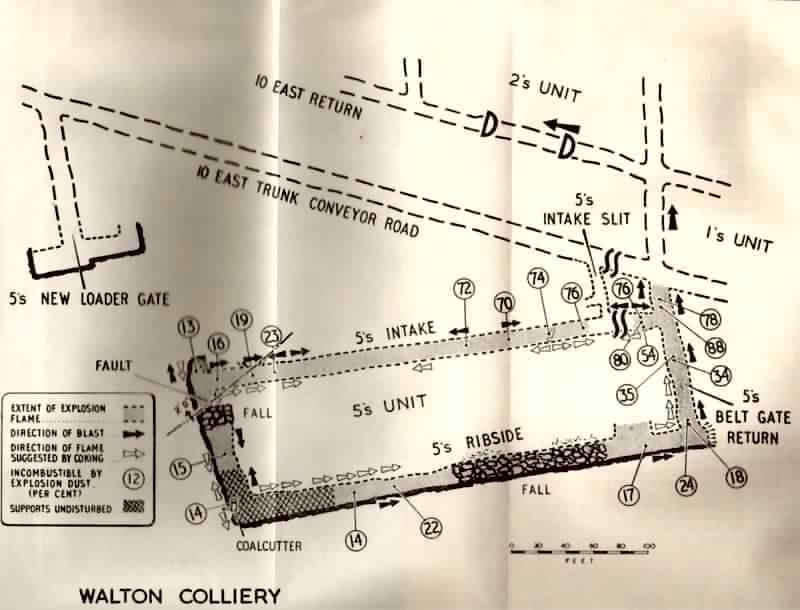
Charred material and signs of coking suggested the flame had traversed all accessible parts of 5's Unit, apart from a zone 3 to 4 yards on either side of the Slit on 5's Intake.
Laboratory examinations of some 200 specimens of explosive dust, and material likely to indicate exposure to flame, confirmed this.
Origin.
The zone of standing props at the return end of 5's face and in the Ribside, together with the indications of blast and deposition of coke convinced Mr. Rogers that the explosion originated somewhere in that zone.
The Igniting Agent.
Mr. Rogers had no hesitation in eliminating most of the known igniting agents.
Contraband.
Careful inspection of the affected area and search of the clothing of the men who were killed; showed no contraband was involved.
Cap Lamps.
Cap lamps found in the area were in good order. Except for two, which the explosion had clearly damaged.
Shotfiring.
Shotfiring was not in progress when the explosion occurred. Exploders were all in "approved" condition except for from damage caused by the explosion.
Heating.
There were no signs of heating on the face or the ribside conveyor machinery, nor at a leak found on a compressed air hose in 5's Intake.
Incendive Sparking.
There were no indications that incendive sparking had occurred as a result of rock movement.
Electro-Static Sparking.
A sample of conveyor was found to be anti-static. Mr. Rogers excluded electro-static sparking as a source of ignition.
Frictional Sparking.
Frictional sparking from coal cutting machine picks was a possibility, the Top Haigh Moor seam contains occasional streaks of pyritic nature near the floor.
Such sparking was not produced in the undercut when the coal-cutting machine was made to cut into some of these pyritic intrusions.
This was ruled out as a possible igniting agent.
Contents
Electrical Equipment.
Except for the gate-end switch and a trailing cable, the signalling apparatus and electrical equipment in and near 5's Unit was found to be well maintained and in safe condition.
The gate end switch was situated opposite the entrance to 5's New Loader Gate drivage; 11 of the 12 cover plate screws were loose and the flange gap at one corner of the cover plate was 0.083 inch, well above the permissible flameproof gap of 0.02 inch.
The enclosure of this switch was tested in firedamp in this condition and was found not to be flameproof.
It was however well outside the explosion area and could not have been the igniting agent.
Coal cutter trailing cable.
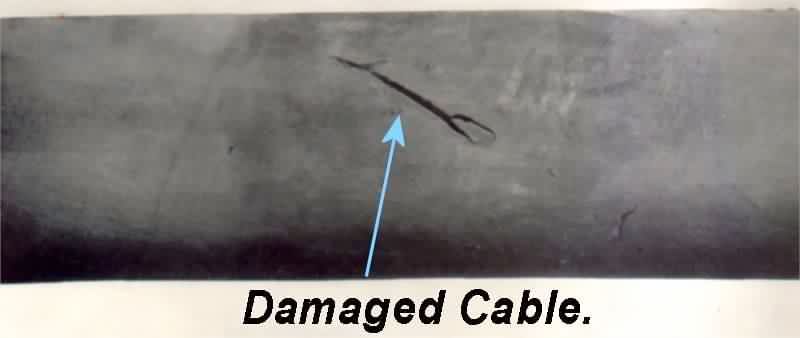
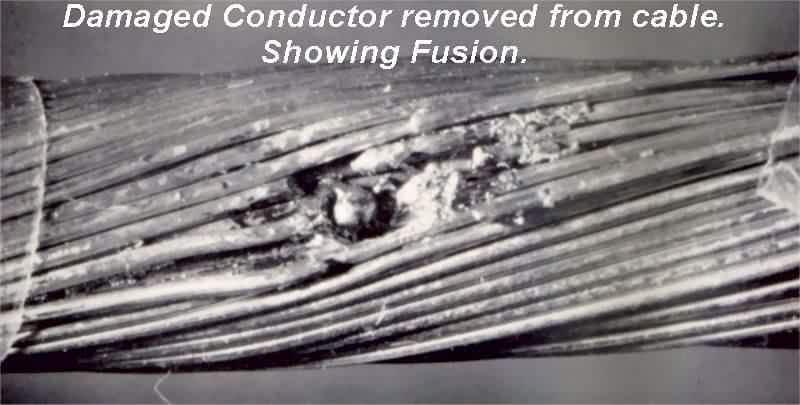
The trailing cable that supplied the coal-cutting machine was examined closely and found to have a superficial cut at about 11 feet, and a deep cut about one inch long at about 21 feet from the machine end.
The damaged cable was carefully dissected.
Beneath the cut, and between the outer sheath and the screened conductors, there was a patch of white powder. This was later to be shown to be similar in composition to the rock of the roof.
There had been severe arcing between a power conductor and its earthed screen; the wires of both showed signs of fusing and there were indications of heating on the inside of the cut in the sheath.
Mr. Rogers concluded that the arcing occurred at the time of the explosion, there was no electrical defect except the damaged cable to account for the tripping of the earth leakage protective devices, which occurred simultaneously with the explosion.
Such an arc could have ignited firedamp.
There was evidence that at the time of the explosion the cable was partly coiled up near the coal-cutting machine, so the damaged part was well within the area that Mr. Rogers concluded the explosion began.
The control wheel on the cutter was found to be in the "check" position (rotated sufficiently back from the "on" position to open the remote control contacts at the gate-end switch and make dead the power conductors of the trailing cable).
This fact did not rule out the damaged cable as an igniting agent: had an arc occurred the machine operator could easily and instinctively have the control wheel the small amount required to reach the "check" position.
Mr. Rogers concluded that arcing from the damaged cable was the igniting agent.
Contents
Cause of Damage to the Cable.
Suggestions.
(i) By an accidental blow from a hand pick.
(ii) By a broken wire in the coal cutter haulage rope.
(iii) By a stone, possibly one projected by shotfiring.
After examinations Mr. Rogers concluded that the last hypothesis was the most probable. Although it was impossible to say how or when the damage occurred.
Intervals of a few hours to a day before the explosion was suggested, but the period may have been longer.
A contact made between the conductor and its screen while the cable was "dead" could have been broken by the resilience of the insulating material.
The breakdown at the point of damaged insulation could occur much later.
Contents
Nature of the Fuel.
Mr. Roger's conclusion was that the explosion was one based on the joint contribution of gas and coal dust.
It began when an arc from a damaged trailing cable ignited firedamp near the left corner of 5's Face.
The resulting flame raised dust into the air as it travelled along the working face and down the Ribside. Flame and coal dust were projected from the face into 5's Intake. Probably finding additional fuel at the roadhead.
At the same time the explosive force travelling down the Ribside raised and ignited coal dust there and continued the explosion into the Return Gate.
The Amount of Gas.
The total volume of flame, which traversed the face, was calculated to be about 50,000 cubic feet, which could have resulted from the ignition of some 17,000 cubic feet of a 7 percent mixture of gas and air.
This would in turn have represented 1,200 cubic feet of methane.
As the most likely explanation of the development of the explosion is that both gas and coal dust were involved, the quantity of gas required would be considerably less than this.
How much less is speculation?
Source of Gas.
Mr. Roger's concluded that methane did not come from the hard sandstone roof. The only other possible source was the underlying Low Haigh Moor Seam.
An emission would be most likely to result from the formation of suitable channels in the fireclay separating the two seams.
In a post explosion examination one of the H.M. Inspectors, W.H.N. Carter, found a break in the floor along the Ribside.
Mr. Roger's considered there were probably similar breaks in the inaccessible waste.
In his view these breaks were the result of the perimeter of 5's Unit excavation being subjected to increased pressure from its overlying strata. This pressure developed because the thick sandstone bed above the seam supported the load on the 40-yard wide excavation substantially without breakage and transmitted that load to the perimeter of the excavation.
In these conditions the fireclay bed would "heave" a little and fracture.
The methane was likely to be emitted from these breaks in the waste and carried by the leakage currents to the lower end of the Ribside where it could have taken part in the explosion.
Gas on the face came from the downthrow fault of 2 feet or so, which had been exposed in the right hand corned. This fault was a line of inherent weakness, which would predispose the formation of an open break along its plane by the forces described earlier.
The ventilation would carry any emission of gas from the floor at this fault forward. Some through the waste and some towards the point of ignition.
The view of Mr. Rogers was that all the emissions were heavy seepages rather than a sudden outburst, since the weak ventilation diluted the total emission to a concentration not greatly above the lower limit of inflammability.
Shortly after the explosion a heavy concentration of firedamp was found to have accumulated in the inbye half of 5's Intake Gate, towards the highest point in the Unit.
This considerable volume of gas must have been released after the explosion. It was considered this gas came from floor breaks at the fault and elsewhere and aggravated by strata movement due to displaced supports.
The "bumps" heard after the explosion were, in Mr. Rogers view, noises caused by strata movement.
Contents
The Standard of Ventilation.
The ventilation of 10 East District inbye the Loading Point had nothing to commend it. Air measurements taken on 6th. and 8th. May by J. Carver ( H.M. Inspector), showed serious ventilation losses beyond the Loading Point.
The 6th. May measurements were in conditions approximately close to those at the time of the explosion, though it was impossible to reproduce those conditions.
A quantity of 12,165 cubic feet per minute was measured 300 yards outbye of the Intake Slit.
Only 2,240 cubic feet per minute reached a point on 5's Intake 10 yards inbye the intake slit.
10 yards back from 5's Face the quantity was further reduced to 1,580 cubic feet per minute.
The loss, shown by chemical smoke cloud tests, was caused by air leaking through the left-hand roadside pack into the waste.
On 5's Face from the intake end, smoke tests showed air was coursing down the waste, this leakage became less marked as the ribside pack was approached. In the waste immediately adjoining the pack the air was stagnant.
On the face, air velocity in the restricted area over the coal-cutting machine was estimated to be 22.5 feet per minute. In the left corner the air quantity was too small to measure.
Towards the outbye end of the Ribside there was a gap 9 yards long in the packing, through this gap at least 825 cubic feet of air per minute was passing.
Tests on the 8th. May showed different results because the pack had been filled in. But they confirmed that losses of the same kind were still occurring and that the air current in the left hand corner of the face was so slow as to be "indeterminate".
These conditions were the result of widely distributed defects in planning and execution which in Mr. Rogers view arose from a failure to appreciate fully some elementary, but fundamental considerations.
Reasons for this view.
Immediately outbye 5's Unit for about 280 yards there was severe leakage from intake to return of some 50 percent of the air.
The leakage had been known of since early March 1958, and its extent had been measured by the safety officer, K. Staples, in January 1959.
The roadside packs of 1's Unit were built with rock ripped down from the hard sandstone roof. The material was excellent as a roof support but much less from a ventilation point of view.
There would have very little small stone to fill up the joints and make the packs reasonably airtight.
The strong roof of the old 1's Face(the 40-yard width of which had been settled largely by surface support considerations) would be unlikely to consolidate the packs or to fall in the waste.
These conditions were bound to allow considerable leakage.
Section 59 of the Mine and Quarries Act, 1954, makes it unlawful to use roads as intake and return airways unless there had been taken such steps as are necessary to minimise the leakage of air between them.
At the time of the explosion the relevant length of the two roads concerned lat within 450 feet of a working face and so was outside the scope of the section, though this had not always been the case.
There is room for argument as to what steps are "necessary" if the quantity of air arriving at the end of a road is adequate for ventilation purposes.
The management was attempting to meet the situation by driving a new return airway (2's Drift).
Notwithstanding this loss of air the quantity reaching Intake Slit might still have been satisfactory for the ventilation of 5's Unit had there been no further loss.
However the layout was such as to encourage leakages.
The Intake Slit was low and narrow, the cross sectional area at its smallest part was only about 10 square feet.
This small passage, 37 feet long, was bound to restrict the flow of air through it to some extent and so cause more air to leak into the return at 2's Transfer Point.
Steps taken to minimise this leakage could have been more effective. Two brattice sheets must have allowed a considerable amount.
A rule made in 1947 by the North Eastern Division of the National Coal Board said:
"Ventilation must be diverted or regulated by doors at least in duplicate. Brattice sheets must not be used as a means of diverting or regulating main air currents, but should only be used for hurdle sheets and for ventilating fast corners".
Carver's measurements inbye of the Intake Slit illustrated further defects some of which were a reproduction of those found when 1's Face, also 40 yards wide, was being worked.
An additional source of leakage came into being on the Friday before the explosion when a backward extension of 5's Intake holed through into 5's Return, providing another route by which the ventilation of 5's Unit could short-circuit.
This connection was necessary for the ultimate development of the double unit longwall face, but evidence did not convince Mr. Rogers it was necessary to have it at that stage.
When made it was closed with brattice sheets, weight of evidence suggesting two sheets were provided. Whatever their number they could not have prevented serious leakage at that point to the detriment of the quantity of air reaching 5's Face.
This leakage would have been increased by traffic through the sheets. There was evidence that on the morning shift before the explosion some 20 small tubs of stone were taken through the sheets, since the empty tubs had to pass through in the reverse direction, the number of disturbances due to this cause alone would be about 40.
Leakage through the left pack of the Intake Gate should have been expected from previous experience, though not necessarily in degree.
The gap in the Ribside pack would intensify this leakage and cause some of the air reaching the roadhead to short circuit round the pack into the waste. The gap had existed throughout the life of the face, Mr. Rogers was surprised to be told of two sets of statutory air measurements made on 28th. February and 28th. March 1959, which purported to show that the amount of air reaching the left hand corner corresponded almost exactly with the amount leaving the intake roadhead.
Contents
Firedamp Detectors.
There was no firedamp detector near the coal-cutting machine at the time of the explosion. Furthermore Coe's lamp was found in 5's Intake and was thus not under observation.
Had it been at the machine it might easily have been seen to indicate the presence of gas in time to avert the consequences.
In the pit as a whole, some 104 flame lamps were issued daily and more were available in the stores.
Mr. Machen (National Union of Mineworkers President, Yorkshire Area.
) criticised the management for not doing enough in relation to Regulation 11 of the Ventilation Regulations to induce men to learn to use flame safety lamps as firedamp detectors, and afterwards to carry and use them as such.
On the other hand there was evidence that workmen considered these flame lamps to be unsuitable and would not readily undertake to carry them.
It was said this was a national problem.
Recommendations of the Bryan Committee.(referred to by Mr. Rogers).
"We are perturbed by the number of incidents in which firedamp detectors have not been used or even carried by the workmen in the requisite numbers as required by the Ventilation Regulations. A new and powerful campaign at colliery level should be initiated through the consultative machinery and in conjunction with the local union officials to obtain the co-operation of workmen in carrying out in full the requirements of the Regulations. We consider that the effectiveness of providing these firedamp detectors can be appreciably improved either by issue of relighter lamps on a more liberal scale or else by ensuring a sufficiency o f underground relighter stations. This would eliminate the risk that lamps once extinguished remain unlighted throughout the shift or alternatively the necessity of taking in spare lamps or sending lamps to bank for relighting".
Contents
Precautions Against Coal Dust.
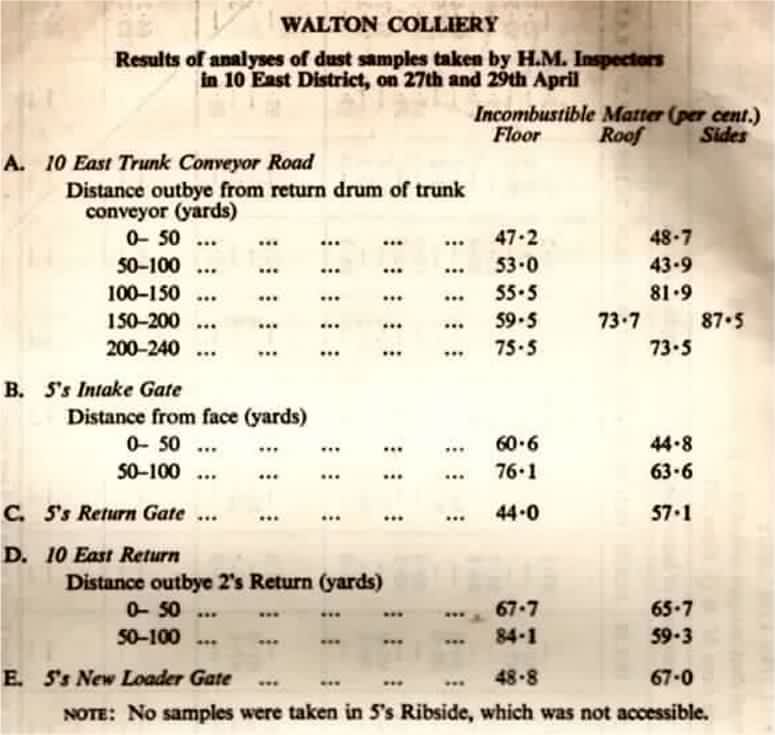
The Top Haigh Moor Seam contained 35.9 percent of volatile matter and accordingly the Coal and Other Mines (Precautions against Inflammable Dust) Regulations, 1956, required roadway dust to contain a minimum of 75 percent of incombustible matter.
10 East District.
The last interval between samples was 5 days more than the 30 allowed by law, the road had been sampled 12 times in just over 11 months. The last set of samples had been collected 14 days before the explosion. Six samples had been collected on each sampling occasion on 10 East Haulage and Trunk Conveyor Roads. Two more would have been necessary to reach the rate of 10 samples per mile required by law.
Only one sample of the 72 collected contained less than 75 percent of incombustible matter.
5's Return Gate.
Two samples had been collected in 5's Return Gate on 8th. April, although this road had a length less than the 150 feet at which sampling becomes obligatory.
The roof and sides sample contained 79.2 percent of incombustible matter but the floor sample only 66.3 percent.
However the explosion died out in this road for lack of fuel.
5's Intake Gate.
Two samples had also been collected in 5's Intake Gate on the 8th. April. When after the explosion, the results of analysis were received, the roof and sides sample contained 93.9 percent and the floor sample 81.2 percent of incombustible matter.
Twenty-three dust samples were collected by Mr. R. Lawrence (H.M. Inspector), on the 27th. and 29th. April.
The results of analysis cannot be directly related to pre-explosion conditions but the general picture is that the incombustible dust content was substantially lower than that shown by the samples collected before the explosion.
There was evidence that the coal conveyors in the effected area had not been well maintained. On 10's East trunk conveyor there was found after the explosion, spillage so excessive as to prevent a large number of rollers from turning.
Pre-explosion conditions would not have been much different. The evidence indicated that there was little coal on the conveyors before the explosion occurred.
This conveyor also carried stone from 2's Drift so some of the spillage might have been stone.
The bottom belt conveyors on the Return end on the Ribside were not supported anywhere on rollers; the bottom belts ran on the floor. They had run in the same track for a considerable time during which the grinding effect of the bottom belt on coal spillage must have produced a great deal of fine dust and from that point of view the equipment was unsuitable.
With any type of conveyor it is difficult to maintain a coal transport road in a state that will guarantee immunity at all times from the coal dust explosion hazard.
For this reason it is regarded as sound practice to provide stone dust barriers as a second line of defence.
A National Coal Board instruction on the subject of stone dust barriers, dated 1st. September 1953, was read out at the Inquiry. The purpose of this instruction was to make the provision of dust barriers obligatory in mines owned by the Board.
This document required the provision of at least one barrier outside 5's Unit.
There were no barriers in the district and it is extremely fortunate that the explosion flame was confined to the area of 5's Unit.
There were arguments at the Inquiry as to whether 5's Ribside was a face or a road. Mr. Rogers considered it unnecessary to attempt to settle the legal argument; as a mining engineer he regards such a place as a standing face but, in the circumstances, a place even more dangerous than a conveyor roadway from the coal dust explosion point of view.
Airborne dust endangers health as well as increasing the potential explosion risk.
Dust suppression measures were not being taken in the working coal, though there was a water spray at 2's Transfer Point.
Mr. Rogers regarded their absence as regrettable even though sampling by thermal precipitator indicated that dust conditions were well below the limit currently regarded as satisfactory.
In his view dry cutting should be avoided as a matter of course. Wet cutting would have the additional advantage of reducing the likelihood of incendive sparks from pyritic intrusions in the cutting horizon.
Contents
Electrical Matters.
Notice of Intention to introduce Electricity.
The last occasion on which, in pursuance of regulation 2 of the Coal and Other Mines (Electricity) Regulations, 1956, the management gave notice of intention to introduce electricity into workings in the Haigh Moor Seam in 1954.
That notice related to the use of electricity on the South West Haulage Road and no specific notice was subsequently given in respect of its extension into 1's, 2's, or 5's Units.
It was unlikely that any objections would have been made to the introduction of electricity into 1's or 2's Units.
It might have been otherwise in the case of 5's Unit because of the obvious weakness in the ventilation arrangements.
Before 1957 notice of intention to introduce electricity underground was required in respect of any "ventilating district" but the comparable provision in Regulation 2 of the present (at the time of the explosion) regulations relates to its introduction into "any part of the mine".
Neither expression is free from ambiguity, and it is difficult to say exactly when notice is required by law as it stands.
In Mr. Rogers opinion it would not be possible to devise a regulation defining precisely the circumstances in which notice should be given, but it is important that H.M. Inspectors should know when any substantial extension is to be made in the use of electricity at a mine. What is "substantial" depends on local circumstances.
Trailing Cables.
The trailing cable was "type 14 of British Standard 708", widely used in British mines.
Each power conductor has a protective earthed screen. Earthed screens and associated earth-leakage protection devices, in this case the core balance type, offer protection against the risk of electric shock, but not necessarily against the ignition of firedamp by an arc, should an electrical fault develop as the result, for example, of physical damage to the cable.
The provision of this latter protection is a long-standing problem.
However rapidly a protection device operates there will still be a time lag in the physical opening of the circuit breaker. In that time incendive sparking or arcing may occur.
It may be possible to reduce the danger by employing a protective system in which earth fault currents are restricted. At least one system employing this principle is already in use in this country.
Another approach lies in the development of reliable firedamp monitoring equipment. Such equipment could be incorporated in the face machinery and arranged to cut off the power supply at the gate end switch in the event of the detection of a firedamp content greater than some pre-determined level.
Contents
Management at the Colliery.
General.
Evidence was give on matters (including alleged contraventions of the law) designed to illustrate the general standard of management at the colliery.
A number of these matters did not appear to have sufficient bearing on the circumstances of the explosion to justify Mr. Rogers dealing with them in this report.
Changes in Staff.
Mr. G.S. Senior, manager at the time of the explosion, bears general responsibility for many of the unsatisfactory features which existed in the workings of 10 East District.
Mr. Rogers had sympathy with him to some extent in the position in which he found himself. He had taken charge of this large mine about 11 weeks before the explosion in the temporary absence of the regular manager.
It would take him some time to get a firm grip on his new responsibilities and in that time he would depend more than normal on his under-managers and other officials.
At the time of his appointment, the 40-yard face of 5's Unit was just about to start and at that time he would not have been acting unreasonably in treating the general ventilation conditions in 10 East District as satisfactory since the ventilation records did not show any significant quantities of firedamp.
The ventilation difficulties must have become more pronounced as the Unit developed and the under-officials directly responsible for 5's should have appreciated this.
Unfortunately there was another change of management staff just after the 40-yard face began; the under-manager A.S. Harris, who had seen the starting of the Unit, was transferred to another mine on the 21st. February, three weeks after the manager had been changed.
Harris had clearly been concerned about air leakage when gas was found near a fault in 2's and he asked Staples to make the measurements in 10 East District.
In respect of 5's development Harris said in effect that he expected some leakage between the intake and return as 5's face advanced, but thought that this could be tolerated as he had about 5,000 cubic feet of air per minute at the Intake Slit.
He would, presumably, not know that another connection would be made between 5's Intake Gate and the Return before the proposed connection with the New Loaded Gate, nor have foreseen that a gap would be left in the Ribside pack as this omission apparently occurred just about the time he was succeeded by Gregg.
Virtually simultaneous changes of manager and under-manager may sometimes be inevitable but are generally very undesirable from a safety point of view.
Contents
Deputies Duties.
Plenty of deputies were employed in 10 East, more than enough to carry out the basic statutory duties, but they were neither well organised nor well controlled.
Thus the manager did not satisfy Mr. Rogers that he had discharged effectively his duty to assign to the deputies their respective districts and to fix meeting stations with the required identification marks.
As a result of this omission some deputies regarded the pit bottom as their meeting station, while others thought that their district began at the entrance to 10's East Main Haulage Road.
Certain deputies, and some at least of their superior officials, lacked a proper appreciation of the statutory responsibilities.
There were failures to carry out the statutory requirements in relation to inspections and reports.
An afternoon shift deputy, for example, commenced his pre-shift inspection four hours before the night shift was due to enter the district instead of the statutory two hours.
In other cases, statutory reports were written by deputies other than the one who had made the inspection.
These disclosures were very disturbing. In particular, the irregularities in inspection times cannot be regarded as technicalities.
It is possible for conditions in a district to vary quite suddenly and unexpectedly and the whole purpose of a pre-shift inspection is to make as certain as possible that a district is safe for men to enter.
The statutory interval of two hours allows reasonable time for a deputy to inspect his district and brings the inspection reasonably close to the time of entry of the following shift; to double the interval quite arbitrarily was an irresponsible action.
In this matter the superior officials, to say the least, were far from alert.
The time worked by the afternoon shift deputy was such that had the pre-shift inspection in fact been made at the times entered in the statutory report books, he would have had to work overtime unless some other deputy had been sent to do it.
The overman concerned would be bound to know that the deputy was not working overtime and I find it difficult to believe that they did not know what was going on, even though one of them admitted that he did not examine the statutory reports made by the deputy in question.
The manager did not see the originals of reports made by deputies, but he regularly saw the daily summaries of them, which the law allows, as an alternative, and these summaries were also seen occasionally by the under-manager.
The summaries showed the times entered by deputies for their pre-shift inspections, and it should have been seen quite readily that those times were not consistent with the working hours of the deputies concerned.
A point of general importance.
Before the Mines and Quarries Act, 1954 came into force an under-manager had to read and countersign the deputies' reports daily. But he has now (at the time of the explosion) no obligations corresponding to those imposed on the manager by Section 10 of that Act.
This omission should be remedied.
The system of presenting statutory reports to the manager in the form of summary sheets is a sound one but it is essential for the person preparing them to understand what sort of matters ought to be specially noted.
The discrepancies between shift and inspection times were not brought to the manager's attention. If the person who is to prepare the summaries has not the experience to allow him to recognise unusual matters, he should be given careful instructions on how to perform his duties.
Contents
Summary of Conclusions.
The accident was an explosion of firedamp, initiated at the left hand corner of 5's Face by an electric arc from the damaged trailing cable of a coal-cutting machine.
The explosion was propagated to some extent by coal dust.
The firedamp involved emanated from the Low Haigh Moor Seam some 7 feet below and was emitted fairly rapidly, though not suddenly, from floor breaks mainly at a fault.
The ventilation of 5's Unit did not, by any standards of good practice, allow a sufficient margin of safety.
As the result of defects in short term planning and in execution, there were air leakages so great that the velocity of the air at the left hand corner of the face was not sufficient to deal with any substantial increase in the usual make of firedamp.
In respect of both choice and maintenance of equipment insufficient attention was given to precautions against coal dust in 5's Unit.
Summary of Recommendations.
Ventilation.
The appropriate development plan for a colliery should show particulars of ventilation, including the means to be adopted for ventilating new workings at each stage of their development.
At all levels in the industry there should be energetic efforts to overcome the difficulties which are resulting in workmen being reluctant to carry and use firedamp detectors.
Regulation 7 (5) of the Coal and Other Mines (Ventilation) Regulations 1956, is technically defective and should be amended.
Precautions against Coal Dust.
It should be made obligatory to provide stone dust barriers on coal conveyor roads underground.
Coal cut by machine should be cut "wet".
Electricity.
A further attempt should be made to devise an electrical protective system that will be capable of eliminating, or at least substantially reducing, the dangers of incendive arcing from a damaged trailing cable.
Local arrangements should be made between individual managements and H.M. Inspectors to ensure that notice of intention to introduce electricity is given at appropriate stages in the development of electrical installation.
Statutory Reports.
Under-managers should be given legal responsibilities similar to those imposed on the manager by Section 10 of the Mines and Quarries Act, 1954.
Any information shown in italics has been added by me (B.R).
Contents
View Plan.
View Cable.
View Cable.
View Dust Results.
Photo's Courtesy Joe Stocks.
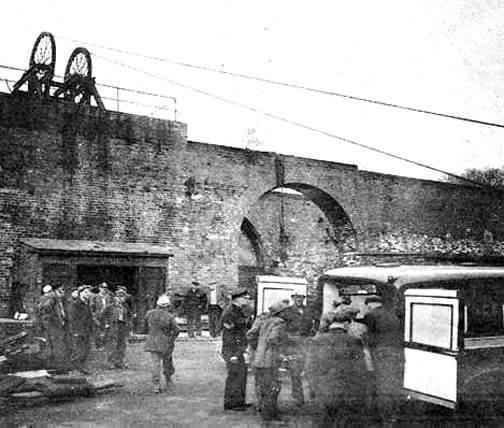
Walton Rescuers.
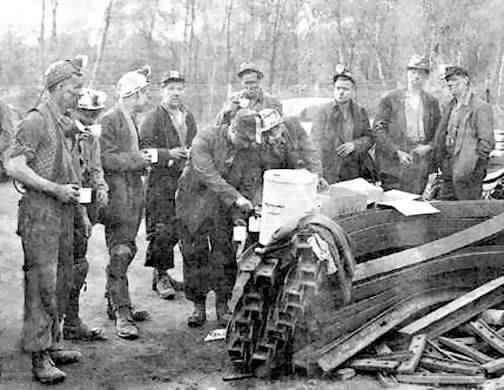
Walton Rescuers.
Contents

|