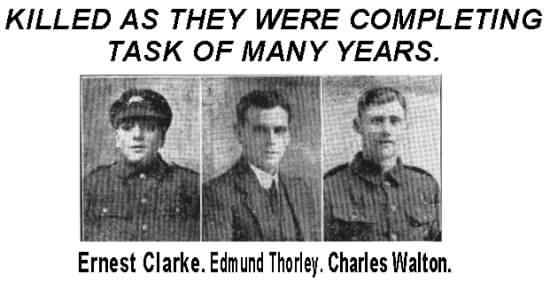
I'm indebted to Keith Parkinson for sending me all the information used on this page. Keith's Grandfather Charles Walton was killed in this accident.
THORNE, COLLIERY, YORKSHIRE.15th. March, 1926.
REPORT
On the Causes of and the Circumstances attending the Shaft Accident which occurred at the No. 2 Shaft, Thorne Colliery, Yorkshire, on 15th March, 1926.
By Major H. M. HUDSPETH, D.S.O., M.C., M.Sc.,
H.M. Divisional Inspector of Mines.
The mine is situated 11 miles N.E. from Doncaster, and is owned by Messrs. Pease and Partners, Ltd.
Developments were commenced as long ago as 1909, and on 22nd. February 1926, sinking operations proper were completed at the No. 2 shaft, in which the accident occurred on Monday 15th. March, at 12.20 p.m., whereby six men lost their lives.
Edmund Thorley,.………...aged 33, occupation, 1st. Chargeman Sinker.
John Hansbury,….……....aged 34, occupation, 2nd. Chargeman Sinker.
John William Barley,…….aged 51, occupation, Sinker.
Charles H. Walton,……...aged 33, occupation, Sinker.
Ernest Clark,………….....aged 26, occupation, Sinker.
John A. Reed,…………...aged 21, occupation, Sinker.
Described briefly, the accident was caused by the breaking of a capstan engine and the consequent precipitation of a sinking scaffold with its supporting ropes to the shaft bottom.
The No. 2 shaft is 21 ft. finished diameter, and has been sunk to a depth of 964 yards, the horizon of the Barnsley seam. At a depth of 863 yards there is an inset at the Kent's Thick or High Hazel seam, in which a connection exists with the No. I shaft. At the time of the accident there was water in the No. 2 shaft to a depth of some 11 ft.
The cement lining of the shaft had been completed, and the sinking scaffold was last in use at a depth of 919 yards for the purpose of removing some temporary sheet steel lining from the inside of the shaft.
The position of the scaffold at the time of the disaster is not exactly known, but when last seen by Messrs. Knox (engineer) and Carter (foreman sinker) at 10 am, on the day of the accident it was 919 yards from the surface. The deceased chargeman (Thorley), had been directed by Carter that the next work to be done from the scaffold was at a point some 15 yards below the High Hazel inset, and it was towards this point that the scaffold was moving immediately prior to the accident. If the distances that the scaffold moved, as estimated by the capstan engine-driver, Ingram, are to be relied upon, the scaffold was some 74 yards above the shaft bottom when it fell.
The scaffold weighed 6 tons, and was supported by two lock- coiled ropes from a double-drum capstan engine fixed 74 ft. 6 in. from the shaft. The ropes led off the top sides of the drums at an angle of 38 degrees to the horizontal, and passed over pulleys fixed at a height of 60 ft. 6 in. from ground level.
The ropes, made by Messrs. Latch and Batchelor, were purchased in February, and put into use on the 24th.July, 1910. They were each 1,035 yards in length, 5 ½ inches in circumference, weighed 10 tons 5 cwts., and had a breaking strain of 172 tons.
The capstan, made by the Uskside Engineering Co., of Newport, Monmouthshire, was erected at the same time. It was designed to lift 25 tons on each drum or 50 tons on one drum. The two drums, each weighing 9 tons, were driven by worms, themselves driven by spur gearing from a twin high pressure reversible steam engine, having 14-in. cylinders fitted with slide valves. The drums were mounted axially in line, and were fitted with band brakes at the outside ends. The worms operated underneath the inside ends, which were provided with ratchets, where pawls could engage under certain circumstances.
The pawls pivoted on pins fixed on the shaft side of the capstan, and at a level well below that of the drum axles.
When raising the scaffold the pawls were held into their work by weighted levers, and would engage in the event of the drums moving in the reverse direction. When lowering the scaffold the pawls were held free from their engaging positions by raising the weighted levers. To effect this, wire rope attachments were provided. The ropes passed under the drums and terminated in metal handles on the driver's side of the capstan. The handles could be put in I two positions over fixed vertical iron pins corresponding to lowering and raising operations.
The steam supply, at a pressure of 150 lbs. per square inch, was controlled by a stop valve and throttle. The latter and the reversing lever were used when operating the capstan. The reversing lever was approximately vertical in position, having a catch pin, which could be lifted by a small spring-controlled lever on the handle, or it would engage in one of three slots on a metal sector. The slots corresponded to the "raise,'' "neutral,'' and lower '' positions of the lever.
The left-hand drum from the driver's position was spoken of as the north drum and the other the south drum.
When operating the engine the driver faced the south drum and the shaft, with his right hand on the throttle and his left hand on the reversing lever. To put the engine in motion the reversing lever would first be placed in the desired position before admitting steam by the throttle valve. To stop the engine the lever would be centred and the throttle valve closed. The stop valve was only closed if the capstan engine was to stand for any considerable length of time. At the time of time accident there was approximately two- thirds of one complete rope lap on each drum, and the ropes were coiling on towards the inside cheeks of the drums. In order to ensure the coils of the first lay fitting closely, 2 in. metal pipes, held by six men (three per drum), were used as guides.
Contents
NARRATIVE OF THE ACCIDENT.
The six men were on the scaffold at the time of the accident, the narrative of which is best told, so far as the movement of the scaffold ropes is concerned, in the words of the banksman-son of one of the deceased.
"I was on duty at the time of the accident, and started at 6.00 a.m. I had to transmit the scaffold moving signals. 'The scaffold had been raised just before 7.00 a.m. about the depth of a ring (2 ft.). About 12.05 or 12.10 p.m. I got a signal '7,' followed by '5.' The scaffold was then lowered to allow the ropes to be properly recoiled on the drum. Ingram, the capstan driver, told me that he had seen George Carter, the foreman sinker, about lowering the scaffold. I saw Thorley (deceased) before he went down and arranged about the lowering.
Ingram came and told me when he had lowered enough, and I signalled '4' to Thorley, and got '4' back, which meant lift the scaffold. The scaffold was raised, and held by a signal '1' from the shaft, when about half-way up before the accident. It stood five minutes. I then got '4' again, and passed the signal on to the driver. He raised again, and stopped on his own account. The capstan stood two or three minutes, and then started again. I was watching the ropes in the shaft, which were raised two or three yards. The capstan stopped again for two or three minutes, and the next time the engine started up it gave one cough of the exhaust, and the ropes went down. The ropes did not raise on the last occasion, but just 'eased' a little. Both ropes seemed to go down together.''
The above description is closely allied to that of Albert Ingram, the capstan engine driver, who gave the following description of the occurrence.
"The engine had always been satisfactory, and I was fully acquainted with its working. It had been frequently used. I started work at 6.00 a.m., and the scaffold had been moved on several occasions that shift. Just prior to the accident I had lowered the scaffold some 12 yards in response to signals. I then raised it 40 yards, and stopped to allow the guides for the ropes going on to the capstan drum to be adjusted. It was when I started away that the accident happened. The engine gave a jar; then I saw the far drum lift. I reversed, then centred, and screwed up the brake on the near drum. The pawls were in. They had been out when 'lowering' but had been put in before ' raising' commenced. I am sure I did not put steam against the engine, i.e., to lower. To ' raise' the lever had to be put forward-to 'lower' backward.
The engine just seemed to stick; I had no signal to raise at the moment of the accident. The ropes were leading off the drums nearer the worm sides than the other."
Evidence given by the men who were in the capstan engine house guiding the ropes on to the drums was to the effect that the ropes were actually coiling on to the drums at the moment when the accident occurred. Their evidence not only contradicted the two statements above, but was otherwise unsatisfactory.
Contents
Recovery Operations.
Almost immediately after the accident Mr. Hoyle, the agent, descended the shaft to the water-level, where nothing could be seen. Apart from some marks on the shaft sides below the point from which the scaffold fell, no damage had been done except that some of the girders at the High Hazel inset had been dislodged by the falling scaffold ropes.
Recovery operations were put in hand at once. The water was removed, and parts of the rope guides in the shaft bottom had to be cut out by means of oxy-acetylene burners before the bodies were recovered.
The first was got out on the Wednesday and the last on the Friday following. Only one of the unfortunate men was pinned by the scaffold the others were found above the scaffold, which had turned completely over.
The shaft bottom was completely cleared by the 25th. March. Only two loose rope ends were found, and these were devoid of the outer layers.
Contents
Cause of the Accident.
In order to explain fully the cause of the accident it is necessary to describe in detail the capstan as it was found immediately afterwards.
The most evident damage suffered by the capstan was the breaking of each of the inside drum shaft pedestal bearings in two places. The minimum cross sectional area, where fracture result, was 40 square inches. The material was cast iron and the fractured surface shewed no flaw.
The drums were raised at their inside ends to such an extent that the north drum was quite clear of the worm, and the south drum almost so. The inside cheek of the north drum had been revolving on the overturned pawl. The rim edge of the south drum worm wheel had scored the worm.
The inside cheeks of both drums each had a piece broken out at the points where the pawls had undoubtedly engaged.
The wire rope for disengaging the pawl of the north drum was broken, and in respect of the south drum the vertical pin previously referred to bad been straightened out into a horizontal position.
Both worms were in gear, both brakes were off. The reversing lever had been centred, and the steam throttle closed by the capstan engine-driver.
The drum barrels were devoid of rope but inside each drum was found the outside layer of each rope, which had been "sloughed" off as the rope drew out of the clamps.
It is beyond dispute:
(1) that the pawls had engaged when the drums were moving in such a direction as corresponded with the lowering of the scaffold.
(2) that the pawls had been forced inwards and under the drums.
(3) that the inside ends of the drums were clear of the worms when the drums lifted the 4½ in. necessary to force the pawls inwards.
The only question to he settled is whether the reverse rotation of the drums was initiated by the capstan engine, or was caused by the pull of the scaffold ropes.
Discussing the latter first - The dead weight of the scaffold and ropes amounted to 25 tons, or l2 ½ tons per drum. The load on the inside bearing of each drum would he two-thirds of this-owing to the leading-off position of the ropes on the drums at the time of the accident- or approximately eight tons.
In addition to the dead weight there would be an extra strain to put the load in motion; and there is the remote possibility of the scaffold getting a fast hold in the shaft.
I say remote, because the shaft cement walls were perfectly smooth, and there was nothing in the shaft to engage the scaffold in the vicinity of the place where it was when the accident happened. Examination of the shaft failed to disclose any marks on the shaft sides indicating that the scaffold had been in any way held.
There is not the slightest evidence to show that the scaffold ropes transmitted any other pull on the capstan engine than that due to dead weight as given above, plus the added strain due to moving the dead weight from rest.
The latter would be adequately allowed for if the dead weight be calculated as a live load, or say twice the dead weight. The pull on the inside bearing of one drum caused by one scaffold rope would then be 16 tons, of which the vertical component would be about 10 tons.
The weight of each drum, with the rope on at the time of the accident was 10 tons, which falls to be deducted from the load transmitted by the scaffold ropes.
The unbalanced vertical load on each inside bearing was therefore in the neighbourhood of five tons.
It is inconceivable that such a load would break the pedestals. The capstan was designed for a safe working load of 25 tons per bearing, and the calculated load to break the pedestals in transverse stress amounts to 60 tons.
The breaking load of the pedestal bearings is calculated on a breaking stress of 1½ tons per square inch.
This is a very low figure, but the stress to which the bearings were subjected was in the nature of a transverse one, to resist which cast iron is not a suitable material.
The alternative is that the engine-driver unwittingly put his reversing lever into the lower position. The drums would then be driven against the pawls, and as the latter did not give way would tend to rise. This, I hold, they actually did, until by breaking the pedestal bearings they were free from the worms, and at once began to rotate due to the weight of the scaffold and ropes, etc., assisted at the commencement by the engine.
A steam pressure of 150 lbs. per square inch on a 14in. piston is equivalent to a load of 10 tons. The total gear reduction between engine and drum was 90. Allowing a very liberal margin for friction and loss, the pressure which the engine could exert against the bearings under the circumstances given above would be very considerably in excess of the load due to the weight of the scaffold, ropes, etc.
Contents
REMARKS.
The pawls were so fitted that in the event of the engine being driven against them disaster must result. It would appear therefore that pawls should not be fitted on worm-driven capstan engines unless they can be so arranged as to avoid such an occurrence.
The difficulty of ensuring this is such that, in my opinion, pawls should not be used.
Contents
Newspaper Report, Wednesday, March 16. 1926.
No Hope of Survival.
ALL-NIGHT EFFORTS TO REACH THE
BODIES OF THE VICTIMS.
Doncaster, Tuesday . - Throughout last night willing helpers were busily engaged at No 2 shaft of the Thorne Colliery near Doncaster, in the preliminary work necessary to reach the bodies of the unfortunate men who were flung down the shaft as a result of yesterday's accident. The first difficulty which is being tackled is the dewatering of the shaft, and then efforts will be concentrated on the removal of tons of debris on the victims.
Despite the numerous calls on his time, Mr. C.F. Hoyle, the agent of the colliery, very courteously received a special representative of the Press Association this morning, and explained fully the present position. "Men will continue working day and night at each shift, and no efforts will be spared to reach the bodies of the men at the earliest possible moment.'' he stated. He went on to explain, however that owing to the mass of debris, consisting of the scaffolding , on which the men had been standing, while at work, some girders and two thousand yards of rope, there was little hope of the rescuers attaining their object before the lapse of a few days.
No Possibility of Escape.
Mr Hoyle was firmly of the opinion that there was little hope of any of the men surviving the accident more than the slightest space of time. The fall of ninety I yards, together with the weight of the wood and Iron, added to the force with which the men would strike the twelve feet of water below, prevented any possibility of escape.
Describing the suddenness of the fatality. Mr. Hoyle said the engineman had told him that as the scaffolding was being raised there was a jerk in the engine. The engine collapsed, the rope threw out, and the whole of the platform, together with the men, went down the shaft in less time than it took, to tell.
At the time of the occurrence Mr. Hoyle was elsewhere, but when informed of the accident he went at once with his engineer down to inspect the shaft to see if anything could be done for the men. "All we could see was the surface of the water," he added, "and 1 could see there was no hope for the men."
Clearing the shaft.
To expedite the work of clearing the shaft a new engine and a new platform are being installed. It is expected that it will be found necessary to burn out, by means of an acetylene burner, the wire rope which collapsed when the accident happened.
Mr. H. M. Hudspeth, H.M. Inspector of Mines, visited the scene of the disaster yesterday afternoon, and is making another further visit this afternoon, when the question -of an official inquiry may be discussed. As to the inquest, it is thought it will not be held for at least a week.
There is a note of poignant tragedy in connection with the loss of the Irishman Hansbury. One who knew him well told the Press Association representative that he had got new clothes and boots and had sent for shamrock to celebrate St. Patrick's Day. As to another of the victims, it is stated that he had been for some time in possession of a black cat mascot, but on Saturday he parted with it.
|
Contents
WEDNESDAY MARCH 17. 1926.
The Thorne Colliery Disaster.
Two bodies Recovered.
OTHERS TANGLED IN DEBRIS AT BED OF SHAFT.
The first Body of the six victims of the Thorne, near Doncaster, Colliery disaster was recovered this morning from the Number 2 shaft. The men were thrown into the sump at the bed of the shaft on Monday last when, as a result of an engine breakage the platform on which they were standing fell ninety yards to the bottom of the pit.
The party had been working all night and the body they reached was that, of Charles Henry Walton (33) married, a pit sinker, living at Thorne.
The body was brought to the surface and placed in the rescue room of the colliery, which is being used as a mortuary. The man has been badly injured through the fall, and must have been killed before his body reached the water in the sump.
A SECOND BODY.
The second body-that of Ernest. Clarke (26) a single man, of Thorne - was recovered at 1.30 today.
It was entangled in some of the 2,000) yards of wire rope which went down the shaft when the accident happened. Clark's watch has been recovered. and it had stopped at 12-2O, the time that the accident occurred. Some of the other bodies can be discerned, but on account of the wire and debris which was carried to the bottom of the shaft. It may be some time before they can be reached.
The Bishop of the diocese, accompanied by his wife, paid a visit to the homes of the bereaved families this morning and took them flowers.
|
Contents
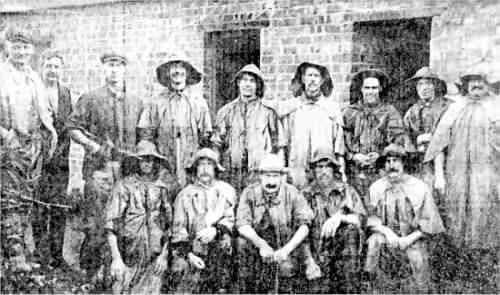
Men Who Sank Thorne pit.
by GARY HORNE
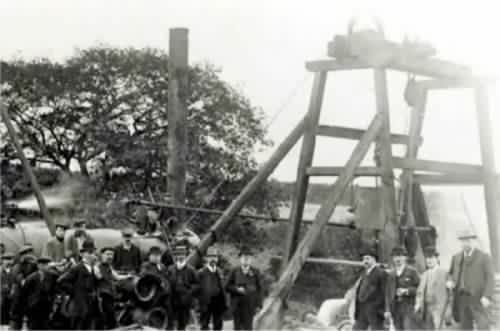
AS the £200m redevelopment of Thorne Colliery goes ahead spare a though for some of the original pit sinkers pictured above.
Decked in linseed oil soaked calicos, to keep them dry, they were the ones who helped sink the original pit shafts between 1909 and 1926.
The photograph, taken in 1923, depicts one of the shifts.
Mrs. Effy Hiley, whose husband Harold worked as a sinker and who kindly supplied the picture said, "about that time there was a pit disaster which involved the cage and six miners were killed. My husband just missed it as he was on the other shift.
'Harold started work when he was 17 but told them he was 21 else he wouldn't have got a job.
"He went on to work at Armthorpe, Harworth and Yorkshire Main, before retiring through ill health in
1957. He died last November, aged 75," said Mrs. Hiley of Leamington Gardens, Intake.
A Coal Board spokesman said it took from 1909 to 1926 to sink the shafts because it was designed by
German engineers who had to go off to fight in the First World War.
"The pit was closed in 1956, but re-opened last year and should be in production in 1984.
"We have just brought the shafts back into working order and put up the second headgear," he said.
Sinking Thorne Colliery Shaft. Photo Courtesy Joe Stocks.
|
|
Contents
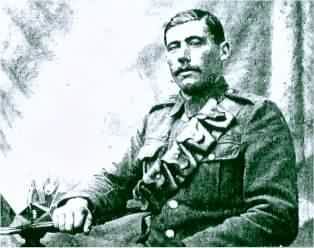
In Loving Memory of
Charles Henry Walton
(The dearly beloved Husband of Maria Walton)
Who was accidentally killed at
Thorne Colliery,
On March 15th. 1926
Aged 34 Years.
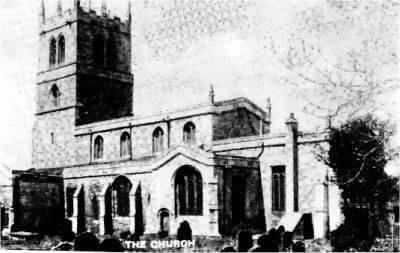
Interred in Thorne Churchyard, March 19th,
at 3-0 o'clock.
Had we but seen him yet in life,
Watched by his dying bed,
Caught the last flickering of his breath,
And touched his dying head,
We think our hearts would not have felt
Such bitterness of grief,
But God had willed it otherwise,
And now he rests in peace.
|
|
Contents

|