Sutton Colliery, Nottinghamshire.
Explosion, 21st. February 1957.
I'm indebted to Joe Stocks for sending me the Report On the causes of, and circumstances attending, the Explosion by A. Winstanley, C.B.E., D.Sc., H.M. Deputy Chief Inspector of Mines.
It is the only source of information used on this web page.
Sutton Colliery, Known locally as 'Brierley Colliery' (possibly renamed by the Staffordshire colliers who moved here from the Brierley Hill area), or the 'Bread and Herring Pit' because of the poor condition of the colliery.
Summary of the Accident.
At about 11:30am firedamp was ignited at the intake roadhead of No. 28's fully mechanised Longwall face in No. 28's district in the Low Main Seam. A stone about 3 by 3 feet by 1 ½ feet fell from the insufficiently secured top or sides of a cavity about 36 feet long, 9 to 12 feet wide and 10 to 12 feet high above the roadway supports.
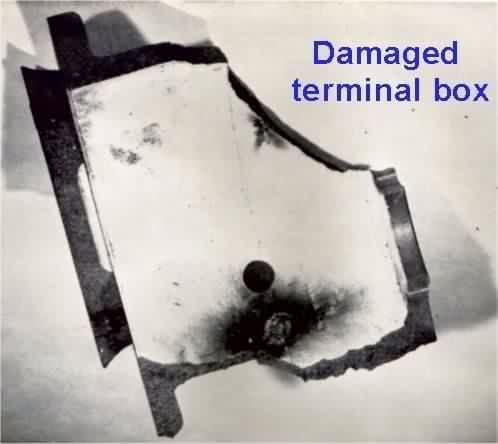
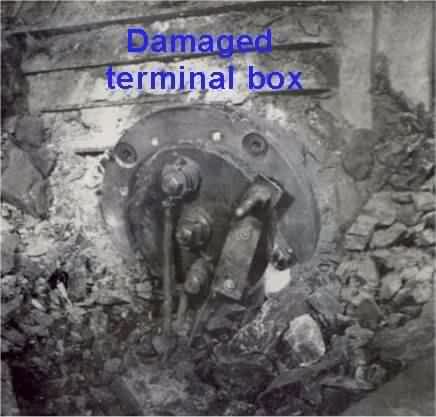
The stone struck the cast steel terminal box of a 50 H.P. face conveyor driving motor and smashed it. This caused an electrical short circuit and an incendive flash.
Firedamp was apparently brought down from the roof cavity by the stone as it fell. The incendive flash ignited the firedamp.
The flame travelled the whole length of the face, 150 yards, and about the same distance back along the intake airway.
It was fed by firedamp from the cavity and possibly by firedamp previously spilling from the cavity and trailing along the roof along the coalface and back along the roof of the intake gate against a very sluggish air current
Coal dust did not play any part in propagation of the flame.
Twenty-five men, suffered multiple burns, five men subsequently died.
Twenty-two were at or near the coalface; one was the loader gate face conveyor attendant who was at the roadhead with the undermanager and a deputy.
Contents
Names of men who died: -
W. Savage, 29 years of age, occupation, Coal Getter.
J.W. Betts, 55 years of age, occupation, Ripper.
J. Lemm, 35 years of age, occupation, Shearer Assistant.
L. Reeves, 45 years of age, occupation, Coal Getter (stable hole).
J. Godber, 16 years of age, occupation, Supplies Hand.
Names of men seriously injured: -
G. Atterby, 28 years of age, occupation, Faceworker.
S. Brewer, 46 years of age, occupation, Shearer Driver.
F. Bradley, 32 years of age, occupation, Faceworker.
W. Bacon, 37 years of age, occupation, Acting Under-manager.
F. Clayton, 33 years of age, occupation, Faceworker.
G.I. Deakin, 16 years of age, occupation, Supplies Hand.
W. Fudge, 23 years of age, occupation, Faceworker.
C. Fudge, 29 years of age, occupation, Faceworker.
J.W. Kirk, 52 years of age, occupation, Deputy.
T. Lindley, 30 years of age, occupation, Faceworker.
W. Middleton, 33 years of age, occupation, Shearer Assistant.
W. Riley, 45 years of age, occupation, Faceworker.
H. Sage, 17 years of age, occupation, Belt Driver.
S. Wilson, 32 years of age, occupation, Faceworker.
S. Ward, 39 years of age, occupation, Faceworker.
Contents
Description of the Colliery.
The Colliery was in the National Coal Board No. 4 Area of the East Midlands Division.
Sutton Colliery is about four miles from Mansfield in Nottinghamshire.
It had two shafts, 15 feet in diameter, were sunk in 1874 to the Top Hard seam by the Skegby Colliery Company.
1896/1897 they were deepened to the Low Main seam, 467 yards below the surface.
Seams worked were: -
Top Hard, (which had been exhausted many years before the explosion).
Deep Hard.
Deep Soft.
Low Main (had been worked for the past 40 years).
Piper.
Daily output at the time of the explosion was 1,200 tons; 850 tons coming from the Low Main seam; the remainder came from the Piper seam.
The district concerned, 28's, was one and a half miles inbye, at this point it was 580 yards below the surface.
Up to a month before the explosion the seam was worked by machine cutting at floor level, blasting and hand filling on to belt conveyors.
The system on No. 28's face was changed on the 28th. January 1957, to an Anderton shearer coal getting and loading machine.
Usually on 28's district there were: -
30 men on the day-shift.
12 on the afternoon-shift.
10 on the night-shift.
On the day of the explosion 40 men were on the district, including, an electrician, a fitter and the undermanager.
An exhausting direct-coupled steam driven Davidson Sirocco double inlet fan ventilated the mine. Which was situated on the surface and circulating 115,000 cubic feet of air per minute at 3.3 inches of water gauge.
A new diesel engine driven fan designed to circulate 175,000 cubic feet of air per minute at 7.7 inches of water gauge had been installed and was nearly ready to be used.
Three days after the explosion it was put into use.
There were no records of any previous explosions at Sutton Colliery.
Safety lamps.
Safety lamps were used throughout the mine, the workings were not considered to be gassy, although firedamp is found.
Lamps in general use: -
Oldham G.W. electric cap lamps.
Protector Type flame safety lamps were provided to certain workmen.
Officials use Protector Type No. 6 flame safety lamps fitted with pyrophor bar internal igniters.
Gauzes of all flame safety lamps were of 28 mesh.
Automatic firedamp detectors, Ringrose 47/125 Type were provided. There appeared to be some reluctance by the men to use them. Only two were in use in the mine at the time of the explosion: neither in the district concerned.
Contents
Management.
Area General Manager, Mr. F.D. Severn.
Area Production Manager, Mr. T. Wright.
Deputy Area Production Manager (operations), Mr. C. Round.
Deputy Area Production Manager (planning), Mr. J. Atkinson.
Group Manager, Mr. T. Frith.
Manager (acting), Mr. A. Stone.
Under-manager (acting), Mr. W. Bacon.
The previous Manager, Mr. E. Maiden, left the Colliery on the 1st. February 1957, to take charge of another colliery.
The under-manager, Mr. A. Stone was appointed temporary manager.
Officials on 28's district, Low Main seam: -
Day-shift Overman, Mr. T. Buckley.
Day-shift Deputy, Mr. J.W. Kirk.
Day-shift Shot firer, Mr. S. Derbyshire.
Afternoon-shift Overman, Mr. W. Warren.
Afternoon-shift Deputy, Mr. J. Aldred.
Night-shift Overman, Mr. A. Walker.
Night-shift Deputy, Mr. M. Cox.
Face work was split into stints, each about 30 yards long.
Ten men worked in pairs, advancing the conveyor, setting and withdrawing supports.
Five men filled out coal in the loader gate stable hole, removed the original left side pack of the loader gate and took up the floor of the loader gate so the conveyor-driving engine could be advanced.
Four men were filling out coal at the return gate stable hole.
Two additional men were working at the left end of the face where it was slowly being extended.
Total Men and occupations on the district: -
1 Machine Operator.
2 Machine Assistants.
1 Chargeman.
10 Facemen.
5 Loader gate Stable Hole Fillers.
4 Return gate Stable Hole Fillers.
5 Return Gate Rippers.
2 Return Gate Repairers (both in the loader gate when the explosion occurred).
2 Stablers extending the left end of the face.
1 Transfer Point Attendant.
1 Stage Loader Attendant (about 20 yards from the face).
2 Electricians.
1 Fitter.
1 Shot Firer.
1 Deputy.
1 Acting Under-manager.
Contents
Development of 28's Face.
The coal seam was 3 feet 3 inches thick, with a medium clunch floor, and a roof consisting of 9 inches of clunch, 4 to 6 inches of coal, and 35 feet of grey bind with 60 feet of sandstone above.
There was a variable but thin section of sandy material between the grey bind and the sandstone.
30's face, a double unit coal face, 280 yards long, had been advanced 1,250 yards to the northwest rising about 1 in 100. The face was cut by a machine, blasted and then hand-filled on to a face conveyor belt.
30's face had three roads, the middle and right side roads were intake airways, and the left hand gate was the return airway. The middle road was also the loader and conveyor gate.
Electricity was used to operate the machinery in this district.
On the 11th. June 1956, 120 yards from the junction of 30's loader gate and old 28's face trunk road, a scouring was started from 30's loader gate, driven through the waste to 30's right side gate, and for a further 15 yards to the solid coal on the right side of 30's right side gate.
In the coal, the road continued for 10 feet; then the face was widened to 30 feet. The road was dipping at about 1 in 8 and was supported by steel arches 12 wide by 9 feet high, with 9 feet stone packs on either side.
An auxiliary fan, 18 inches in diameter, driven by a 5 H.P. electric motor, supplied the ventilation. The fan forced air through a canvas ducting to the face.
By the 14th July 1956, the road had advanced 63 yards from 30's right side gate where it was stopped.
28's old face had been worked to the north-east, but was abandoned because of difficulties in maintaining the roads.
It was intended to replace 28's old face with a new face advancing in the same direction, north-east, but leaving solid coal 80 yards wide between the ends of 28's old face and 28's new face. 50 yards of solid coal was also to be left to the right of 30's right side gate to protect this gate from damage.
Plans were changed two or three times, regarding the layout and direction of new 28's face, and the ventilation.
Eventually the decision was made to open the new 28's face 150 yards long to the right of 30's right side gate, leaving no coal for protection of this road and extending to the left of the original development road.
150 yards long by 12 feet wide face was developed to the left of the development road, going in the same direction as 30's face.
Then a connection was made through the pack back into 30's right side gate.
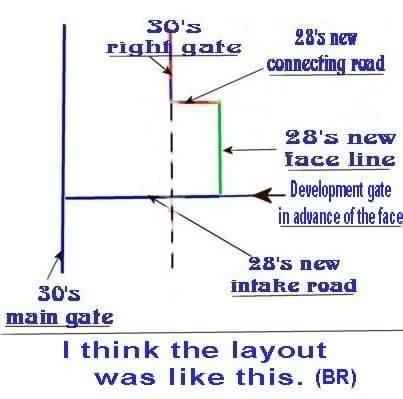
This was completed on the 29th December 1956; ventilation for 28's new face came via 30's main gate, up 28's new intake road, along 28's new face line, down the connecting road (which became 28's return), and into 30's right side gate.
It then travelled up 30's right side gate, along 30's face and out down 30's left side gate/return.
So the ventilation for 28's and 30's was in series.
The Coal Mines Act, 1911, was in force and also the Electrical Regulations under that Act.
Regulation 119 required notice to be given of intention to introduce apparatus into any mine or into any ventilating district in any mine. But in this case 30's and 28's districts were part of the same ventilating district and electricity was already in use in that ventilating district.
Contents
28's face.
28's face was advanced 10 feet by hand getting. Then an Anderton shearer mounted on an armoured chain conveyor was installed. Both were electrically driven.
The face support method was prop-free front to allow the conveyor to be advanced broadside following each cut of 20 inches.
3 feet 3 inch link bars sat on top of hydraulic props fitted with castellated heads supported the face.
The rows of coupled bars were set at maximum distance of 3 feet, with a maximum distance of 6 feet between props in the same row.
The maximum distance between the front row of props and the face was not to exceed 5 feet 6 inches. Alternate bars were advanced after each cut.
12 feet wide by 9 feet high steel arches were being set in both 28's gates; these were set 3 feet apart.
But within 20 feet of the face smaller arches were used.
The intake gate had a 3 yards wide pack on the left side of the gate and the return gate had packs on both sides of the gate.
The first 15 feet of advance of the face with the Anderton shearer, strip packs, 3 yards wide, were built 9 yards apart in the waste between the two gate ends. Three pre-fabricated steel chocks were set along the edges of the face working adjoining each waste.
The face was turned a little here by taking taper cuts starting with 10 inches at the loader gate (which was also the intake gate), and taking 20 inches of cut at the return gate end of the face.
Mr. Maiden, the manager at the time, had informed the District Inspector that he intended to stop the intermediate packs once the face had advanced far enough to establish proper control of the roof.
Full caving started on the 11th. February 1957, it extended from the left side pack of the loader gate, to the right side pack of the return gate, a distance of about 130 yards.
This caving system continued up to the time of the accident. During which time the face advanced another 44 feet.
The management claimed full caving was introduced earlier than intended because the roof in the wastes between intermediate packs was not breaking down regularly to provide packing material. The waste edge support by chocks was doubled and the roof at the face improved.
The loader gate was difficult, a 3 yards wide pack on the left side had to be removed to allow the face conveyor and its driving machinery to load on to the stage loader; it was rebuilt behind the conveyor.
These difficulties became more serious after full caving was introduced. Large falls of roof occurred on the loader gate, which continued as the face advanced.
The road was widened to 17 feet by extending it on the left side. (The cavity left by falls of roof widened on this side). 5 feet long horizontal joists were inserted between the arches to cover the extra width.
Falls occurred for several days before the explosion and also between 6 and 7a.m. on the morning of the explosion. A cavity about 36 feet long, 9 to 12 feet wide and 10 to 12 feet high was above the arches.
The top and sides of the cavity were partly, and inadequately, secured by two chocks of wood built on wood lagging pieces laid over the steel arches.
Men had to work at the face under the edge of the cavity. The electric motor and cables for the face conveyor driving gear were also under it with only the arches, covered by boards, to protect them against further falls of top or sides from the cavity.
The fall that occurred between 6 and 7 a.m. on the day of the explosion partly buried the face conveyor engine and closed access to the coalface.
Miners had to be withdrawn for a time and under supervision of the under-manager and the deputy, they helped remove enough debris to enable the face conveyor to run again.
Steel arches, horse-head girders, and covering timber were displaced by this fall. One of the chocks fell out leaving even less support to the top and sides of the cavity.
An electrician and a fitter examined the machinery and say they found no damage. They agreed it was safe to restart the face conveyor and work resumed at the face.
Nothing was done to secure the top and sides of the cavity.
Regulation 12 of the Coal and Other Mines (Support) Regulations, 1956, required that: -
"if a fall of roof or side involving the displacement or breakage of any support has occurred at a place where any person has to work or pass, it shall be the duty of the person for the time being in charge of that part of the mine forthwith to ensure that any roof or side exposed thereby is, if necessary dressed and is secured by supports and that any such dressing and securing is done before any work of clearing debris is begun, other than such work of clearing debris as is necessary for the setting of the supports".
These were the conditions under which the explosion occurred.
Contents
The Accident.
At about 11a.m. the Anderton shearer arrived back at the loader gate stable hole after completing its second cut.
Mr. Bacon, acting under-manager, instructed P. Smith and D. Reeves, loader gate stable hole men, to clean up on the face side of the conveyor engine to enable it to be advanced 20 inches.
They were doing this when a stone about 3 feet by 18 inches fell from a height of 10 to 12 feet from the cavity above the arches. The stone struck the conveyor motor.
Immediately there was a flash and a bang and they were thrown forward on to the floor. A ball of flame, which appeared to be red and blue in colour, passed over them and they felt the heat.
There was also thick dust and smoke.
The flame travelled the greater part of the loader gate to its junction with 30's loader gate. It also travelled most of the length of the face.
J. Hill a return gate ripper, along with J. Flay were deployed by shot-firer S. Derbyshire to act as sentries 30 or 40 yards up the face, while he fired two ripping shots in the return gate. The two shots were fired.
Hill gave evidence of the flame passing along the face. He was in a kneeling position facing the loader gate. A few minutes after the second shot was fired, he felt a gust of hot dust-laden air and saw a flame coming from the loader gate. This turned him completely round so he was facing the return gate. His left arm and neck were scorched. He got the impression that the flame travelled along the coal face to the left hand end and returned along the waste edge.
The men on the face together with men in the return gate, made their way out, by groping their way in the thick dust-laden atmosphere, to 30's right side gate, through the door and sheet in this gate, to 28's loader gate.
The men found it difficult to open the door in 30's right gate, it could only be partly opened.
The men in 28's loader gate made their way out by groping along the gate conveyor to 30's loader gate where the air was clearer.
First aid was given to the men with such material as was available. Eight were carried out on stretchers, the rest either ran out or were assisted by colleagues; some were naked to the waist.
Contents
Medical attention.
Most of the injured men had arrived at the Medical Centre by 12:15p.m.
The NCB's Area Medical Officer, Dr. Fernandez, arrived at the colliery at 12:25p.m. 15 men were waiting for treatment.
He immediately sent for ambulances and attended to the men.
Dr. Round, Assistant Area Medical Officer arrived at 12:30p.m. and was followed quickly by others.
25 men received burns of varying degrees, two were allowed to go home after treatment in the Medical Centre, and 23 were admitted to Mansfield General Hospital.
Contents
Rescue teams.
A call was made to Mansfield Central Rescue Station, and they called on Chesterfield Rescue Brigade for assistance.
The Mansfield team descended the pit before noon. The Chesterfield team was at the colliery by 12:12p.m.
A fresh air base was established at the junction of 30's loader gate and 28's loader gate at 12:55p.m.
The rescue teams were informed that all the men were accounted for but two ponies had been left 200 yards along 30's loader gate. The rescue team brought them out at 1:25p.m.
The rescue team explored 28's loader gate and face and returned to the base at 2:30p.m.
They reported 3 ½ percent of firedamp at 28's return gate ripping and 2 ½ percent at in 28's return gate.
Smouldering on clothes, and conveyor belting, was suppressed by extinguishers.
Mr. Frith Group Manager, arrived at the fresh air base at 2:40p.m. and he instructed the rescue team to examine 28's and 30's faces and come out by 30's return gate to the fresh air base.
They reported the whole area clear, and the canary they carried was not affected.
Contents
The Investigation.
Four schemes were considered for 28's district, why the scheme used was chosen is not clear.
28's face was the first armoured conveyor on a prop-free front face installed in Sutton Colliery. The problems associated with advancing the conveyor by snaking were relatively new.
The changes to full caving of the waste, accentuated to a large extent the roof difficulties experienced in the loader gate roadhead.
Statuary reports showed that soon after 28's face started, roof trouble began on the loader gate in the vicinity of the roadhead. The steel arches were subjected to severe pressure and the left side pack, plus the left half of each arch were removed to allow the face conveyor to be advanced after each cut. As the left half of each arch was removed, a piece of straight girder was coupled up to extend over the place that had been occupied by the left side pack.
The process of removing and rebuilding the pack and resetting arches as the face advanced, had a bearing on the damage done to the road and the surrounding strata.
On the night-shift of 30th-31st January 1957, the deputy reported slight falls in the loader gate and again the following night; he reported broken roof in the loader gate.
10th February 1957, the statuary report recorded a fall of 50 tubs of dirt in the main gate; the following night's report indicated it had been cleaned up.
At about this time intermediate packs were stopped and full caving started.
This was a very bad move having regard to the possibility of caving extending over the left side pack of the loader gate, and on the loader gate itself.
It would have been better not to start caving until the face had advanced beyond the original development heading, which became the loader gate.
Work carried out at the site of the face conveyor was already difficult, this decision made it even more difficult and dangerous. Regarding the risk of accidents from roof falls.
Apparently the adverse effects of implementing full caving were not sufficiently considered by the officials, even though falls became more frequent and larger and a big cavity was being left over the newly erected arches in the gate.
Mr. Winstanley, H.M. Deputy Chief Inspector of Mines, commented that it was not really necessary to cave the waste to the pack, only 9 feet wide, on the left side of the loader gate and risk the caving extending over the pack to the loader gate itself.
An additional temporary road could have been ripper and packed to the left of the loader gate and this would have provided its own packing material and also protected the loader gate against excessive damage, which was almost inevitable when the caving was taken up to the narrow pack on the left of the loader gate.
Alternatively, the pack on the left side of the loader gate could and should have been widened to about 20 feet to keep the caved waste far enough from the gate.
Statutory reports by the night-shift deputy on 11th-12th February again referred to a fall of about 50 tubs of dirt at the loader gate having been cleared to allow the face conveyor to run.
The afternoon-shift deputy reported on the 12th February that 15 tubs of dirt had fallen at the loader gate end. The night-shift deputy on the 19th - 20th February referred to broken roof at the loader gate end. A cavity 36 feet long, 18 feet wide and about 12 feet high, had resulted from these falls and it extended to the coalface.
On the 21st February, between 6 and 7a.m., another fall of roof occurred and some of it fell on the face conveyor motor and drive head. Men were withdrawn from the face and some of them were used to clear a passage through the debris.
An electrician said he examined the electrical gear at about 8:00a.m. He found no damage had been caused by the fall, so the conveyor was restarted and the men returned to work on the face.
After this the under-manager spent some time at this roadhead and was seen shining his light into the cavity. Small stones kept falling.
He was near the roadhead again when, at about 11:30a.m., a stone 3 feet by 3 feet by 1foot 6inches, fell from the cavity and struck the cable gland on the conveyor motor.
There was a flash as an electrical short circuit occurred owing to the smashing of the cast steel gland and the tearing away of the conductors.
The automatic overload and protection devices operated and cut off the current, but not before firedamp, which had apparently been brought down from the cavity by the falling stone, was ignited.
The flames of burning firedamp spread back along the intake gate and also along the coalface and burned 25 men. 22 were on or near the coalface, one the conveyor drive attendant, at the roadhead.
Two chocks supported the cavity above the arches, each about 2 feet square. These were built on top of wood lagging over arch extension pieces.
The first of these chocks was set during the week prior to the explosion and was about 9 feet high. The second chock was built on Tuesday night-shift 19th / 20th February and was about 6 to 7 feet high.
Reliance was placed on these chocks and on boarding or lagging the arches all round to arrest any falls that might occur.
The first chock was seen in its original position after the explosion, but the second chock was reeled out by the fall that occurred between 6 and 7 a.m. before the explosion.
It was not replaced.
It seems that little attention was given to the cavity after the fall : -
1. To pack it.
2. Ventilate it.
3. To secure the top and sides.
The fall happened four to five hours before the explosion.
Evidence indicated a failure to carry out the requirements of Regulation 12 of the Coal and Other Mines (Support) Regulations, 1956, following the fall of roof and displacement of supports at 28's loader gate roadhead between 6 and 7 a.m. on the 21st February 1957.
Progressive enlargement of the cavity, and the frequent falls, should have caused steps to be taken to control the movement of the strata, and proper support of the roof and sides, necessary to keep the working place secure.
That is a requirement of Section 48 of the Mines and Quarries Act 1954.
Contents
Ventilation.
The new Davidson double inlet diesel driven fan was due to start up at the end of 1956. The manufacturers experienced difficulties during testing, so the old fan was maintained and kept in use longer than anticipated.
The manager intimated that the new fan would be put into operation during the weekend of 19th /20th February 1957. This was further delayed by mechanical difficulties.
The weekend after the explosion the new fan was successfully run.
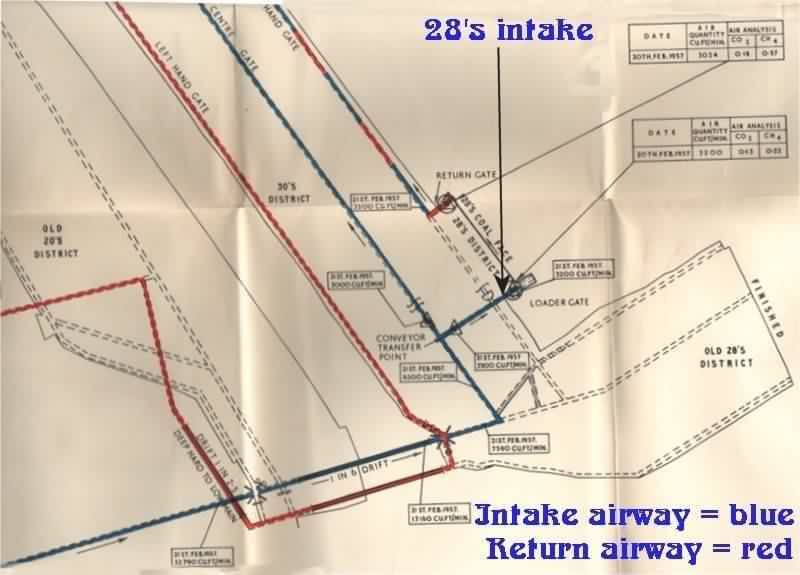
The record dated 20th February showed the quantity of air circulating 28's face
: -
1) About 10 yards from the face in 28's intake, was 3,200 cubic feet of air per minute.
2) The return gate air was 3,024 cubic feet of air per minute.
Taking these air velocity measurements would be difficult as the velocity was about 25 feet per minute and the anemometer would barely turn at this velocity.
Flow of air near the roof would be very low.
Mr. J. King, who took the readings, said he had to erect a brattice sheet to reduce the cross section of the road to get the anemometer to show a reading.
He was unable to produce any written record of the actual measurements.
There were many places on the airways and travelling roads, not used for transport, in which the cross sections were too small and undoubtedly they restricted the flow of air.
These should have been remedied before they had become so bad as to restrict the ventilation and travelling by persons.
Little regard appears to have been paid to the probable adverse consequences of the restriction to the ventilation arising from the falls at the loader gate roadhead, although earlier in the shift it had been necessary to withdraw all the men off the face due to this cause.
To make matters worse ripping shots had been fired in the return gate roadhead and the debris from these shots further restricted the ventilation of 28's face.
There was considerable leakage taking place at 30's overcast. In the main intake trunk roadway in the 1 in 6 drift there was, according to air measurements made after the explosion, 13,160 cubic feet of air per minute passing, and this quantity had fallen to 7,590 cubic feet per minute at a point outbye 30's loader gate junction.
The only possible source of leakage was at 30's overcast; this was some 5,570 cubic feet per minute, 42 percent of the available quantity.
The management must have been aware of this high leakage but no definite action was taken until after the explosion.
28's and 30's faces were ventilated in series, but the reliability of the ventilation of 28's face was dependent on a door and a brattice sheet near the outbye end of 30's right side gate. Air passing through this part of 30's right side gate would miss 28's face.
Perhaps of greater importance was the dependence of two sheets of brattice near the outbye end of 30's middle gate, which was also the conveyor gate. The conveyor and coal had to pass through the sheets; if the sheets became torn or displaced more air would pass into this gate and rob the ventilation of both 28's face and the right half of 30's face.
Sheets are not dependable for such a purpose and there should have been at least two stoppings with hinged doors for the conveyor to pass through.
The air measurements recorded including those of the 20th February, indicated that a disproportionate amount of the ventilation was passing into 30's middle gate.
It was more than twice the amount going into 28's face to ventilate also the right half of 30's face.
The restrictions, leakages and unreliable features about the ventilation were sufficient to account for the ventilation in 28's district being insufficient to prevent firedamp, which accumulated in the unventilated cavity above the arches at the loader gate roadhead, from spreading in a layer along the roof both along the coal face and also back against the air current along the loader gate.
Contents
Firedamp Reports.
There were no references in any of the statutory reports of the deputies of finding firedamp in 28's district.
T. Buckley, day-shift overman, said he visited the loader gate on the 20th February, the day before the explosion, but he made no tests for firedamp in the cavity because Mr. Bacon, the under-manager, and Mr. Kirk, the deputy, were in the district and he wanted to get away to 30's district.
W. Warren, afternoon-shift overman, said that on the afternoon of the 20th February he tested for firedamp in the cavity up to the roof using his safety lamp. He was not sure whether he used the top feed on his safety lamp, but he found no firedamp. W. Adams, contractor ripper confirmed this.
J. Aldred, afternoon-shift deputy, said he tested for firedamp in the cavity, but did not use the top feed on his safety lamp. He found no gas in the cavity. He said two rippers, H. Camm and H. Coleman, saw him make the test.
A. Walker, night-shift overman, said he spent most of the shift preceding the shift on which the explosion occurred, supervising the work in progress in 28's loader gate. A shot was fired in the floor dint to enable the face conveyor engine to be advanced on the next shift.
He saw the shot prepared and saw a test made for firedamp in the cavity. M. Cox, night-shift deputy, and Walker said they made tests for gas together up to the roof of the cavity, by standing on the covering boards on top of the arches.
No firedamp was found. According to Cox the arches over the forward end of the cavity, above the face conveyor engine, had been covered with split bars and covering boards.
S. Derbyshire, the shot-firer, fired four shots in the coal at the loader gate end at about 6:a.m. on the 21st February. He said he tested for firedamp before charging the holes, his tests extended from 10 to 15 yards along the coal face, at the edge of the waste, in the advanced heading, and back along the loader gate for 15 yards. He tested to the height of the horse-head girders, but he could not get his lamp higher at that time because of covering timber, consisting of round props and splits set skin to skin over the arches.
He did not test in the cavity as small pieces of dirt were falling from the sides.
Shortly after these shots were fired in the stable hole another fall occurred and dislodged a chock, cover boards and girders, leaving the top and sides of the cavity exposed above the conveyor driving motor.
The situation at the loader gate roadhead was, a large cavity, which the shot-firer considered too dangerous to enter.
Nothing was done to make it safe.
Shot-firing and normal coal production continued.
Mr. Winstanley was in no doubt that the cavity contained firedamp at the time of the explosion, and that the overflow may have tailed off as a thin layer near the roof along, at least part of the face, as well as migrating against the ventilation back along the roof of the intake roadway, which was rising outbye at 1 in 8, to another cavity at the junction of 28's loader gate and 30's right hand gate where an overcast was being prepared.
This might have been expected in view of the extreme low air velocity in this road at the time, the lightness or buoyancy of the firedamp and the inclination of the road.
Contents
Source of firedamp.
The probable source of firedamp in the intake was the coal on the right side of the intake gate. It is likely that the increased abutment pressure on this coal was liberating firedamp, which would also pass along the roof bed partings into the unventilated cavity where it would accumulate until it spilled over to trail along the roof at the face and also back against the ventilation up the intake gate as it must have been doing at the time of the explosion.
G. I. Deakin, a 16 year old supplies hand, who was carrying supplies to 28's return gate stated, that at about 7:00a.m. on the 21st February he saw a lot of men in the return gate and later saw they had gone back to the face. Sometime later, two other men, Betts and Bailey, were carrying and dragging supplies down the return gate to the face, and Deakin went as far as the shot-firing curtain about 20 yards from the face.
There was a flame safety lamp hanging on the shot-firing curtain on the left side looking inbye. The flame of the lamp was jumping past the top of the glass and there was a blue haze on it.
J. Betts showed him the lamp and said "just look at that oil lamp". He did not know whose lamp it was but he remembered Betts saying to S. Derbyshire, the shot-firer, "look at that lamp" and Derbyshire replied but he could not remember the exact words.
Derbyshire had a lamp of his own which he was trying to relight.
W. Bailey confirmed that between 10 and 10:30a.m. on the 21st February, Betts, who died as a result of the accident, drew Derbyshire's attention to the flame safety lamp, which was hanging on the shot-firing curtain in 28's return gate. Derbyshire said he would light his own lamp and see what was there, but he could not relight his lamp.
J.W. Kirk, deputy, came down the gate at that time. Bailey turned down the flame of the lamp but it continued to rise up and down. A blue flame was rising into the gauze.
Both Derbyshire and Kirk when questioned about this incident, said they could not remember it.
Bailey, Betts and Deakin then went on with their work back to 30's right hand gate and they did not know what action was taken about the flame safety lamp. They saw J.W. Kirk again about 11:20a.m. going towards the loader gate but he did not mention the lamp.
If the flame of the safety lamp was behaving in that way, it indicated that there was firedamp in dangerous quantity in the air current in 28's return gate and that it required immediate action by the deputy and shot-firer to ensure the safety of the men in the district.
The Anderton shearer was taking its second cut at that time and this was likely to increase the rate of issue of firedamp.
Contents
Statutory air measurements and samples.
The management failed to have air measurements and samples taken as required by the Coal and Other Mines (Ventilation) Regulations, 1956.
The only records of air measurements and samples for firedamp content in the general body of the air current in 28's district were for the day before the explosion, despite the fact that the development of this face had been completed by the week ended 29th December, 1956.
These samples indicated a firedamp content of 0.22 percent, making about 7 cubic feet per minute, in the general body of air in the intake and 0.57 percent, making about 17 cubic feet per minute, in the general body of the air in the return gate, at statutory points 10 yards outbye of the face.
Statutory samples and air measurements had not been made in 28's district until the day before the explosion.
The results were not available to the management until after the explosion.
Essential information about the quantity of the air flowing and the firedamp discharging in the district was not available as it should have been.
Contents
Mr. A. Winstanley's General conclusions on ventilation.
The ventilation along 28's intake loader gate failed to dilute and render harmless the inflammable gas that eventually filled the cavity.
This appeared to be a breach of Section 55 (1) (a) of the Mines and Quarries Act, 1954.
To what extent the falls across the entrance to the face at 28's loader gate roadhead contributed to the accumulation of gas in the cavity is not known.
The deputies and other officials state that they made regular examinations for gas in the cavity and they failed to detect any.
If this is true, then the cavity must have filled up with gas during the day shift of the day of the explosion.
Regulation 22 (2) of the Coal and Other Mines (Ventilation) Regulations, 1956, is also relevant in that only two sheets were used to restrict the flow of air on 30's loader gate, although this regulation requires that there shall be provided and properly maintained at least two doors, or if that is impracticable at least one door and one or two sheets.
It was quite practicable to have two doors on that road.
Contents
Ignition.
Contraband was not found in the district and smoking or the illegal use of naked lights can be ruled out.
All the lamps on the district were impounded and later examined by H.M. Inspectors. All were found in good order with the exception of an electric cap lamp (Oldham G.W. No. 324) used by J.W. Kirk, deputy, which had a severed cable. It was established that this cable was cut at Mansfield General Hospital.
Consideration was given to other possible sources of ignition, including the firing of two shots in the left return gate ripping lip just before the accident.
The face of this ripping lip was behind the waste edge line, and investigation by H.M. Inspectors some four hours after the explosion did not reveal any sockets, excessive bed separation or induced breaks.
It would appear that shot-firing as a source of ignition can be ruled out.
The ignition medium was undoubtedly an electrical flash, all concerned in the investigation agreed this.
The armoured conveyor was running at the time and the cable terminal box of the driving motor was struck by a large stone falling from the cavity.
The terminal box was smashed and one lead of the cable was pulled adrift.
Part of the smashed terminal box was forced into contact with another part of the earthed casing and the live conductor, causing a flash, which ignited firedamp.
Contents
Electrical installation and apparatus involved.
The electricity supply for the mine, obtained from the East Midlands Electricity Board, was alternating current at 11,000 volts, 3-phase, 50 cycles.
This supply was transformed on the surface down to 3,300 volts for general distribution on the surface and underground.
An electricity supply at this voltage was taken inbye to 28's substation some 350 yards from the 28's coal face where the accident occurred.
There was a 250 KVA 3-phase transformer in the substation where voltage was transformed down to 550 volts, 3-phase, for supplying the electrical apparatus on 28's face. The neutral point of the 550 volt supply was connected with earth.
Adjacent to the transformer was the section switch for controlling the 320 yards long 0.1 square inch P.I.L.C.D.W.A. feeder cable to 28's intake gate end boxes.
The section switch of flame proof design and covered by the Ministry of Power Flameproof Certificate, was of the air-break type with integral and interlocked isolator, fitted with three over-current trips, set at 200 amperes, with time lags and also with core balance earth leakage protection device designed to trip when a fault current from phase to earth exceeded 5 amperes.
The feeder cable from the section switch in the intake gate road supplied a bank of four flameproof air-break gate-end boxes and a drill transformer unit.
Of the four gate-end boxes, one was a spare. The others supplied: -
a) The face conveyor motor.
b) The stage loader.
c) The stable hole cutter or alternatively the Anderton shearer coal cutter.
The four gate-end boxes, all with interlocked isolators, were fitted with over-current protection and core balance earth leakage protective device.
Between the gate-end box and the face conveyor motor there was a length of Type 22 pliable wire armoured 4-core flexible cable, the cable containing conductors for a pilot remote control circuit, which with a remote "START-STOP" push button unit situated near the stage loader motor enabled the operator to start and stop the face conveyor.
The face conveyor was driven by a 50 h.p. squirrel-cage motor of flameproof design covered by the Ministry of Power Certificate.
Attached to the terminal box was a 100-ampere restrained type plug and socket coupler and an interrupted pilot circuit gland to which was connected the 2-core Type 60 remote control cable, at the other end of which was connected the remote "START - STOP" push button unit.
Mr. Burkle, H.M. Electrical Inspector, found this unit in the "RUN" position. There appeared to be no defect in the flameproof enclosure of this apparatus.
In addition to the face conveyor motor there was an Anderton shearer loader mounted on the face conveyor and situated adjacent to the conveyor motor.
The flexible cable and plug attached to the Anderton shearer loader was supplied from a gate-end box some 150 yards away in the tail gate road. The controller on the machine was in the "OFF" position when found after the explosion. A Ministry of Power Flameproof Certificate covered the electrical part of the machine and no defect of the flameproof enclosure was seen during examination.
The motor of the stage loader some 30 yards outbye from the face conveyor was of a flameproof squirrel-cage type covered by a Ministry of Power Flameproof Certificate. The "START - STOP" push button unit controlling the motor was in the "RUN" position. This unit was also of flameproof design covered by a Ministry Certificate. Examination of the flameproof enclosure of the motor and the "STOP - START" unit revealed no defect of flameproof enclosure.
Two intrinsically safe bells with associated Approved Type batteries were impounded and tested at the Safety in Mines Research Establishment. Tests indicated they were generally in good condition and that the standard of intrinsic safety had not been impaired.
The evidence of electrical fusion on one of the conductors in the terminal box where the ignition started, and on part of the terminal box casing, indicate that the motor was running at the time. This fusion was no doubt caused when a broken part of the smashed terminal box casing was forced into contact with another part of the earthed casing and the live conductor.
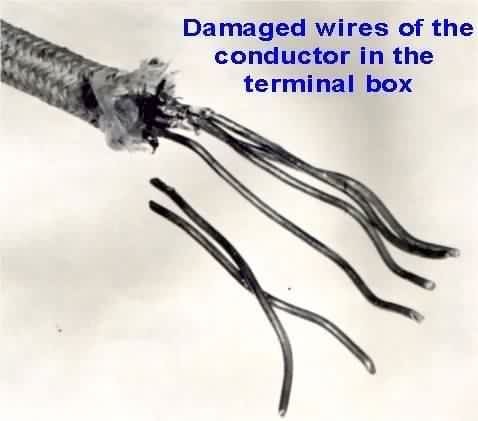
Three of the seven S.W.G. 17 copper wires of the conductor in the terminal box were fused asunder and another wire was on the point of being severed by fusion. The damaged conductor had also been pulled away from the shell clamp washers on the middle terminal of the three motor terminals to which each had been attached.
There was evidence of electrical fusion at two places on the broken part of the terminal box casing, indicating electrical contact simultaneously with the remaining earthed metal casing of the terminal box and the damaged live conductor.
Contents
Precautions against the explosion risk from coal dust.
Stone dusting of the roads and stone dust barriers were used.
The quantity of stone dust sent into the mine was 26 tones per calendar month, about 2 ¾ lb. Per ton of coal raised.
A figure that is somewhat lower than the average for collieries in the area.
The standard of cleaning up and stone dusting appeared to be reasonable having regard for the conditions.
Estimation of incombustible matter in the dust samples is by colour test and the statutory records show that all samples taken in this district of the mine contained more than 75 percent of incombustible matter.
After the explosion dust samples taken by H.M. Inspectors in 30's district were: -
30's gate in Zone N.J.1, Sub-Zone 2 Floor…………76.7 percent incombustible.
30's gate in Zone N.J.1, Sub-Zone 1 Floor…………72 percent incombustible.
Zone N.A.11…………………………………………..81.4 percent incombustible.
A stone dust barrier, consisting of several shelves loaded with stone dust, was fixed on 30's loader gate about 100 yards outbye of 28's loader gate transfer point.
Contents
Mr. Winstanley's Recommendations.
1. Falls of ground, which result in large cavities such as, in this case can and should be prevented by well-known methods of strata control and support. Small falls of ground show the need for more intensive support, which is usually necessary also to prevent the falls from spreading.
The top and sides of cavities left by such falls should be supported and packed until this has been completed, they should be ventilated to prevent accumulations of firedamp.
2. Any large cavities in the roof should never be concealed by supports and cover boards, which act as an umbrella and are unable to prevent danger from further falls and from accumulations of firedamp.
3. A minimum of 20 feet of packing should be stipulated between a road used for ventilation or transport, and any waste exceeding 100 feet in width.
4. Electrical apparatus and cables should be effectively protected against damage such as might cause incendive open sparking, or where this is impracticable, the electric apparatus or cables should be moved to a safe place.
5. The possibility of eliminating incendive sparking, by reducing the time of action of automatic devices for cutting off electricity in the event of excessive earth leakage or short circuit, should be investigated.
6. Section 55 (1) (a) of the Mines and Quarries Act, 1956, requires the manager of every mine to take such steps as are necessary for securing that there is constantly produced in all parts of the mine below ground ventilation adequate for the following purposes: -
Diluting gases that are inflammable or noxious so as to render them harmless and removing them.
In this connection minimum ventilation standards on the lines suggested in National Coal Board Bulletin No. 55/153 entitled "Planning the Ventilation of new and reorganised Collieries" should be applied to all mines and efforts should be made without delay to bring those below the standards at least up to the minimum suggested.
7. Where two intake roads are provided to any coal face without a return airway between them, they should not be more than 30 yards apart to avoid unreliable ventilation of that part of the face between them.
Recovery of the District.
An inspection of the affected area was made by all interested parties, including H.M. Inspectors, management, and National Union of Mineworkers' officials, some three hours after the explosion.
The district was found reasonably clear, although about 3 percent of methane was detected by flame safety lamp tests in the cavity two feet above the arches and some 8 yards outbye of the face.
Detailed examinations along the loader gate outbye from the ripping lip indicated a thin layer of methane against the roof. This appeared to be migrating to the large cavity at 30's right gate junction where the overcast was being prepared.
There were no appreciable signs of violence.
It was decided by H.M. Inspectors and National Coal Board officials that the cavities should be drained of firedamp by means of pipe columns, and if necessary by the use of a venturi ejector, for the purpose of conducting this gas into the main return airway at 30's overcast.
At the request of Mr. W.B. Brown, C.B.E., H.M. Divisional Inspector of Mines, further restoration work on the panel was stopped until it had been definitely ascertained that there was no indication in the district of residual burning, which might possibly have initiated a second explosion.
Special samples of air were obtained and the results carefully considered in respect of the normal CO content and CO/oxygen.
On the advice of H.M. Divisional Inspector the cavities were successfully drained of firedamp by 2 ½ inches diameter steel pipes, which collected the methane at roof level and delivered it into the main return at 30's overcast at about 22 and 14 cubic feet a minute respectively.
In this way the cavities were cleared of gas although it was necessary to move the collecting pipes from the top of the cavity (30's right gate junction) back to the outbye end of the roadhead cavity to clear the latter.
This action enable the cavities to be completely stowed with bags of sand and rubble.
The whole operation was completed by 7th March 1957, when a joint inspection was carried out by representatives of the management, the National Union of Mineworkers' and by H.M. Inspectors.
Their report was satisfactory and work resumed.
Following the joint inspection it was agreed that a parallel roadway, 10 yards from the loader gate, should be driven and used as a temporary loader gate with a short cross conveyor until the face had reached the extremity of the advance heading.
In the meantime an auxiliary fan was installed to ventilate the advance heading and a cavity at its inbye end. This cavity was stowed in a similar manner.
The preparation of the parallel gate and stable-hole was carried out by means of pneumatic picks, explosive not being used in the district until the face had advanced well into the new strata and the loader gate proper been re-established.
At the requests of H.M. Inspectors, strip packing was resumed in place of total caving.
Photo's / Plan.
View District Plan.
View Damaged Cable.
View Terminal Box 1.
View Terminal Box 2.
Contents

|