ST. JOHN'S COLLIERY, NORMANTON. EXPLOSION. 3 KILLED.
I'm indebted to Joe Stocks for sending me this Report.
REPORT ON THE CAUSES OF, AND CIRCUMSTANCES
ATTENDING, THE EXPLOSION WHICH OCCURRED AT
ST. JOHN'S COLLIERY, NORMANTON, IN THE WEST
RIDING OF YORKSHIRE, ON 26th SEPTEMBER, 1959
12th December 1959.
The Right Honourable Richard Wood, M.P.,
Minister of Power.
SIR,
I-INTRODUCTION.
1. In accordance with the direction of your predecessor given under the terms of Section 121 of the Mines and Quarries Act, 1954, I beg to report on the causes of, and circumstances attending, the explosion which occurred in l's District of the Eleven Yard Seam at St. John's Colliery, Normanton, in the West Riding of Yorkshire, at about 2.0 a.m. on 26th September, 1959.
2. The inquest on the bodies of the three men who died as a result of the accident was opened by Mr. S. H. B. Gill, H.M. Coroner for the Wakefield District in the West Riding of Yorkshire, on 30th September, 1959, and adjourned after the taking of formal evidence of identification. Mr. Gill, sitting with a Jury of seven men, resumed the inquest on 4th November and concluded it on 5th November. The Jury found that death in each ease resulted from injuries following an explosion of firedamp which was caused by a spark from a coal drilling machine which was being used to extend a heading in the colliery; and that the same was by misadventure. On 4th and 5th November I attended the inquest, which was searching and exhaustive, and I welcome this opportunity of expressing my appreciation and thanks to H.M. Coroner.
Contents
I1-GENERAL PARTICULARS OF ST. JOHN'S COLLIERY.
3. St. John's Colliery is a safety-lamp mine at Normanton in the West Riding of Yorkshire. At the time of the accident 786 men were employed underground and 209 on the surface; the daily output, obtained from the Silkstone, Eleven Yard, Blocking and Beeston Seams was 1,600 tons, about one-third of which was from the Eleven Yard.
4. The colliery is owned by the National Coal Board and is in the F Group of No. 7 (Wakefield) Area of the Board's North Eastern Division. At the time of the explosion the Group Manager was T. Dodd and the manager of the mine B. H. Hatherton. The workings in the Eleven Yard Seam where the explosion occurred in the right side of l's Face, were included in the responsibilities of A. S. Harris, one of the two under-managers. At the time of the explosion J. Cotton, overman, appointed by the manager under Section 9 of the Mines and Quarries Act, 1954, was in charge of the mine.
III-1's DISTRICT IN THE ELEVEN YARD SEAM.
The face.
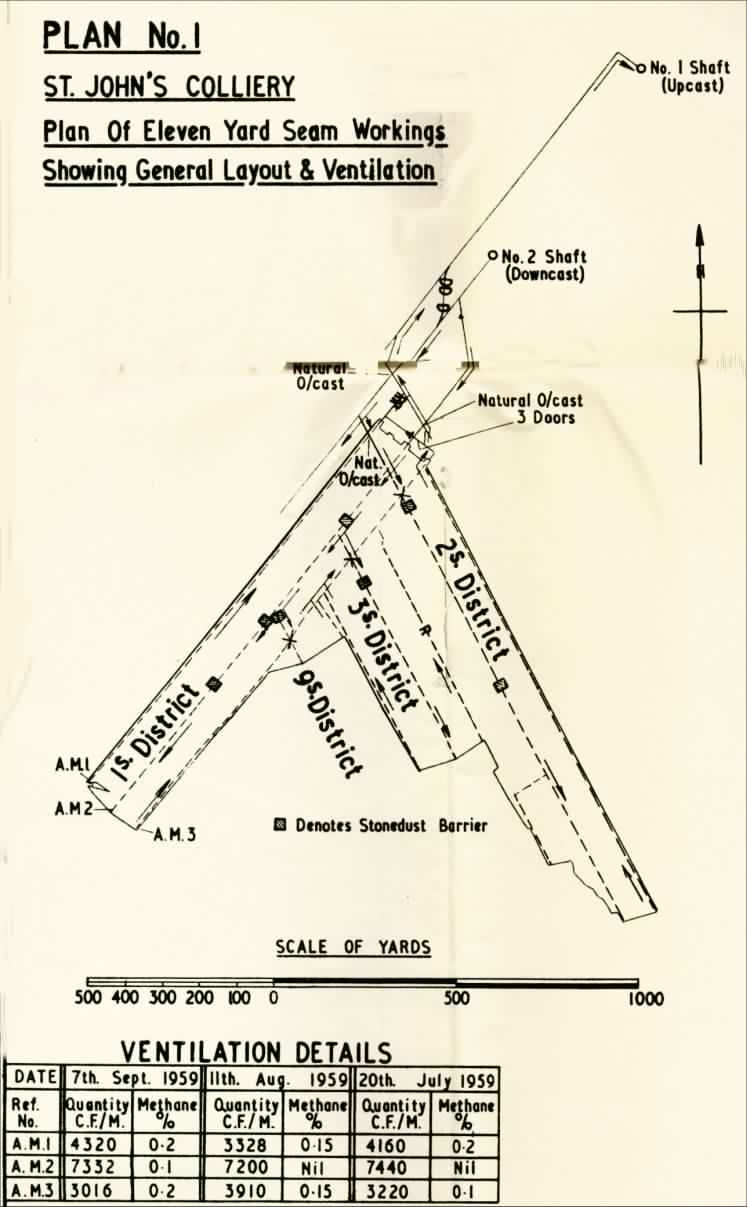
5. The Eleven Yard Seam which is 2 feet 4 inches thick lies below a grey bind roof and above a few inches of dark fireclay beneath which is a stone bind. Plan No. I shows the general layout and system of ventilation of the workings in the seam. These were begun about seven years ago by the formation of l's District, a double unit longwall face. 200 yards long dipping from right to left at 1 in 80. By the time of the explosion this face had advanced about 1,700 yards in a south-westerly direction from the shafts. Besides being an important producing face, it had served for development. Three successive double unit advancing faces, 2's, 3's and 9's. had been set away from it in a south-easterly direction. At the time of the explosion 2's had finished 3's and 9's were in production.
6. The coal on l's face was undercut by machine, loosened by explosives and hand-filled on to face conveyors with a common transfer point on to a gate conveyor at the loader gate which was central to the face. The gate conveyor also received the coal from 3's and 9's Districts.
Ventilation.
7. Unit ventilation was practised. The air entered by the loader gate and when it reached the face, split right and left so that each tail gate served as a return airway. On Plan No. I are particulars of air measurements taken in the district in July, August and September. The last statutory measurement before the explosion was taken on 7th September. A quantity of 7,332 cubic feet of air per minute was then reaching the face; 4,320 cubic feet per minute was passing through the right tail gate and 3,016 cubic feet through the left. As the air in each tail gate was sampled at the same time and shown by analysis to contain 0.2 per cent, of methane, the total make of methane on the face was about 14 to 15 cubic feet per minute. Thus, the workings in the seam were not free from gas.
8. The Silkstone and other seams above had already been worked and this may well have drained nearly all the gas from the Eleven Yard Seam. I was not surprised, therefore, to learn that on no occasion during the 12 months before the explosion had any deputy recorded in his statutory report the finding of firedamp in the district. Copies of the monthly ventilation records were posted in the pit bottom office for deputies to see and these showed that firedamp in low concentration was present in the general body of the air in both return airways.
Electricity.
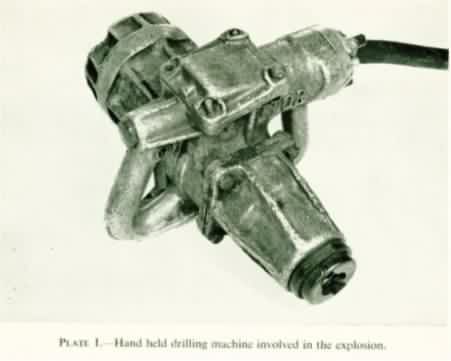
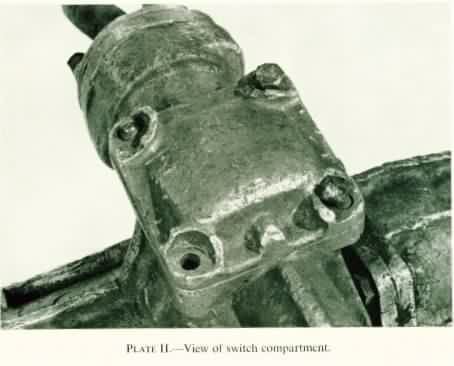
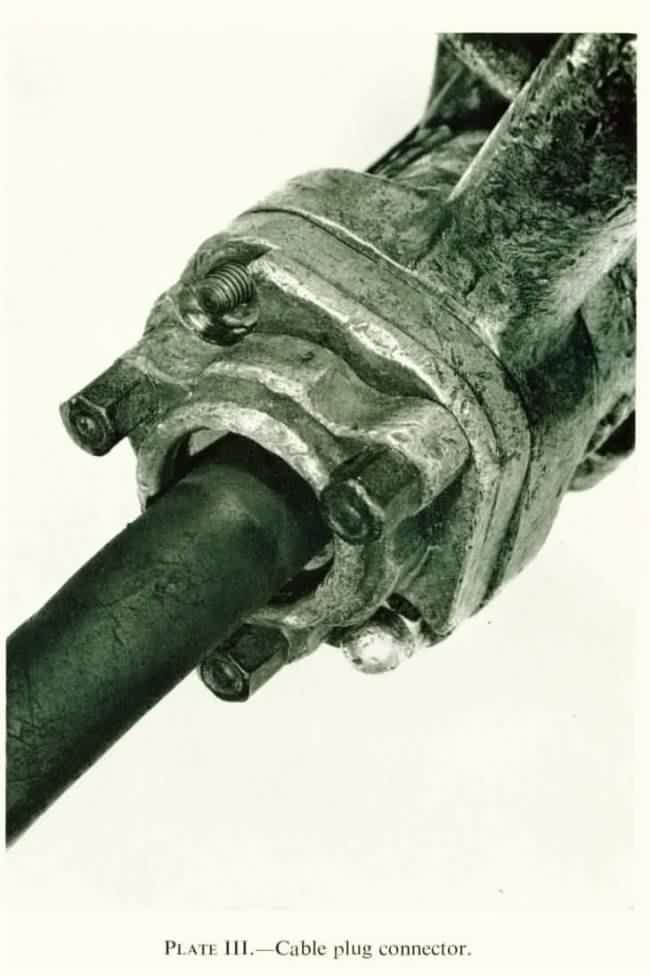
9. All the machinery in l's District was electrically driven; the power supply was alternating current, three phase, fifty cycles, at 550 volts with the neutral point earthed. The supply was taken to a group of gate-end switch panels, each of a type certified by the Ministry of Power as flameproof. situated in the loader gate. One of these panels was a drilling unit of the frequency changer type and was provided with two socket outlets for supplying, by trailing cables, two hand-held drilling machines (see Plate 1) either simultaneously or separately. The apparatus was so designed that the drilling unit could be operated by means of remote control from a switch on either drilling machine, which consisted of a flameproof casing housing a l½ h.p. motor and a small switch compartment (see Plate II), containing the remote control switch. The drill trailing cable was attached to the machine by a bolted type plug and socket coupler; the socket formed an integral part of the casing. The plug was designed to be attached to the socket by two studs, with nuts, spaced diametrically opposite each other; the cable itself was secured to the plug by a three bolt clamping arrangement (sec Plate Ill). The cable supplying the machine had five cores; three of these provided power for the motor, one served as a pilot core and one as an earth return core. By closing the remote control switch on the drilling machine the remote control circuit was completed at 25 volts thereby operating the drilling unit which then supplied electricity at 125 volts to the machine. The casing of the plug and socket coupling formed part of the remote control circuit so that if a gap occurred at the joint between the plug and socket whilst the switch was closed, the remote control circuit would he interrupted or broken and open sparking could take place at that gap.
The advance through faults.
10. When the Silkstone Seam, 17 yards above the Eleven Yard Seam, had been worked in the same area 15 years earlier, a number of faults were encountered. As was expected, these faults were found to have extended down to the Eleven Yard Seam and in April l's Face at its left corner struck the first, a downthrow, running at an angle of 15 degrees to the line of face. At the loader gate this fault had a displacement of 9 inches (see Plan No. 2) and the advance of the face was not interrupted.
11. Towards the end of May a second downthrow fault was struck. The line of this fault was almost parallel to the face so that with each turnover it moved rapidly across the face to the loader gate at which point the displacement was 3 feet 6 inches. Because this displacement was greater than the seam thickness it was found impracticable to turn over every day as the advance of the face was controlled by the rate at which a new face line could he won out. Progressively, the number of turnovers per week was reduced until, in the week of the explosion, only one was made. Because of the increased displacement of the fault the following method was adopted to negotiate it on the right hand face.
12. From the loader gate a heading. which was to become the new face, was driven in the coal for a distance of about 34 yards along the downthrow side of the larger of the two faults. At the same time the right face was swung round, with the face conveyor delivery point as a pivot, so as to strip the coal as much as possible on the upthrow side of the fault. This allowed the right tail gate to he taken to within a short distance of the faulted ground, through which it was then continued as a small heading ready to connect to the new face in due course. It was not possible to recover all the coal up to the fault; the coal not recovered is shown in black on the plan. Four slits about 6 feet wide were driven through this coal and through the faulted ground at distances of 40, 50, 64 and 80 yards from the loader gate. When the face heading reached the first slit the face conveyor was transferred to the heading in order to expedite its progress.
13. Each of the first three slits was successively continued diagonally to follow and ventilate the coal heading which was establishing the new face. Stone from a roof ripping, about 18 inches thick, was used to build a 4 feet wide Continuous pack up the centre of the heading. The ventilating current was made to reach the face of the heading by having to pass round this pack which was kept to within 4 to 5 yards of the head end. The current then travelled back through the slit, to the old face line, along which it passed to the tail gate. Earlier in the week during which the explosion occurred it was found from survey that the face was slightly ahead of the tail gate heading which was 25 yards beyond the fourth slit. The face advance was therefore halted to enable the two to be connected. After the heading reached the fourth slit the system of ventilation which had been followed up to that point was abandoned, and no other provision was made for ventilating the heading beyond the last slit.
14. The face heading had almost reached the tail gate heading by 25th September. In fact the hole which was being drilled when the explosion occurred was possibly a proving hole. The tail gate heading was then not more than 4 feet away but not quite in the direction in which the hole was being drilled.
Contents
IV-EVENTS LEADING UP TO THE EXPLOSION.
15. The Group Manager last inspected l's District on 27th March, 1959. Thereafter he received reports every day up till 11th September of the progress made by the face. He left on 12th September for a holiday which ended on 26th September, the day of the explosion.
16. The manager inspected the face on 12th September when the heading was about 5 yards beyond the fourth slit. He has told me that he then considered that the place was too narrow and that he directed that it should be widened. On 17th September he made his last inspection before the explosion; he says that he found the heading had made no further advance, that it had been widened as he had directed, and that the roof had been taken down at the face end of the slit.
17. The under-manager had made a practice of inspecting the face at least once a week. During the week in which the explosion occurred he made three inspections. On Thursday, 24th September, two days before the explosion, workmen in the face heading and in the tail gate heading could hear one another for the first time. The distance between the two places was about 5 yards but they were separated by faulted ground and the face heading was about 4 feet 6 inches below the level of the tail gate. The under-manager therefore gave instructions for a narrow pilot heading to be driven from the face heading steeply upwards in the direction of the sound (see Section A-B-C on Plan No. 2). The soft material in the fault leader was sheared by hand so that the coal and stone could be blasted.
18. On the Friday day shift only one man, E. Bradley, was working in the heading; he had with him a flame safety-lamp. The colliery records do not show Bradley to have been a person who was authorised to operate electrical apparatus. During the shift Bradley discovered that the drilling machine would not start. He reported accordingly to the deputy, N. Wilson, who by external examination of the machine saw that it was not in a proper working condition as its cable plug attachment was not secured in the proper manner. Wilson considered that it was not his, but an electrician's business to deal with a machine in such a condition. The machine was detached from the trailing cable and put on one side. Wilson then sent Bradley to obtain another machine from the tail gate. When Bradley returned with this other machine which had a new switch cover plate it was coupled up to the trailing cable and tried. It would not work. Wilson then sent for an electrician, T. Thatcher, who was in 3's District. The two men met in the loader gate, discussed the trouble and went along the face. As they went along Thatcher examined the trailing cable except for short lengths of it which were covered by fallen stones or conveyor equipment.
19. When they reached Bradley in the heading it was demonstrated to Thatcher that the machine with the new switch cover plate, which was still connected to the trailing cable, would not start. Thatcher was told that the other machine was the machine Bradley had first tried to use and that it would not start, but he was not told of its condition and he did not examine it. After examining the machine with the new switch cover plate and finding it in order, Thatcher deduced that the trailing cable was defective and that a replacement was necessary he left the district to arrange for this. Before the replacement cable arrived, however, the machine with the new switch cover plate was disconnected and taken away for use elsewhere. The first machine with the plug attachment not properly secured, was left in the heading. The deputy did not report either verbally or in writing, to anyone about the condition of that machine although he had seen that it was not in proper working order.
20. The replacement cable was taken into the district by the afternoon shift. W. H. Grinsill, collier, took it along the face and into the heading. Grinsill, who had a flame safety-lamp with him, was to work alone in the heading for that shift. He was not authorised to operate electrical apparatus. The drilling machine which was there was coupled to the new cable, and Grinsill found that it worked. He did not examine it in evidence he said, "I rarely bother about a machine if it works all right ". During the shift Grinsill drilled several shot holes in the heading face and these were fired by the afternoon shift deputy, J. 'McNiff. McNiff's attention had not been called to any defect in the drilling machine and he did not examine it. Grinsill left the place at 8.30 p.m. at the end of his shift.
21. The night shift, during which the explosion occurred, comprised a deputy and seven workmen. Two. L. Grinsill and Bradley, had worked on the day shift and, at the request of the under-manager, had returned on the night shift. Their job was to work in the heading. They did not have a gas detector. The job of the other five including T. Joyce, leading cutterman, who had a flame safety-lamp, was to cut the face from the coal cutting machine, which was some 35 yards to the right of the loader gate. towards that gate. The deputy in charge of the district was J. Dean.
22. Work started on the face at about 11.0 p.m. Joyce turned the coal cutting machine. jibbed it in, and then began cutting towards the loader gate. Dean spent most of his time with Grinsill and Bradley who were working in the heading. Dean fired three rounds of shots in the heading. the last about one hour before the explosion. At about 2.0 a.m. the coal cutting machine reached the loader gate where it was stopped. The conveyor was stopped at the same time.
Contents
V-THE EXPLOSION.
23. Soon after this, Joyce felt the ventilation suddenly reverse and small pieces of coal strike him in the face. At first he thought that the heading had connected with the tail gate. He then realised that if this had occurred its effect would have been to increase the flow of ventilation in the normal direction and not to reverse it. Feeling some concern, therefore, he spoke to his mates and went the few yards outbye to the telephone. On the telephone he spoke to Cotton. the overman in charge of the mine, who was at the pit bottom. Cotton asked him to go along the face to see what had happened. This Joyce did but without his flame safety-lamp. When halfway along the face he noticed a general settlement of dust on the floor and the supports. As this was unusual he thought it was something serious. He went on to the slit and came upon Dean conscious but badly burned. He pulled Dean into the slit and sent one of his mates back to give a general alarm. Before going forward to find the other men, Joyce asked Dean for his flame safety-lamp. Dean said he had dropped it in the heading. Joyce. very commendably, because the atmosphere was hot and thick with dust, then went in and recovered Dean's lamp which was near the face conveyor tension end. He then returned to the slit, examined the lamp and, finding it in order, re-lit it. He then went back to the tension end and found Grinsill lying face downwards as if in a deep sleep. He turned Grinsill's head sideways clear of the dust on the floor to ease his breathing. He went up to the face of the pilot heading where he found Bradley (see (3) on Plan No. 2) unconscious. Bradley was kneeling with the drilling machine in his hands. Joyce took the drilling machine away from him. He then returned to Dean. Dean told him that Bradley had been drilling when a flash occurred. When help arrived the three injured men were taken out on stretchers they were met some distance outbye by Dr. Reeve. A local doctor, who found that Bradley and Grinsill were dead. Dean was taken to hospital where he died three days later.
Contents
VI-THE INVESTIGATION.
24. At about 5 a.m. the manager inspected the heading. He found it clear of firedamp except for a small accumulation of about 3 per cent. confined to the top right hand corner of the pilot heading. Before leaving he made an external examination of the drilling machine and noticed that it was defective. Shortly afterwards he returned with the secretary of the local branch of the National Union of Mineworkers. They inspected the heading together and agreed that there was no further danger. At about 9.0 a.m. C. Gorrie, one of H.M. Inspectors, carried out an inspection; he tested for gas and took air samples in the ventilating current and in the heading which he found clear apart from the pilot heading. Twelve feet back from the face of the pilot heading he tested and found l½ per cent of gas at the floor and 3 per cent. at a height of about 2 feet. but upon raising his lamp higher the flame spired. He then took an air sample at roof level at the same point and this was found by analysis to contain methane in explosive proportions, namely, 11.94 per cent.
25. Since it was apparent that gas was slowly accumulating in the heading arrangements were made as Gorrie left at about 10 a.m. for a brattice sheet to be erected from the slit to the heading face in order to conduct air into the place and make it clear for the main investigating party. Gas was not found in the heading when at about 1 p.m. H.M. Inspectors, assisted by officers of the Safety in Mines Research Establishment, made a thorough investigation of the affected area in the presence of representatives of the National Coal Board and other interested parties. The results of these investigations and the conclusions which I draw from them, are described below.
The circumstances of the explosion.
26. Signs of violence were slight and the system of ventilation, though momentarily reversed, had not been disturbed. Scorch marks on timber, charred paper and some small coke deposits on a few props, indicated that flame had extended for a distance of about 40 yards back along the face from the pilot heading, which could have given a maximum volume of flame of about 3,000 cubic feet. Coal dust did not seem to have played any part in the propagation of the explosion. The relatively small amount of explosion dust deposited in the area suggested that the explosive medium was a fairly rich inflammable gas mixture. The total quantity of methane involved could have been as much as 50 to 60 cubic feet. Post mortem examinations subsequently showed that Grinsill and Bradley died from carbon monoxide poisoning and Dean from complications following extensive burns.
The igniting agent.
27. The explosion was known to have occurred at a time and place where there was in use an electric drilling machine. Although this was so, a complete investigation of all possible igniting agents was made. Most were quickly eliminated. Careful search failed to reveal any contraband. Compressed air had not been in use. All the lamps which had been in use in the heading were recovered and found to be in good order. I am satisfied that shot firing had not been in progress at the time of the explosion. There were no signs of frictional heating, and the working place was not high enough for a falling stone to produce an incendive spark.
28. Attention was therefore concentrated on the drilling machine, the condition of which is shown in Plates I to III. S. Luxmore, H.M. Electrical Inspector of Mines, and the Electrician-in-charge of the mine examined the machine underground. Its cable attachment was of the bolted plug and socket type and should have been secured by two studs with nuts. One of the nuts was missing, the other was only "finger tight" and the attachment was loose. They found that they could move the plug and obtain a maximum gap of 0.015 inches at one point at the flange joint which was of the spigot type (see Plate III). They also found when examining the cover of the pilot switch compartment on the machine that of the four bolts securing the cover, one was missing, two had been replaced by studs which were bent sideways and were without nuts and only one was secure in position. Notwithstanding this the maximum flange gap measured at a point near to the vacant studhole did not exceed 0.01 inches and the cover was quite securely held (see Plate II).
29. Because of the defects which they had found, the machine, the associated cables and the drilling panel were sent to the Safety in Mines Research Establishment at Buxton to be tested. When the testing officers tested the remote control circuit part of the machine, they found that sparking occurred at the joint between the plug and socket coupler and this sparking ignited an inflammable methane/air mixture.
30. I conclude that the igniting agent was an incendive spark at the flange gap between the plug and socket coupling of the drilling machine which was being used at the time to bore a shot hole. The drill rod was found fast in the hole. It is possible that Bradley, in an attempt to release it, might have been twisting the machine and so caused movement to take place between the plug and socket of the cable attachment.
The source of the gas.
31. Gas had not previously been found during the heading out of the face. During this operation many shots had been fired and numerous tests for gas ,should have been made. I credit Dean with having tested for gas in the course of the last three rounds which he fired.
32. After the explosion, which apparently consumed all or most of the gas, the manager had detected a small accumulation confined to the top right-hand corner of the pilot heading. Nearly eight hours after the explosion, this was shown by Gorrie to have increased in volume and reached explosive proportions. I estimate that the amount of pure methane then present could have been from 20 to 25 cubic feet which would have been produced at an average rate of about 0.05 cubic feet per minute from the time when the explosion occurred. This demonstrates that even a fractional rate of emission can produce a highly dangerous accumulation given the time and conditions. The sample containing the explosive mixture of gas was taken at the horizon at which Bradley would have been holding the drilling machine. I conclude that at or near the point where the manager had found gas there was a feeder from which the gas involved in this explosion issued after the last round of shots had been fired, that is to say, in the one hour before the explosion. During this hour, the average rate of emission of the methane would have been about one cubic foot per minute.
Ventilation.
33. Apart from the heading, the standard of ventilation throughout the district was satisfactory, indeed any greater quantity of air passing through the right face might have caused discomfort to the men working there.
34. The deputies told me that they had never conducted air into the face heading after it had passed the fourth slit because the ventilation there was thought to be satisfactory. This assumption appears to have been based on the fact that gas had never been detected by a flame safety-lamp and it took no account of the ventilation records which showed that methane was present in a low concentration in the return airway. To extend the face heading beyond the fourth Slit to the point it had reached at the time of the explosion took about a fortnight. I can understand why in the first 18 yards of this extension no gas was detected because any which was there would either have layered very thinly against the roof or, being dispersed into the general body of the air by the many activities in the heading, would have given a very low concentration.
35. After 18 yards however, the extension rose steeply in the form of the pilot heading which passed through the faulted ground, which was in itself likely to contain more gas. In addition to this any gas which was present would tend to accumulate in the roof of the pilot heading before spreading to the rest of the heading. As the pilot heading rose above the normal seam roof the point was sure to be reached at which the drilling machine would he raised into any accumulation of gas. Whether gas was suspected or not, good mining practice called for a high standard of ventilation in such conditions, and ordinary prudence should have shown that it was necessary in this heading. No one made any effort to see that this ventilation was provided. That the ventilation could easily have been provided was clearly demonstrated by the fact that the gas which was discovered by Gorrie after the explosion, was easily removed by bratticing between the time when he left the heading at 10 a.m. and the time when the investigating party arrived at about 1 p.m.
36. It is quite clear that at the time of the explosion the necessary steps had not been taken for securing that there was constantly produced in the heading, ventilation adequate for diluting gas that was inflammable so as to render it harmless and remove it.
Precautions against inflammable dust.
37. There appears to have been complete compliance with the Regulations in regard to inflammable dust and I am satisfied that it played no part in the explosion.
Authority to operate electrical apparatus.
38. On the shift on which the explosion occurred, and on the two preceding shifts, the drilling machine was used by at least two persons who appear not to have been authorised to operate electrical apparatus. The drilling of shot holes in coal is now carried out on a very large scale and a man can quickly become expert in operating electric drilling machines; it is possible that many persons who are not duly authorised are tempted to use them. All persons who may have occasion to use a machine should he trained in accordance with the requirements of Section 88 of the Mines and Quarries Act, 1954, so that, if suitable, they may be duly authorised. They must be properly instructed in the operation of any machinery or electrical apparatus that may be specified, and special emphasis must be placed on the duty to report forthwith to an official of the mine any obvious defect which might impair the safe working of the machine or apparatus.
Deputies and electricians.
39. The attitude of the deputies towards the operation and condition of electrical apparatus was somewhat disturbing. One deputy saw that the machine was defective but he did nothing about it because, so he told me, he thought it was the business of the electrician. Another deputy did not examine the machine, nor did he satisfy himself that W. H. Grinsill was authorised to operate it. A deputy has many duties, one of which is to take all reasonable steps to ensure that all machinery, apparatus and other equipment in his district is properly maintained and that any which is found by or reported to him to be in an unsafe condition is not used while in that condition. A deputy is not expected to be a specialist in electrical matters but if he sees, in the course of his inspections of his district, apparatus which is clearly defective, it is his responsibility to ensure that it is not used. If electricity is in use in his district this adds to the duties and responsibilities of the deputy; he is not relieved of any part of this additional duty by an electrician. The functions of the two are distinct but complementary to each other. An electrician's functions are more detailed and expert and involve not only the operation and inspection of apparatus but also its internal examination, maintenance and testing.
Scheme of maintenance of electrical apparatus.
40. By Regulation 7 of the Coal and Other Mines (Mechanics and Electricians) Regulations, 1956, a manager is required to ensure that there is in force a scheme providing for the systematic examination and testing of all electrical apparatus at the mine to ensure proper maintenance thereof. Such a scheme was introduced at St. John's Colliery in 1956 but it never became fully operative and after a short life it practically lapsed. This was due in part to a shortage of stall although some improvement in organisation might have enabled the staff to make a better contribution than they did it was due also to a lack of interest or participation in the scheme by those whose statutory duty it was to see that it was fully implemented.
41. The scheme could have been made to operate successfully only if steps had been taken to ensure that the electricians made their daily reports relating to the inspection, testing and maintenance of apparatus in proper form. Seldom, however, in their reports were drilling machines, if mentioned, identified. Indeed, in submitting what were called "block" reports, that is to say, reports stating that "all" the electrical apparatus had been examined in a district, the "all" as explained by the electricians, would not include apparatus which had been in use at the time of their inspections and was not therefore available to them. This applied particularly to drilling machinery which was used intensively. The scheme could not possibly be made to work under such a system of reporting.
42. The scheme of inspection and maintenance for electric drilling machines as conveyed to me required daily inspection by the operator, weekly inspection by an electrician of the mine and overhaul every three months in the surface workshop. According to an unofficial notebook kept in the surface workshop, the machine involved in the explosion had last been overhauled at the surface on 24th July, 1959, but there was no statutory record to this effect. According to an electrician's report the last external examination of the machine underground was on 29th August when an electrician of the mine reported that it was in order. There is no evidence where the machine was or what its condition was between 29th August and 25th September, the day before the explosion. If the scheme of maintenance and inspection had been fully implemented, it would have been clear that the machine was not being examined weekly, and if when this was known, appropriate action had been taken, there is just a chance, and I put it no higher than that, that its defective condition might have been remedied before the day on which the explosion occurred.
VII-INTRINSICALLY SAFE REMOTE CONTROL CIRCUITS.
43. The drilling machine involved in this explosion was of a type first certified as flameproof in 1953 and was fitted with a rectifier for "pilot-earth" protection. This rectifier had been removed to enable the machine to be used with a drill panel having a remote control circuit which did not include " pilot-earth" protection. This drill panel incorporated a remote control circuit operating at 25 volts for which a test certificate of intrinsic safety (T/RC/1) was issued during 1939. This certificate was granted following tests carried out at the Safety in Mines Research Board testing station at Sheffield. The test procedure adopted was believed, at the time, to represent the most dangerous conditions of circuit interruption. From about 1940 further research in connection with intrinsic safety was undertaken and it was found that under a more modern method of testing some doubt was cast upon the safety of this and a number of other remote control circuits.
44. From 1940 to 1946, 11 ignitions, causing the death of 13 persons and injuries to 13 others, occurred in connection with the use of electric drilling machines underground.
45. Each of the 11 accidents presented certain disturbing features, two of which were common to each case, namely,
(1) local defects in the ventilation arrangements, accompanied by failure on the part of those immediately concerned to detect and appreciate the potential danger; and
(2) a concurrent electrical defect which resulted in open sparking. The attention of the owners and managers of all mines under the Coal Mines Act, 1911, and of the secretaries of National and Local Associations of Owners, Officials and Workmen was drawn to these matters in Ministry of Fuel and Power Safety Circular No. 148, dated 25th September, 1946, which referred to intrinsically safe remote control circuits, and No. 153, dated 30th December, 1946, which referred to electric drilling machines. Details were given of each accident and of the precautions which should be taken to avoid similar types of accident. The Chief Inspector and the Principal Electrical Inspector in their reports covering the years 1939 to 1946, and the Principal Electrical Inspector in his reports for the years 1949, 1952, 1953 and 1954 called attention to these circulars.
46. 1 think it is important that I should quote the recommendations contained in the circulars in full because the explosion at St. John's might not have occurred if the precautions which were then recommended had been observed.
M.F.P. Safety Circular No. 148.
Intrinsically Safe Remote Control Circuits.
"1. There can be no dangerous sparking unless a remote control circuit is deliberately or accidentally interrupted at contacts which are exposed to the atmosphere. The deliberate bridging of pilot and earth contacts, when the plug has been withdrawn from the socket, as a means of testing the operation of the remote controlled switch should be avoided.
"2. A remote control circuit includes an earthing conductor. Care should be taken to see that it is not interrupted by loose connections or faulty contact between the parts of a plug and socket coupler, and the continuity of the earthing conductor should be tested at frequent intervals.
"3. Plug and socket couplers are likely to be subjected to very rough handling. They should be examined daily and replaced as often as may be necessary, and in so far as this is practicable dispensed with altogether.
"4. Finally, there can, of course, be no danger of a firedamp explosion unless firedamp is present in the air. Therefore, look after the ventilation. This is specially important in fast ends, particularly if driven to the rise, where electric drilling machines may be used."
M.F.P. Safety Circular No. 153
Electric Drilling Machines.
The Circular emphasised the importance of: -
"1. a high standard of ventilation being maintained in all places where
electric drills are used, particularly right up to the roof at a ripping lip;
"2. the use at all times of suitable firedamp detectors by properly trained competent workmen;
"3. frequent and thorough examination of all drilling equipment by properly appointed and qualified electricians;
"4. proper care of drilling machines and their associated apparatus by all workmen operating them, who should be thoroughly instructed in their use;
"5. full regard to the precautions necessary in handling the remote control apparatus associated with electric drilling machines, as outlined in M.F.P. Safety Circular No. 148."
47. Until such time as appropriate modifications could be made in the design of remote control circuits and such modified circuits were generally available, it was considered that the risk, if any, of allowing existing circuits to remain in use could be controlled by observing the precautions which had been recommended.
48. A large number of these remote control circuits are still in use and are likely to remain so for some time. As long as they do remain in use the recommendations in the Safety Circulars of 1946 will hold good. All persons concerned with the installation or operation of apparatus which incorporates these remote control circuits should ensure that these recommendations are fully implemented. For general guidance I would point out that remote control circuits with certificate numbers less than T/RC/31 have been found by modern methods of testing to be suspect.
49. Ignitions of firedamp caused by drilling machines incorporating the older types of remote control circuit occurred in this Division in 1952 and 1954. As a result of correspondence between my predecessor and the Production Director of the North Eastern Division of the National Coal Board, the Board carried out a review which showed that in 1955 there were still in use 1,005 of these electric drilling machines with remote control circuits on the safety of which doubts had been cast: these were being gradually replaced by new or modified types. By the time the St. John's explosion took place, 512 had been replaced or modified and rather less than half of those in use in 1955 were still in use. If these are replaced or modified at the same rate it will be five years before they have been eliminated from the Division.
50. The hazard presented by the use of apparatus which incorporates this early type of remote control circuit is not confined to the North Eastern Division. The amount of such apparatus in use throughout the whole country must be very large. It is however important that its use should be discontinued. I therefore recommend that the National Coal Board and any other mine owners who may be concerned should review the position and then arrange for the withdrawal of this apparatus, giving priority to that used for drilling which presents the greatest hazard.
Contents
VIII.-SUMMARY OF CONCLUSIONS.
51. My conclusions are summarised as follows -
1. The explosion was one of firedamp initiated in the pilot heading being driven to win out the right side of l's face (Paragraph 32).
2. At the time of the explosion steps had not been taken for securing that there was constantly produced in the heading, ventilation adequate for diluting gases that were inflammable so as to render them harmless and to remove them in accordance with Section 55 of the Mines and Quarries Act, 1954 (Paragraph 36).
3. The igniting agent was an incendive spark at the flange gap of the plug and socket coupling of a drilling machine which was being used at the time to bore a shot hole (Paragraph 30) in a place in which inflammable gas, although not normally present, was likely to occur in a quantity sufficient to be a danger (Paragraph 35).
4. The scheme for systematic examination, maintenance and testing of all electrical apparatus at the mine was not being fully implemented (Paragraph 42).
5. The recommendations contained in M.F.P. Safety Circulars Nos. 148 and 153 in regard to the use of electrical apparatus incorporating the type of remote control circuits described therein were not observed (Paragraph 46).
IX.-ACKNOWLEDGMENTS.
52. I welcome this opportunity of expressing my sincere thanks to the representatives of all organisations. members of the staff of the Safety in Mines Research Establishment as well as members of my staff, who assisted m the investigation of this explosion and in the preparation of material for this Report.
I have the honour to be, Sir,
Your obedient Servant,
H. J. PERRINS.
Contents
Joseph Dean, aged 46, Deputy.
Leslie Grinsill, aged 33, Collier.
Edwin Bradley, aged 47, Collier.
Plate 1.
Plate 2.
Plate 3.
Ventilation Plan.
Contents

|