Old Coal Face Support Methods. Part 2.
Longwall Mining.
Longwall faces could be 200 yards or more longer.
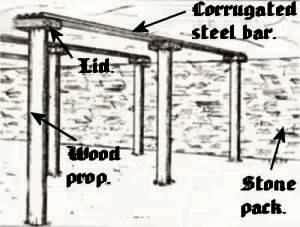
Roof supports were set along the length of the face in rows.
Distances between supports were laid down in the Managers support rules.
The distance between rows could be 4ft. to 6ft.
The distance between props in the same row was up to 4ft.
Complete set of timber.
Contents
3 shift system.
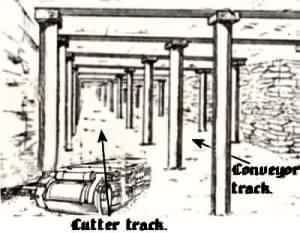
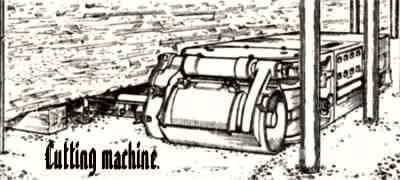
First shift. Coal cutter undercuts the coal.
Second shift. The coal is blown down with explosives and filled onto a bottom loading conveyor. Supports are set where the coal has been removed.
Third shift. Dismantles and re-erects the conveyor in the new track, which is now forward of the old track. As the coal face advances so must the conveyor.
Usually a "driller" works between the cutting and filling shifts, he drills the whole face ready for shot-firing.
Contents
Pillar and Stall.
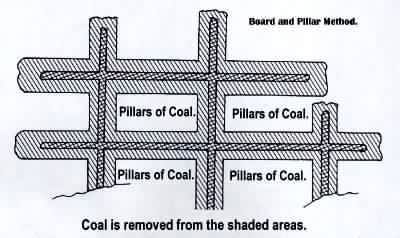
(a) board and pillar
(b) pillar and stall
(c) room and pillar
(d) stoop and room.
The name varied depending upon the part of the country the mining took place, however the method was basically the same.
Coal was extracted by driving headings and cross headings ( the 'rooms' , stalls etc.), pillars of coal were left in to support the roof. When a boundary was reached they began working their way backwards, removing the pillars on a retreat basis.
With this method of working the coal is cut and filled each working shift as required.
Contents
Setting supports at the face end.
Support systems need to be flexible to allow for machinery, gear-heads, etc.
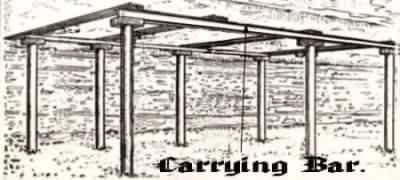
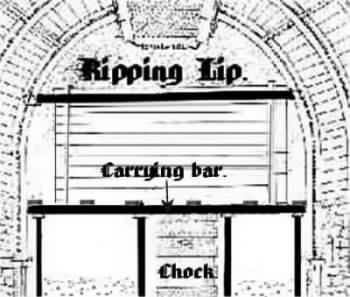
Long bars or girders are used in certain places; they span the length or width of a specified area. These long bars, support the face bars; and are often called "carrying bars".
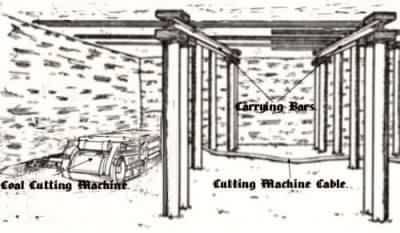
Rippers also use carrying bars as a guide when they are dropping a ripping lip.
A wood chock may me built under carrying bars to give greater stability and support.
Contents
Withdrawing supports.
All supports except the packs were withdrawn at the edge of the waste (goaf) as the face advanced.
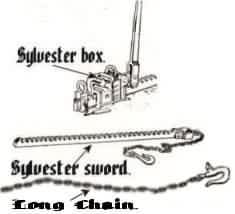
When supports are withdrawn the roof above the withdrawn support often collapses. So a Sylvester was often used for safety reason.
A temporary support could be set to secure the roof while the supports were withdrawn.
This "catch prop" helps prevent sudden falls of roof, which gives workmen a chance of avoiding an accident.

Contents
Using a Sylvester.
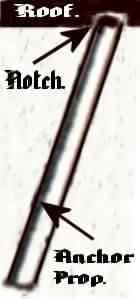
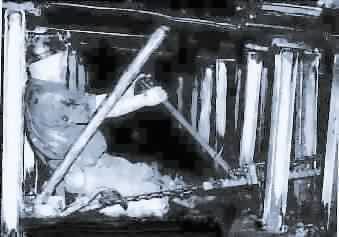
Set an anchor prop, which is inclined towards the support that is being withdrawn and with the top of the anchor prop inserted into a previously made notch in the roof.
Put the Sylvester sword chain around the foot of the anchor prop, ensuring the hook passes under the chain.
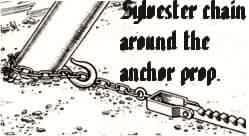
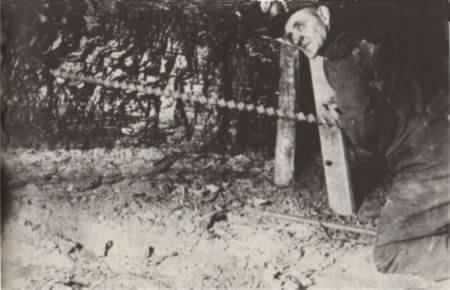
In this photograph a purpose made shoe is being used under the anchor prop.
Place the hook of the long chain round the top of the prop to be withdrawn.
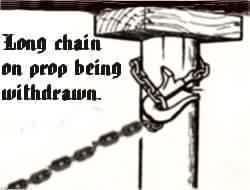
Pull the chain as tight as possible and place a link into the eye of the Sylvester box.
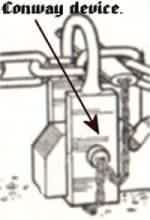
Ideally a Conway device should be used to help to guide the chain; in my experience this device was rarely used.
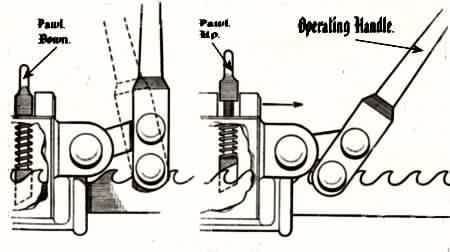
Pulling on the lever handle operates the Sylvester; the box slides along the sword. Inside the box is a spring-loaded pawl, which engages the teeth of the sword and prevents the box from slipping back when the operating handle is released.
Contents
|