


| Newspaper Articles |

|
Newspaper Articles |
 |
 |
West Cumberland Times
Article from the West Cumberland Times, 4th September 1957
"Historian's" Notebook
Early Progress In The Coal Industry
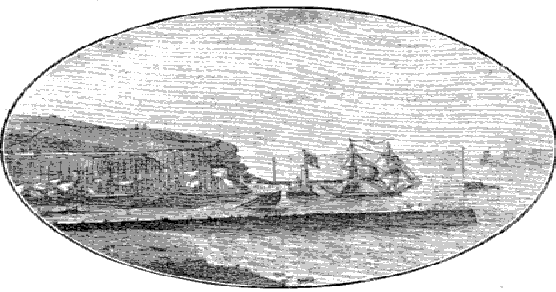
A view of Whitehaven Harbour as it appeared early in the 18th Century when the coal trade was growing fast
In the latter half of the eighteenth century there were several aspects of coal-mining in Whitehaven which distinguished it from other colliery districts. Most striking of these was the way in which coal was loaded in vessels lying in "this remarkable creek." The height of the banks was such as to allow the wagons to reach a point directly above the waiting vessels, and there, following a procedure now almost universal at coal ports, the bottom of the wagon was swung open and the coal slid down a wooden chute directly into the hold. Hand heaving was, therefore, unknown at the port, and it was estimated that eight or ten vessels of 120 tons burden could be loaded at a single tide, at a cost of 10s each.
At this date the coal mines had earned the distinction of being described as "perhaps the most extraordinary in the known world." If money could have bought such a title, the pits of Whitehaven deserved it, for it was estimated that Sir James Lowther and his father Sir John (who was the first to mine coal for export) had in the course of the preceding century had expended something like half a million pounds on working and improving the pits.
Under The Sea
The entrance to the mines, we understand, was by an opening which led through a steeply descending passage to the lowest coal measure. This main passage was intersected by numerous galleries, all the intervening coal being cut away with the exception of strong pillars, three yards high and about twelve yards square at the base in the deepest parts of the mine. (It will be recalled that the removal of similar pillars was held responsible for the Lady Pit disaster at Workington in the last century.)
The mines, considered at that date to be the deepest ever sunk, were of about one hundred and thirty fathoms and went far under the sea. Between the three strata's of coal there was a "communication by pits." Dykes, as faults in the strata were known among miners, were frequently encountered and a number of experimental upcast or downcast shafts were often needed to discover the lost seam. On other occasions, when the fault was extensive, a laborious and expensive level had to be driven through the solid rock to reach it.
Fire Damp
Ventilation was, as now, a matter of prime importance, for even though the chemical and physical cause of "fulminating damp" and "choke damp" were only indifferently understood, the danger had been demonstrated on a number of disastrous occasions. The accumulation of fire damp in deserted workings, where ventilation had been discontinued, was the common cause of explosions, and subsequent fires which in some cases burned for several months had to be quelled by means of complete flooding of the affected district. A common means of preventing accumulation of damp was to search for the crevices where the discharge was most noticeable, confine the escape and conduct it to the surface through pipes, at the end of which the gas was kept perpetually burning.
"Safety Lamp."
Mr. Spedding engineer to the Lowther's, also undertook much serious research into mine safety precautions, and after he observed that "fulminating damp" was likely to be ignited by flame only, and not by hot iron or sparks from flint, he invented a machine consisting of a revolving steel wheel with flints in contact with it, whereby miners were given a light sufficient to enable them to get to the coal face where the usual naked candle or oil flame would precipitate an explosion. It was considered that this invention was the only alternative to closing many productive areas.
Flooding was a close second to fire as the miner's enemy Number One, and against it "fire engines" (steam pumps) were in use. The largest of these had a cylinder bore of seventy inches and it was calculated that it would have taken over five hundred men to keep its pumps in operation by hand. The same statistician calculated that this engine could raise as much water as 2,520 men with buckets and rollers. Nearly two millions gallons daily were extracted by four engines of this type. One of these pumps raised the water from eighty fathoms to a cistern at sixty fathoms, a second to forty fathoms, a third to twenty and the fourth to the level of high tide.
Horsepower
The confinement of fire damp was achieved by boards a few feet out from the sides of the galleries, giving a free circulation of air between (or so it was claimed). There is no mention of forced draught, or of draught induced, as in some early pits, by the sinking of a second shaft at the foot of which a fire was kept lit to create convection current.
The raising of the coal itself was, however, still a matter of horsepower, provided by two animals which were changed at the end of each shift of eight hours.
We learn that Sir James Lowther earned from the colliery, and rents of his buildings, something like £16,000 a year ("while his grandfather made only £1,500.") Sir James was not a grasping employer, however. Far from it. He is said to have kept a granary perpetually full of oats, which he never disposed of while the markets were low, but as soon as the price rose above five shillings a bushel he opened the granary and sold the grain to his employees at five shillings, no matter what it had cost him.
"No Fields Remain."
The writer on mines and miners had not great optimism about the future of the industry. "The quantity (of coal) left to work," says one of them. "is, in my opinion, no great matter, though they talk of two miles under the sea, for a few years will exhaust it; and if the roof gives way in any one place the coal will not only be drowned but above two hundred people will lose their lives. The strata are almost spent to the length of Workington, at least no great fields of coal do remain. Calculations in the 1700's were, it seems, not of a very high order.
Newspaper transcript kindly provided by
West Cumbria Mines Research.
 |
 |
| Names mentioned in this article | |
 |
 |
| Name | Age | Occupation | Notes |
|---|---|---|---|
| Lowther, James, Sir | Mine Owner | ||
| Lowther, John, Sir | Mine Owner | ||
| Spedding, — | Engineer |
|
|
| Links to Collieries/Mines mentioned in this article | |
|
|
 | Whitehaven Colliery |




 Contains public sector information licensed under the

