


| Newspaper Articles |

|
Newspaper Articles |
 |
 |
30th May 1951
Miners Trapped After Pit Explosion
14 Bodies Found : Over 60 Men Missing
Sixty-six men are trapped in Easington colliery, County Durham, where a violent explosion occurred early yesterday morning.
Last night the National Coal Board issued a list of 81 men dead or unaccounted for. This includes 14 bodies which were found, and one injured man who was brought to the surface but died later.
Rescue teams, working under great difficulties, were trying to reach the trapped men last night. One of the rescue workers lost his life.
Mr. E. H. D. Skinner, chairman of the Durham division of the National Coal Board, stated late last night that it would be in the nature of a miracle if any number of men were got out alive.
The King sent a message of sympathy to Mr. Skinner expressing the deepest distress of the Queen and himself on learning of the disaster.
Hopes Fading
Rescuers Delayed By Rock Falls
From Our Special Correspondent
Easington, May 29
By early evening one man had been brought to the surface seriously injured, 14 bodies had been found, and 63 men — and possibly one or two more — had not yet been traced after an explosion at 4.45 a.m. to-day at Easington colliery, about 10 miles north of West Hartlepool. Later it was announced that one of the rescue workers, Mr. J. Y. Wallace, of Murton, died during rescue operations.
In a final statement late to-night, Mr. Skinner said that it would be in the nature of a miracle if any number of men were got out alive. There was still just a chance that some men might be packed away in an air pocket somewhere, but the rescue teams had been up the one passage which it was thought that any trapped men could have reached. No further progress had been made towards the face.
It was the condition of the air, not the rock, which was stopping the rescuers now, and having lost one rescue man they were consolidating the satisfactory air base in the way the men must go before progress could be resumed. The normal ventilation had been interrupted, and air was blowing back instead of going forward along the workings. No bodies would be moved from the pit until to-morrow morning.
He added that Lord Hyndley, chairman of the National Coal Board, is expected here to-morrow.
The cause of the accident has not been stated, but Mr. Skinner said that from all the evidence the explosion was violent and there had been a serious disaster.
"Great Cloud" Of Gas
There have been heavy falls of rock in the roadways, but a few men working nearer the shaft, though blown down by blast, were not seriously hurt and were able to make their way to the shaft. One of these, Mr. George Williams, the 19-year-old twin brother of Mr. Matthew Williams (who was taken about noon to Ryhope Hospital, where he died later), related how, when a great cloud of black gas came along the road towards them, he tried to go inwards where his brother was working, but he was stopped by the overman.
Mr. H. E. Collins, divisional production director, said that the explosion occurred in the Duckbill district in the five quarter seam. Soon after 5 o'clock rescue brigades arrived from the main surrounding stations — Crook, Houghton-le-Spring, and Newcastle upon Tyne — and promptly went down the pit to see if anything could be done immediately. They had since explored parts of the affected area, and from the reports which they had made it was fairly evident that the explosion had been of a violent nature.
At the time of the explosion, he said, it was getting towards the end of the night shift, which consisted of repairmen and cutters and other ancillary workers on the coal face, and at the beginning of the fore shift, which was a coal-filling shift. The seriousness was increased by the fact that the explosion had taken place at that changing time.
The district involved was a longwall face roughly a mile and a quarter from the shaft bottom and lying at a depth of about 900ft. from the surface. The district was of land coal — under the land (part of the colliery workings are under the sea). The seam was the top seam of the pit. The coal from the longwall face was loaded by means of conveyors which operated roughly from about three-quarters of a mile in. Teams of men were working on the intake side to work their way through the falls, which were blocking the roadway to the face.
The rescue teams wore breathing apparatus to protect them from gas, and carried walkie-talkie apparatus to keep in touch with a mobile wireless van on the surface. During the day they were reinforced, until 12 visiting teams and many volunteers from this pit were taking it in turns, trying to clear a way to the scene of the explosion. Some bodies were found at a loading point nearly half a mile in. Beyond that a heavy fall was encountered, and proved so extensive that ultimately the rescuers had to abandon this main ingress and make up the intake airway and branch off it to regain the road on the inside of the barrier, which proved to be about 150 yards long.
The conditions of the roads down the pit were described as very rough, and blankets had to be spread over the entrance ways to galleries from which bad air was driving in. There did not appear to have been any fire consequent on the explosion, though the rescued youth and some of the bodies were badly burned by the blast. One disturbing feature is that although there were at least six telephones in the affected area, the workers on the surface have received no communications over them.
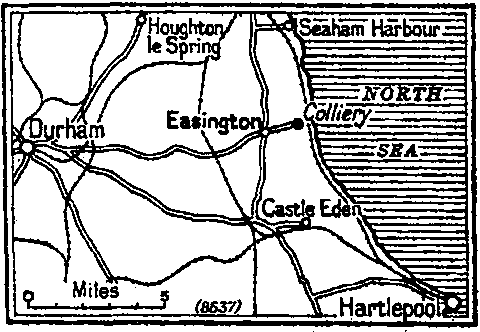
A serious loss of life must be feared in this pit which has hitherto known no major disaster. Indeed the Durham coalfield as a whole has been free from big accidents. The largest took place in 1909 at West Stanley, where 168 men were killed.
Easington colliery, which was opened in 1910, has been earmarked for a big development scheme.
The King's Message
The National Coal Board announced to-night that The King had sent the following message to Mr. Skinner :—
"The Queen and I have learnt with the deepest distress of the explosion at Easington colliery and of the severe loss of life there. We send our heartfelt sympathy to all those who have lost husbands or sons. — George R."
Mr. Skinner said he had sent the following reply to the King's message :— "The people of Easington colliery are deeply grateful for your Majesties' gracious message of sympathy in our sorrow. I deep0ly regret to say that hopes are dwindling, but I assure your Majesties that rescue operations are being tirelessly pursued."
Commons Sympathy
Westminster, Tuesday
Mr. Noel Baker, Minister of Fuel and Power, made a statement in the House of Commons to-day about the disaster at Easington colliery, Durham. In reply to a question by Mr. Bartley (Chester-le-Street, Lab.), the Minister gave news of the disaster so far as then known, and added : "I am sure the House will wish to express their deepest sympathy for the relatives of the officials and miners who have lost their lives or who have not yet been found."
Mr. Bartley said that he was sure the House would join in the sympathy expressed by the Minister, particularly to the people of Easington and to families and relatives. Furthermore, he was sure there was great admiration and feeling for the members of the rescue party who were at the present moment exercising great bravery and courage in this disaster. He hoped they would soon have some success in an otherwise tragic disaster.
Mr. Shinwell Leaves For Easington
Mr. Shinwell, Minister of Defence, whose constituency embraces Easington colliery, left by train for the scene last night and will arrive early to-day. Before leaving he sent the following telegram to the secretary of the pit miners' lodge, Mr. J. Reynolds :— "Have heard with great regret about the explosion at Easington colliery. Trust position is not serious. If I can be of any assistance, please advise me."
Lord Hyndley also travelled by train by night from London to reach the colliery this morning.
 |
 |
| Names mentioned in this article | |
 |
 |
| Name | Age | Occupation | Notes |
|---|---|---|---|
| Bartley, — | M.P. | ||
| Collins, Henry Edward | Production Director | Whos Who Page | |
| Hyndley, Lord of Meads | Chairman | Whos Who Page | |
| Noel-Baker, Philip | Minister of Fuel and Powe | Whos Who Page | |
| Reynolds, J. | Miners' Lodge | ||
| Shinwell, Emanuel (Manny) | M.P. | Whos Who Page | |
| Skinner, E. H. D. | Chairman, Durham Division | Whos Who Page | |
| Wallace, John (Jack) Young | 26 | Rescue Worker | Deceased, Individual Page |
| Williams, George | 19 | Miner | Injured |
| Williams, Matthew | 18 | Miner | Deceased, Individual Page |
|
|
| Links to Collieries/Mines mentioned in this article | |
|
|
 | Easington Colliery |
 |
 |
| Related Articles | |
|
|
| Pub. Date | Article (Newspaper) |
|---|---|
| 29 May 1951 | Pit Explosion Traps 78, One Man Rescued, Eight Bodies Found in Easington Disaster, Bishop At Pit-Head (Sunderland Echo and Shipping Gazette) |
| 29 May 1951 | Editorial, Pit Disaster (Sunderland Echo and Shipping Gazette) |
| 30 May 1951 | Miners Trapped After Pit Explosion, 14 Bodies Found : Over 60 Men Missing (The Times) |
| 30 May 1951 | 63 Are Still Missing in Pit, Lord Hyndley and Mr. Shinwell at Easington Pit-head, 'Won't Give Up Hope' (Sunderland Echo and Shipping Gazette) |
| 30 May 1951 | Relations Keep Night-long Vigil at Pit Head (Sunderland Echo and Shipping Gazette) |
| 30 May 1951 | Miner Listed as Missing Was Safe Home in Bed (Sunderland Echo and Shipping Gazette) |
| 30 May 1951 | Trapped Men Listed (Sunderland Echo) |
| 30 May 1951 | Editorial, Easington Pit Disaster (Sunderland Echo and Shipping Gazette) |
| 31 May 1951 | No Hope For 60 Miners, Lord Hyndley's Statement (The Times) |
| 31 May 1951 | 400 Yards from coal face, No Hope for 58 Missing Men : 23 Bodies Found at Easington, ‘Working Tirelessly' (Sunderland Echo and Shipping Gazette) |
| 31 May 1951 | Disaster Fund Opened (Sunderland Echo and Shipping Gazette) |
| 31 May 1951 | Stricken Village is told there is no hope for miners, Women Break Down as News is Given (Sunderland Echo and Shipping Gazette) |
| 31 May 1951 | Two Were Safe (Sunderland Echo and Shipping Gazette) |
| 01 Jun 1951 | Distress Fund For Miners, Broadcast To-Day By Mr. Shinwell (The Times) |
| 02 Jun 1951 | Easington Pit Inquiry Ordered, Mr. Shinwell's Appeal For Fund (The Times) |
| 02 Jun 1951 | Mr. Atlee Sends Message (Sunderland Echo and Shipping Gazette) |
| 02 Jun 1951 | Silent Village Lays Pit Disaster Victims To Rest (Sunderland Echo and Shipping Gazette) |
| 17 Jul 1951 | Easington Camp Boys Show Their Thanks (Northern Daily Mail) |
| 31 Oct 1951 | Easington Colliery Explosion, Miners' Evidence At Inquiry (The Times) |
| 01 Nov 1951 | Easington Colliery Explosion, Inquiry Told Of Rescue Workers' Deaths (The Times) |
| 02 Nov 1951 | Colliery Explosion Inquiry, Evidence Of Sparking from Machinery (The Times) |
| 03 Nov 1951 | Stone Dusting at Easington, Evidence At Inquiry Into Explosion (The Times) |
| 06 Nov 1951 | Shot Firing In Coal Face, Evidence At Easington Inquiry (The Times) |
| 07 Nov 1951 | Miner's Evidence Of Gas In Pit, Easington Inquiry (The Times) |
| 16 Nov 1951 | Colliery Explosion Inquiry Ended, Union Criticism Of Management (The Times) |
| 09 Apr 1952 | Easington Colliery Memorial (The Times) |
| 23 May 1952 | Pit Fund Appeal (Sunderland Daily Echo & Shipping Gazette) |
| 15 Aug 1952 | Easington Memorial Plans Agreed (Northern Daily Mail) |
| 20 Sep 1952 | Cause Of Mine Disaster, Firedamp Ignition, Inspector On "Bad Practices" (The Times) |
| 20 Nov 1952 | Grave By A Coal Mine (Northern Daily Mail) |
| 20 Nov 1952 | Appeal For Easington Pit Memorial Fund (Northern Daily Mail) |
| 14 May 1954 | Easington Memorial Nearing Completion, To Be Dedicated On Pit Disaster Anniversary (Northern Daily Mail) |
| 29 May 1954 | Tablets Unveiled To Memory Of 83 Killed In Pit Disaster (Sunderland Daily Echo & Shipping Gazette) |
|
|
| Links to related pages | |
|
|
 | Main page for Easington |
| Accident/Disaster Page |
| Text of the official report into the incident |
| Memorial images gallery |



 Contains public sector information licensed under the

