


| Newspaper Articles |

|
Newspaper Articles |
 |
 |
4th March 1944, Page: 205, Column: 1
Colliery Accidents In 1943
Yorkshire Division
As the publication of the annual reports of the Divisional Inspectors of Mines is still suspended, Mr. H. J. Humphrys has issued a review of the accident position during 1943 in the Yorkshire Division at Mines under the Coal Mines Act (1911).
Mr. Humphrys is very glad to be able to report a considerable reduction in fatalities in 1943 compared with the previous year, and reference to the following table shows that a reduction occurred under nearly every heading. The figures compare favourably with pre-war figures ; indeed only in 1934 and 1937 were there fewer deaths from accidents at mines under the Coal Mines Act in Yorkshire.
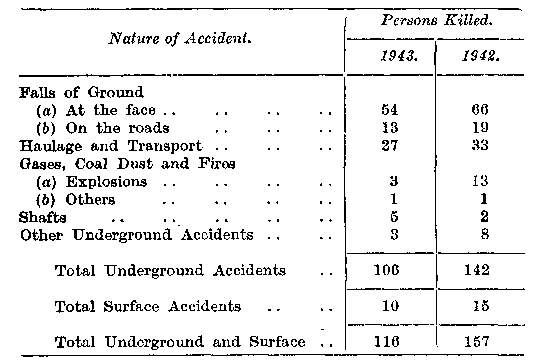
There were 109 separate accidents.
Falls of Ground.
The fatalities, 67 in number, amount to 58 per cent. of the total fatalities and are comprised as follows :—
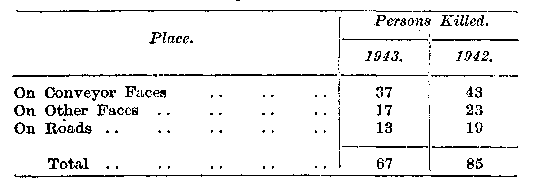
A reduction in fatal and serious non-fatal accidents occurred under this heading for a second year. The figures of each for 1943 are lower than those for 1938 and 1939.
A good deal of credit is due to the members of the Advisory Committee, representing all sections of the industry, who were appointed to consider the prevalence of falls of ground at the working face. They have focused attention on this important question and put forward a number of valuable recommendations Which have been made known to all sections of the industry. They also promoted an essay competition for which £60 in prizes was provided equally by the two Coal Owners' Associations and the Yorkshire Mine Workers' Association. It attracted 168 entries and Sir Henry Walker, C.B.E., LL.D., kindly acted as adjudicator.
It was pleasing to note the growing interest in the subject of roof control which is such a vital factor in both safety and production. Nevertheless, a tremendous field of practical research still remained open and it Was more than ever necessary that it should be explored in view of the probability that machinery would be used at the working face on an ever increasing scale in the future. The acid test of roof control was convergence and that could easily be measured. It is suggested that the aim should be to restrict it to ½-inch per foot measured back from the face with a maximum of 6 inches between the coal face and the waste edge. To secure such a standard, trials must be made to find the proper end areas of supports, the best thickness of lid and the most efficient packing system so that the maximum resistance shall he offered to strata movements. Expert advice is readily available on request.
Haulage and Transport.
There were two fatalities due to breakage of ropes or draw-gear. Nineteen other fatalities occurred on mechanical haulages including self-acting inclines, five (the same number as last year) being caused by runaway tubs. Four fatalities occurred in connection with conveyors. In connection with one of these accidents a young conveyor attendant at the end of his shift was riding out on the gate conveyor belt; he was attempting to jump off on encountering an obstacle and was crushed between the belt and the roller. Riding on conveyors was prohibited at the colliery by notices prominently displayed, following a similar fatality from this cause only three months previously. It was also condemned by Mr. Humphrys last year in consequence of a fatality.
Gases, Coal Dust and Fires.
One explosion occurred during the year. An electrician and two haulage hands, who had gone into a disused district for the purpose of removing a haulage engine from the inbye end of the main level, were killed by an explosion shortly after they reached the engine. Although there were large falls on the face and in the return airway the deputy averred there was no firedamp present at his examination two hours previously. Nevertheless, the flame of the explosion travelled 200 yards outbye from the point of origin and the firedamp probably extended over a length of 40 yards or thereabouts. After the explosion, the ventilation was completely blocked and the bodies of the three men had to be recovered by rescue teams. The ventilation of the district depended on a single sheet placed between intake and return airways, a shortcoming to which attention had been drawn twice in the last two years in published reports on explosions in the Division. As to the igniting cause, all indications fit in with the theory of contraband as cigarettes were found near the body of the electrician, who had not been searched before going underground. The deceased carried only electric lamps and the question of training electricians to test for firedamp or, alternatively, only allowing them near the working face in company with a deputy was raised at the inquest, having also in mind a disaster which occurred at a neighbouring mine seven years ago.
A small explosion of some interest, in which two persons were injured, occurred at a ripping lip where shotholes were being drilled by a boring machine fitted with a small fan having aluminium blades. The fan had become loose in its housing and it was thought probable that firedamp was ignited by frictional sparks caused by the revolving fan blades impinging on the casing or perhaps a steel stud.
Mention has previously been made by the inspector in former letters of the need to instruct officials and ambulance staffs in advance of the notion to be taken in case of explosion so that they shall know exactly what to do if the event occurs. There was, unfortunately, need to repeat this advice since recently three men extensively burnt in a small explosion were allowed to walk to the pit bottom, ascend the downcast shaft, and walk 100 yards to the ambulance room on a cold day, although an overman was present. In the Inspector's opinion, all deputies and overmen should have first aid certificates.
There were no fatal accidents due to the use of electricity despite the fact that upwards of 360,000 H.P. are in use. That was a record of which electrical staffs could be justly proud, but he was moved to mention the reports he frequently received of the ill-treatment of flexible cables which were the weakest link in the whole chain of electrical equipment.
Inspectors still find places fenced off owing to the presence of inflammable or noxious gas. Although this fencing is necessary it is only the lesser part of the obligation imposed upon managements. Section 29(1) of the Coal Mines Act requires constant and adequate ventilation throughout and steps must be taken at once to remove accumulations of gas. To fence such a place off and leave it indefinitely was not sufficient.
Surface.
The accident causing the greatest loss of life during the year occurred at the surface when four persons were fatally scalded by the bursting of a low pressure steam receiver which was overloaded although the steam pressure was only a few pounds to the square inch. Perhaps the best safeguard is to insure plant of this kind so that it is subject to the same outside expert examination as boiler plant under the Coal Mines Act.
In conclusion, Mr. Humphrys states it is a great pleasure to him to make it known throughout the coalfield that His Majesty the King has awarded the British Empire Medal to two colliery workers in that coalfield, the first two such honours to be awarded for bravery in mines. Mr. Newark Parkinson, a fitter, attempted to rescue the under-manager who was overcome by gas at Allerton Main Colliery, and Mr. John Andrew Phillips, a collier, rendered first aid by bandaging and splinting a number of badly injured men who were overwound at Monk Bretton Colliery in the cage in which he was also descending, notwithstanding that he had fractures of the right heel bone and right hip bone. In connection with the first-named episode, Mr. Ernest Bury, charge-fitter, received Commendation by Order of the King. Miners rise to supreme heights in the face of danger and those who know them best feel confident that, appreciating the deadly danger assailing their country, they will, without fail, supply the coal necessary for complete and early victory.
 |
 |
| Names mentioned in this article | |
 |
 |
| Name | Age | Occupation | Notes |
|---|---|---|---|
| Bury, Ernest | Charge Fitter | ||
| Humphrys, Herbert John, Major | H.M. Divisional Inspector | Whos Who Page | |
| Parkinson, Newark | Fitter | ||
| Phillips, John Andrew | Collier | ||
| Walker, Henry, Sir | Whos Who Page |




 Contains public sector information licensed under the

