


| Newspaper Articles |

|
Newspaper Articles |
 |
 |
29th May 1943, Page: 288, Column: 1
Coal-Cutting Study
In a paper — "A Short Description of the Effects of Coal-cutting at Various Horizons in the Lount Seam at Desford Colliery" — read before the Midland Counties Institution of Engineers, Mr. A. D. Butterley remarked that it may well be that insufficient attention has been directed to the question of actual cutting. At the colliery with which he is connected experiments have been carried out for some time, cutting at various horizons, and he dealt with (a) bottom cutting, (b) roof cutting, and (c) cutting top and bottom. He added some notes on general experience on the working face. A table was given showing the effect of different methods of cutting the seam, thus :—
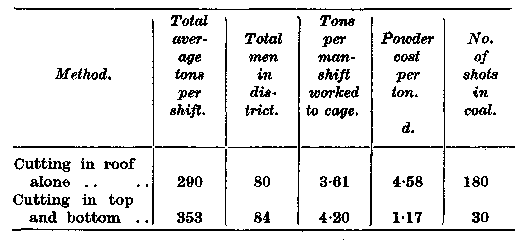
Mr. Butterley concluded by saying that the effects of cutting above and below the seam might be summarised as follow :—
(1) Coal breaks off vertically behind the cut and the roof is not visibly fractured. Danger from overhanging coal is removed and there is improvement in face conditions.
(2) Coal is easily got and only requires a few shots to break down to filling size, thus heavy shot-firing is avoided — a most desirable thing in any seam.
(3) The depth of cut is increased by the effect of the straight break, and actually in practice has averaged 10 yards with six cuts and 4-ft. 6-in. jib.
(4) Labour for extra cut is more than offset by saving in other directions, and extra tonnage is obtained for the same length of face.
(5) Cuttings in coal are largely filled by cuttermen and not lost in goaf.
(6) Although actual tests are difficult to carry out, the management is satisfied that more large coal is made than by the single cut.
(7) Fillers' work is improved and extra coal produced by them.
(8) It is suggested that the method may have application for power loading where coal has to be shattered by heavy shot-firing as a preliminary preparation, and the straight cut at the back is of vital importance.
 |
 |
| Names mentioned in this article | |
 |
 |
| Name | Age | Occupation | Notes |
|---|---|---|---|
| Butterley, Archibald Donald | Whos Who Page |
|
|
| Links to Collieries/Mines mentioned in this article | |
|
|
 | Desford Colliery |




 Contains public sector information licensed under the

