


| Newspaper Articles |

|
Newspaper Articles |
 |
 |
29th May 1943, Page: 281, Column: 2
Flow Of Air In Roadway
Introducing his paper, "An Account of a Ventilation Survey at Manton Colliery," in the current issue of the Leeds University Mining Society Journal, Mr. T. Pollard says :
The practical problem of mine ventilation may be considered as that of transmitting the required quantity of fresh air from the downcast shaft to each of the faces and back to the upcast. Two factors contribute to the mechanism of this conduction : Firstly, induced ventilation caused by the fan; secondly, natural ventilation due to the air increasing in temperature by the absorption of heat from the strata.
Three related factors influence the flow of air in a roadway :
(a) The rate of change of pressure. It is advisable to keep the total pressure drop between the upcast and downcast shafts as low as possible, in order to reduce to a minimum leakage through the goaf and through separation doors. Further, with a low ventilating pressure the fan is required to do less work to pass a given quantity, so that a saving in power results.
(b) The quantity of air flowing per minute. The Coal Mines Act demands that an adequate amount of ventilation shall be produced for the respiration of men and horses, and to render harmless noxious and inflammable gases.
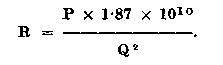
(c) The resistance of the airways. The resistance is measured in Atkinsons, which is the arbitrary constant in the formula connecting quantity and pressure drop, namely, P = RQ2, where P is measured in lb. per square foot, and Q in kilocusecs, i.e., thousands of cubic feet per second.
The quantity flowing per minute is found from the product of the velocity in feet per minute, and the area in square feet ; the mean value at two stations is taken as the quantity flowing along that section of the roadway. Since the pressure drop (P) is expressed in inches of W.G., and the quantity (Q) in cubic feet per minute, it is necessary to use the following modified formula to calculate the resistance in Atkinsons (R) :
 |
 |
| Names mentioned in this article | |
 |
 |
| Name | Age | Occupation | Notes |
|---|---|---|---|
| Pollard, T. |
|
|
| Links to Collieries/Mines mentioned in this article | |
|
|
 | Manton Colliery |




 Contains public sector information licensed under the

