


| Newspaper Articles |

|
Newspaper Articles |
 |
 |
6th March 1943, Page: 206, Column: 2
Mine Gases And Gas Testing
The Coal Dust Hazard — IV
By "Deputy"
We have been greatly interested in a letter received from a reader, Idris Powell, of Treharris. The purport of his communication is to call attention to the reference made by Edward Lhwyd, the Welsh historian, in his history of various parishes called "Parochialia," regarding the dangers of coat dust. Lhwyd, writing in 1680, recounts information supplied to him by the rector of the parish of Baglan, one Anthony Thomas, concerning mining disasters in the area 50 years before that. Mr. Powell comments (with quotations in italics) —
"The most amazing thing is that the observations made on the nature of 'some latent quality of the coal,' i.e., gas, and the remarkable statement: 'There's nothing burns it seemes, but the aire, without it be the dust of the coale' — anticipate by about 200 years the scientific findings under which the nature of varying gases was established, and it was found that coal dust in the air was a prime cause of disaster under certain circumstances."
Readers will be interested to read of this early observation on the inflammability of coal dust, and doubtless they will owe Mr. Powell a debt of gratitude for his reference to the early recognition of the fact. One wonders whether the young Scots Inspector of Mines, who first definitely established the explosive properties of coal dust in the early seventies of last century in South Wales, was aware of the record in "Parochialia." Neither item is referred to in the Historical Review of Coal Mining published by the Mining Association of Great Britain.
Incombustible Matter in Road Dust.
Coal Mines General Regulations (Precautions against Coal Dust), 1939, No. 1803, require that "Such measures shall be taken for the prevention, suppression, collection and, removal of coal dust and for treating it with incombustible dust or in other manner approved by the Board of Trade as will ensure that on the floor, roof and sides, respectively, of every road or part of a road which is accessible, the dust which can be raised into the air shall contain, when tested in the manner . . . prescribed, not less than the percentage of incombustible matter set out in the Schedule to these Regulations according to the volatile matter of the Coal."
Contemplation of the regulations in the light of our experience leads to the thought that the percentage of incombustible matter in the dust on mine roadways can be varied by adjusting the quantity of inert dust distributed in the roadways and selecting the kind of dust which has been proved to be most efficacious. Although shale dust was first used for the dilution of coal dust, we appreciate the advantage derived from the use of limestone dust, and we may be induced to look with favour on other diluents, such as gypsum. Experiments have shown that gypsum is a better suppressor than limestone, that limestone is superior to shale, and that a smaller proportion of the suppressor is required when the coal dust and the inert dust are intimately mixed than when they are kept apart.
Dispersability of Stone Dust.
The words that are in italics in the foregoing paragraph are of real importance, because only the stone dust that can be raised into the air can possibly act as a suppressor of a coal dust explosion. It is therefore important that the incombustible dust used shall be (a) of such fineness that, of the dry dust which passes through a 60-mesh, not less than 50 per cent. by weight and, except with permission in writing of the Board of Trade, not more than 75 per cent. by weight shall pass through a 240-mesh sieve ; (b) of such character that it is readily dispersable into the air and, when in use in places where it is not directly wetted by water from the strata, does not cake but is dispersed into the air when blown upon with the mouth or by a suitable appliance. No incombustible dust shall continue to be used if it is found by tests, which shall be carried out regularly, not to comply with the results ascertained.
The dispersability of dusts is so important, in view of the evidence submitted at the public enquiry into the Wharncliffe Woodmoor Colliery explosion, that experiments have since been made to determine to what extent the dispersability of stone dusts is influenced by the fineness of the dust, the moisture in the dust, and the kind of dust used. The dispersability of any dust is quite conveniently determined by finding the velocity of the air-current necessary to raise it from the floor of a mine into the general body of the air passing through the mine, and the effect of particle size, especially of ultra-fine particles, may be determined simultaneously by finding the percentage of the whole dust smaller than, say, 10 microns. Information of considerable practical value regarding this aspect of the question is given in the Twentieth Annual Report of the Safety in Mines Research Board. Different stone dusts, after being ground, were passed through a classifier a certain number of times in order to reduce the percentage of ultra-fine particles in the dust, and samples of the classified dusts were placed in a gallery in which the velocity of the air was controlled to that necessary for the definite movement of the dust from the floor. The results obtained were as follows :—
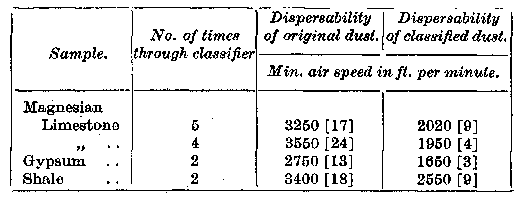
The figures in brackets are the percentages of particle size less than 10 microns.
We may therefore conclude that it is not desirable to have more than a comparatively small percentage of ultra-fine particles in stone dust made from limestone, gypsum, or shale. It furthermore appears that the dispersability of gypsum, limestone, and shale vary downwards in the order named. Further experiments may show that there is a limit proportion of ultra-fines below which dispersability of stone dust increases rapidly. From what has already been done it appears likely that the percentage of ultra-fines in a dust depends on the nature of the rock from which the dust is made.
Application of Stone Dust.
As soon as it has been established that an explosion may be propagated through a gallery, or a mine in which stone dust and coal dust have been laid down intermittently, we may proceed to the further conclusion that the stone dust has not been applied with due regard to the need of so diluting the coal dust as to render it non-inflammable. Stone dust may be thrown by hand against the roof, floor, and sides of a roadway, but in spite of the fact that the amount of dust so applied may exceed the amount necessary to prevent inflammation of the coal dust in the roadway, an explosion may still be propagated because the dusts are not sufficiently mixed.
It seems unreasonable to expect that dust applied by hand, even in abundance, may fail to achieve the object for which the distribution is made ; on the other hand if the stone dust is deposited with the coal dust from the air-current passing through roadways in a mine, the mixture of coal dust and stone dust will be complete. Only then can the efficacy of stone dust be guaranteed.
Removal of Road Dust.
Coal dust is produced in large quantities in some mines. As coal-cutting is proceeding a great deal of dust is raised into the air-current passing along the face, and the density of the dust cloud is increased as a result of blasting and loading out the coal. Much of the dust made on a coal face may be carried into the return airway to be deposited in dangerous quantities in a comparatively short length of the return airway next the face. However, as the transport of coal towards the shaft proceeds dust will be made in tubs and on conveyors from which the coal dust will be varied by the wind passing in the airways and carried along the roadways to be deposited on the roof, floor, and sides. At loading points, or at points where one conveyor discharges on to another, it is usual to find that clouds of coal dust are so dense that it is almost impossible to see the light of a lamp one yard away. The occurrence of such clouds of coal dust has excited the inventive genius of a few mining engineers to the point of designing dust extractors suitable for installation at such points, with the object of preventing the formation of dust clouds, thereby rendering the discharge points more congenial to workmen employed there and preventing the distribution of coal dust along main haulage roads. The extractors designed by Messrs. Dobbs and Anderton, and by Smellie, have been proved efficient in the partial solution of the coal dust problem, but there is still room for the introduction of a convenient means of collecting such dust as is deposited on mine roadways from time to time. The coal dust hazard will have been reduced to safe dimensions when sufficient stone dust has been distributed uniformly with the coal dust and means have been provided for the periodic removal of dust from mine roadways, and that is now only a matter of organisation.
 |
 |
| Names mentioned in this article | |
 |
 |
| Name | Age | Occupation | Notes |
|---|---|---|---|
| Anderton, — | |||
| Dobbs, — | |||
| Lhwyd, Edward | Historian | ||
| Powell, Idris | |||
| Smellie, — | |||
| Thomas, Anthony | Rector |
 |
 |
| Related Articles | |
|
|
| Pub. Date | Article (Newspaper) |
|---|---|
| 19 Sep 1942 | Mine Gases And Gas Testing, Carbon Dioxide and Blackdamp (The Science and Art of Mining) |
| 03 Oct 1942 | Mine Gases And Gas Testing, Carbon Monoxide (The Science and Art of Mining) |
| 17 Oct 1942 | Mine Gases And Gas Testing, Firedamp (The Science and Art of Mining) |
| 31 Oct 1942 | Mine Gases And Gas Testing, Testing for Firedamp (The Science and Art of Mining) |
| 14 Nov 1942 | Mine Gases And Gas Testing, Hydrogen Sulphide and Nitrous Oxide (The Science and Art of Mining) |
| 28 Nov 1942 | Mine Gases And Gas Testing, Atmospheric Pressure and its Measurement (The Science and Art of Mining) |
| 09 Jan 1943 | Mine Gases And Gas Testing (The Science and Art of Mining) |
| 23 Jan 1943 | Mine Gases And Gas Testing (The Science and Art of Mining) |
| 06 Feb 1943 | Mine Gases And Gas Testing, The Coal Dust Hazard — II (The Science and Art of Mining) |
| 20 Feb 1943 | Mine Gases And Gas Testing, The Coal Dust Hazard — III (The Science and Art of Mining) |
| 06 Mar 1943 | Mine Gases And Gas Testing, The Coal Dust Hazard — IV (The Science and Art of Mining) |



 Contains public sector information licensed under the

