


| Newspaper Articles |

|
Newspaper Articles |
 |
 |
20th February 1943, Page: 196, Column: 1
Mine Gases And Gas Testing
The Coal Dust Hazard — III
By "Deputy"
The Altofts' experiments had among other things shown that stone dust was efficacious as a diluent of coal dust in preventing the widespread effects of an initial explosion of firedamp and coal dust or of coal dust alone.
From 1910 onwards these experiments were continued by Dr. Wheeler at Eskmeals, Cumberland, under the direction of the Explosions in Mines Committee. During the period 1912-15 a series of seven reports, dealing with the use of inert (stone) dust as a means of rendering coal dust incapable of propagating the flame of an explosion, was published. It had already been required by Section 62 (4) of the Coal Mines Act (1911) that "such systematic steps, either by watering or otherwise, as may be laid down by the regulations of the mine" should be taken to prevent explosions of coal dust occurring or being carried along underground roadways. In their sixth report, the Explosions in Mines Committee recommended that the general provision quoted above should be made specific by requiring :—
(i) That the roads should be treated with stone dust, and that the coal dust should be removed systematically, so as to maintain at all times at least, 50 per cent. of incombustible matter in the road dust ; or
(ii) The maintenance of at least 30 per cent. of water in admixture with the dust on the roads ; or
(iii) A combination of these two methods.
The War of 1914-18 delayed action on these recommendations, but on 30th July, 1920, after consulting the interests affected by the proposals, the Secretary of State made Regulations which in effect (a) amplified the Act by prescribing in detail the systematic steps to be taken to apply stone dust or water to the roads, and (b) substituted for a somewhat indefinite provision (intended as a measure to minimise the explosion risk) regarding the removal of coal dust from the roads generally a specific requirement (but one that was more concerned with the comfort of persons travelling) that the dust on the floor of every travelling road must be cleaned at regular intervals of time to be fixed in the manner provided.
Safety in Mines Research Board.
Stone-dusting regulations were modified in 1924 with the object of attaining greater safety from the danger of coal dust explosions. By that date the researches carried out by the Explosions in Mines Committee had been taken over by the Safety in Mines Research Board. In 1921, the S.M.R.B. began an extensive research into the characteristics of different coals, and it was found that the "inflammability" of their dusts varied and that, while with some coal dusts the admixture of an equal quantity of inert dust was sufficient, and even more than sufficient, to prevent ignition, this quantity was insufficient with other varieties of coal dust.
Further experiments demonstrated that, broadly and with some exceptions, the relative inflammability of different coal dusts of equal fineness is proportional to their volatile content. The efficacy of various kinds of inert dust was also studied, and it was discovered that some were more effective than others, and that the dispersability of a dust when blown upon is a factor of very great importance.
Amended Regulations.
As a result of these discoveries the Secretary for Mines on 30th May, 1938, proposed to establish further general regulations to modify those of 1920, more particularly with the object of making the quantity of stone dust or inert dust to be applied to roads in order to render the coal dust harmless determinable, not by reference to a fixed maximum of 50 per cent. combustible matter in the mixture, but according to a sliding scale based upon the volatile matter content of the coal, and having regard to the character of the inert dust applied. In the "Precautions Against Coal Dust" Order, dated 8th December, 1939, the schedule framed under Regulation 3, showing the minimum percentage of incombustible matter required for coals of various volatile matter contents, was as under:—
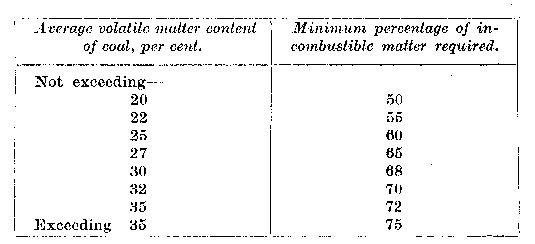
The effect of temporary amendment to the regulations is to substitute a figure of 65 per cent. for the higher figures in the schedule, and there is little doubt that that maximum will not be further amended during the present war. Notwithstanding the results obtained by large-scale experiments at Buxton Research Station it does appear quite likely that, if the present coal dust precautions were carried into effect with a complete understanding of the situation, and a whole-hearted desire on the part of the persons immediately responsible for the safety of coal mines, less would be heard of the calamities in which coal dust plays such a devastating role. Enquiries into recent disastrous explosions in coal mines have shown that, even in well-conducted collieries, eternal vigilance is essential to security of life and property. It is not enough that a mine should earn a reputation for being safe from the danger of a coal dust explosion. It is always important that those responsible should ever be on the alert and ready to deal at once with the slightest evidence of weakening in the system by which safety is secured.
Nature of Inert Dusts.
The stone dust used in the first of the Altofts experiments was produced by grinding shale to an impalpable powder, but with the passage of time and the opportunity for research into the efficacy of shale dust it was decided by the authorities that there were other diluents which might be used with greater advantage and freedom from the harmful effects that might be produced by men breathing shale dust.
Having regard to the danger of breathing dust containing free silica for a long time, it was soon decided that the use of flue dust and shale dust might be discontinued, especially the former ; but so long as inert dust does not contain harmful ingredients its use may be continued.
The S.M.R.B. and others have, however, proposed the use of other inert dusts having very different powers of suppression. Limestone is at present a popular and efficient suppressor, especially in intimate mixture with coal dust. In the 1941 report of the S.M.R.B. it is stated that the percentages of three different inert dusts required to suppress inflammation of Silkstone coal dust were as follows :—
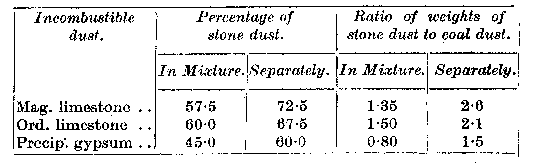
Limestone has the advantage that when it is heated to a bright red heat it gives off carbon dioxide (which is also a suppressor), and gypsum has the further advantage that it contains water of hydration. These additions to the incombustible matter in these dusts renders them very suitable for use as diluents of coal dust on mine roadways.
 |
 |
| Names mentioned in this article | |
 |
 |
| Name | Age | Occupation | Notes |
|---|---|---|---|
| Wheeler, Richard Vernon, Dr. | S.M.R.B. | Whos Who Page |
 |
 |
| Related Articles | |
|
|
| Pub. Date | Article (Newspaper) |
|---|---|
| 19 Sep 1942 | Mine Gases And Gas Testing, Carbon Dioxide and Blackdamp (The Science and Art of Mining) |
| 03 Oct 1942 | Mine Gases And Gas Testing, Carbon Monoxide (The Science and Art of Mining) |
| 17 Oct 1942 | Mine Gases And Gas Testing, Firedamp (The Science and Art of Mining) |
| 31 Oct 1942 | Mine Gases And Gas Testing, Testing for Firedamp (The Science and Art of Mining) |
| 14 Nov 1942 | Mine Gases And Gas Testing, Hydrogen Sulphide and Nitrous Oxide (The Science and Art of Mining) |
| 28 Nov 1942 | Mine Gases And Gas Testing, Atmospheric Pressure and its Measurement (The Science and Art of Mining) |
| 09 Jan 1943 | Mine Gases And Gas Testing (The Science and Art of Mining) |
| 23 Jan 1943 | Mine Gases And Gas Testing (The Science and Art of Mining) |
| 06 Feb 1943 | Mine Gases And Gas Testing, The Coal Dust Hazard — II (The Science and Art of Mining) |
| 20 Feb 1943 | Mine Gases And Gas Testing, The Coal Dust Hazard — III (The Science and Art of Mining) |
| 06 Mar 1943 | Mine Gases And Gas Testing, The Coal Dust Hazard — IV (The Science and Art of Mining) |



 Contains public sector information licensed under the

