


| Newspaper Articles |

|
Newspaper Articles |
 |
 |
23rd January 1943, Page: 172, Column: 1
Mine Gases And Gas Testing
By "Deputy"
The Coal Dust Hazard — I.
The earliest recorded evidence of the danger of coal dust in underground workings was probably that due to John Buddle, a North of England mining engineer, who after the explosion at Wallsend Colliery on September 3, 1803, stated that "the workings were very dry and dusty, and the survivors, who were the most distant from the point of explosion, were burnt by the shower of red hot sparks of ignited dust which were driven along by the force of the explosion." Similar statements have since been made by persons who have seen the bodies of victims of colliery explosions, and in Dr. S. W. Fisher's report on the Explosion at Wharncliffe Woodmoor Colliery on August 6, 1936, he stated that "Several showed 'pitting' — as though hot particles had been blown hard against them."
Buddle's pregnant observation was made at a time when mining men were becoming alive to the danger of firedamp in mines, and had not yet realised that probably the greatest danger arose from the presence in mines of large quantities of fine coal dust which was dry enough to be raised into the air by the shock of an initial explosion of firedamp or possibly a blown-out shot. That firedamp was not the only fuel taking part in colliery explosions was suggested by Faraday and Lyell in their report on the explosion that took place in September, 1844, at Haswell colliery, "the coal dust swept by the rush of wind and flame from the floor, roof, and walls of the works, would instantly take fire and burn if there were oxygen enough present in the air to support combustion, and we found the dust adhering to the faces of the pillars, props and walls in the direction of and on the side towards the explosion, increasing gradually to a certain distance as we neared the place of the ignition." Faraday and Lyell believed that during the explosion much coal gas was made in the air of the mine from the coal dust that was swept along, and they observed that "much of the carbon of this dust remained unburnt only from want of air."
At this date (1844) it had been concluded that: (i) Coal dust in a fine state of division was explosive; (ii) The presence of coal dust in mine airways would add to the fury of an explosion of firedamp ; but it was not until the middle seventies of the nineteenth century that Prof. Galloway in South Wales demonstrated that coal dust was by itself capable of being exploded in the absence of firedamp, but more readily in the presence of even small proportions of firedamp. Galloway, evidently, was unable to prove to the satisfaction of responsible people connected with collieries that coal dust was by itself explosive, because on February 9, 1891, a Royal Commission was appointed "to enquire into the effect of coal dust in originating or extending explosions in mines, whether by itself or in conjunction with firedamp." The commission also considered the means of preventing or mitigating the dangers of coal dust in mines, and as a result of their enquiries the report of June, 1894, gave the following conclusions :—
(i) "The danger of explosion in a mine in which gas exists, even in very small quantities, is greatly increased by the presence of coal dust.
(ii) "A gas explosion in a fiery mine may be intensified and carried on indefinitely by coal dust raised by the explosion itself.
(iii) "Coal dust alone, without the presence of any gas at all, may cause a dangerous explosion if ignited by a blown-out shot or other violent inflammations. To produce such a result, however, the conditions must be exceptional, and are only likely to be produced on rare occasions.
(iv) "Different dusts are inflammable, and consequently dangerous, in varying degrees, but it cannot be said with absolute certainty that any dust is entirely free from risk.
(v) "There appears to be no probability that a dangerous explosion of coal dust alone could ever be produced in a mine by a naked light or ordinary flame."
The reservation contained in conclusion (iii) is symptomatic of the incredulity of at least a majority of the members of the Commission, and at this date we wonder if they had ever heard of such names as Cymmer, Lund Hill, Risca, Ferndale, Swaithe Main, Blantyre, Haydock, Seaham, Clifton Hall, Llanerch, and Albion, to mention but a few of the disastrous explosions which had taken place by the time the report was published. It was therefore, quite in the nature of things that conflicting opinions continued to be expressed by many leading mining engineers who proved incapable of appreciating the true value of the evidence of men like Buddle, Faraday, Lyell, and Galloway.
The Royal Commission on Mines 1906.
Another Commission was appointed in June of 1908 "to enquire into and report on certain questions relating to the health and safety of miners," and the enquiries of that body led to the appointment of a committee to consider what further experiments with coal dust were necessary, having regard to what was already being done in this country and elsewhere. An advisory body consisting of eminent specialists, including Hall, Dixon, Garforth (then President of the Mining Association of Great Britain), Galloway, Atkinson (W. N.) and Capt. Thomson (H.M. Chief Inspector of Explosives), became associated with the committee as a result of the deliberations of the reinforced committee it was agreed that a sum of £10,000 would be required to cover the cost of such a gallery as had been suggested by Mr. Garforth, and after the Government had decided that it could not provide the necessary funds the Mining Association agreed to carry out the suggested experiments and to provide the sum of money required to enable the work to be done. The colliery owners also hoped that the experiments would furnish indications which might lead to the discovery of some effective remedy, as an alternative to watering, which method had by then become widely used in this and other countries.
The new experimental station was built at Altofts Colliery, Yorkshire, and the experimental work was done under the personal supervision of Mr. Garforth. The experiments were designed to elucidate: (i) the explosive nature of coal dust without the presence of inflammable gas, (ii) the discovery of a preventive against, or remedy for, explosions of coal dust, (iii) the chemical and physical phenomena accompanying coal dust explosions.
The experimental gallery was made 7½ feet in diameter and consisted of steel boiler shells riveted together. This form was chosen because it readily enabled the interior to be made to represent an underground roadway. In September, 1908, the main gallery was 788 feet long and the return 295 feet, thus making a total length of 1,083 feet. The main gallery formed the intake airway and was straight, whereas the return airway was made up of five lengths comprising four right angles at each of which there were either doors or partitions which would readily collapse at the moment of an explosion, thus safeguarding the Sirocco fan installed at the outer end of the return airway to produce 80,000 cubic feet of air per minute with a water-gauge of 3 inches.
Arrangements were made for recording the pressure within the gallery during each explosion and for determining the velocity with which the explosive wave traversed the gallery. A cinematograph was also installed near the inlet end of the gallery to enable the discharge from the gallery to be studied instant by instant from the moment of the explosion.
The coal dust used for many of the early experiments was the dust obtained from the screens at Altofts. Later a pulveriser was installed to produce an adequate supply of dust from the coal in the Silkstone Seam. The screen dust differed slightly from the pulverised dust as shown by the analyses in Table I.
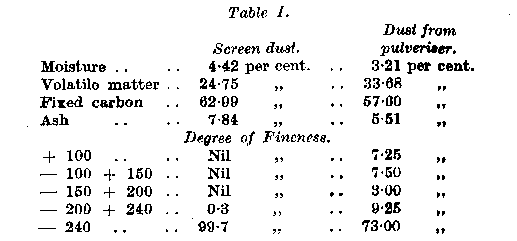
The amount of coal dust used in the experiments was generally 1 lb. per linear foot of the gallery, or 0.39 ounce per cubic foot of air space. Although this was regarded as being less than might be found on mine roadways it was enough to enable the explosibility of coal dust to be established.
For the purpose of raising the dust into a cloud a small cannon measuring 2 feet long and 9 inches in diameter, was used, the bore of the cannon being 1¾ inches and 8 inches deep. It was charged with 4 ounces of gunpowder and 3 inches of clay stemming, and was placed 90 feet nearer the inlet end of the gallery than the igniting cannon and facing the side of the gallery in a dustless zone.
The "igniter" was made of special quality wrought-iron 3 feet long and 6 inches in diameter, the bore being 2 inches and 2 feet 9 inches deep. It was charged with 24 ounces of gunpowder and 8 inches of dry clay stemming. It was fired against the air-current with the bore inclined upwards at an angle of about 30°.
In the first experiment on May 12, 1908, coal dust was strewn at the rate of 0.29 lb. per cubic foot over the whole length of the intake airway which was 255 feet long. The small cannon was placed at a distance of 143 feet from the inlet end of the gallery and the igniter at a distance of 233 feet from the entrance. The small cannon was fired first and two seconds afterwards the igniter with a charge of 40 ounces of gunpowder was fired into the cloud of dust, with the result that five of the safety partitions in the return airway were shattered and there was evidence of flame having travelled 166 feet from the igniter along the intake airway and 150 feet from the igniter into the return airway. The two safety-valves at the junction of the intake and return airways were blown to distances of 63 and 102 feet respectively, and many sets of timber were displaced, thus proving again that coal dust was by itself explosive.
 |
 |
| Names mentioned in this article | |
 |
 |
| Name | Age | Occupation | Notes |
|---|---|---|---|
| Atkinson, William Nicholas | Whos Who Page | ||
| Buddle, John | Whos Who Page | ||
| Dixon, — | |||
| Faraday, Michael | |||
| Fisher, Sydney Walter, Dr. | Whos Who Page | ||
| Galloway, —, Prof. | |||
| Garforth, — | |||
| Hall, — | |||
| Lyell, — | |||
| Thomson, —, Captain | H.M. Chief Inspector of Explosives |
 |
 |
| Related Articles | |
|
|
| Pub. Date | Article (Newspaper) |
|---|---|
| 19 Sep 1942 | Mine Gases And Gas Testing, Carbon Dioxide and Blackdamp (The Science and Art of Mining) |
| 03 Oct 1942 | Mine Gases And Gas Testing, Carbon Monoxide (The Science and Art of Mining) |
| 17 Oct 1942 | Mine Gases And Gas Testing, Firedamp (The Science and Art of Mining) |
| 31 Oct 1942 | Mine Gases And Gas Testing, Testing for Firedamp (The Science and Art of Mining) |
| 14 Nov 1942 | Mine Gases And Gas Testing, Hydrogen Sulphide and Nitrous Oxide (The Science and Art of Mining) |
| 28 Nov 1942 | Mine Gases And Gas Testing, Atmospheric Pressure and its Measurement (The Science and Art of Mining) |
| 09 Jan 1943 | Mine Gases And Gas Testing (The Science and Art of Mining) |
| 23 Jan 1943 | Mine Gases And Gas Testing (The Science and Art of Mining) |
| 06 Feb 1943 | Mine Gases And Gas Testing, The Coal Dust Hazard — II (The Science and Art of Mining) |
| 20 Feb 1943 | Mine Gases And Gas Testing, The Coal Dust Hazard — III (The Science and Art of Mining) |
| 06 Mar 1943 | Mine Gases And Gas Testing, The Coal Dust Hazard — IV (The Science and Art of Mining) |



 Contains public sector information licensed under the

