


| Newspaper Articles |

|
Newspaper Articles |
 |
 |
26th December 1942, Page: 146, Column: 2
Mine Gases And Gas Testing
Moisture in Mine Air
By "Deputy."
We have already observed that ordinary air consists of nitrogen, oxygen, and certain rare gases, together with varying amounts of water vapour. The amount of water vapour that air can contain per unit of volume depends mainly on the temperature of the air, the higher the temperature the greater is the absorbing power or drying effect of air. When air contains as much water vapour per unit of volume as it can at a certain temperature it is said to be saturated. Ordinarily, however, air contains less moisture than is necessary for complete saturation, but it is often found that in the return airways of collieries the dry- and wet-bulb readings of hygrometers are the same, thus denoting the complete saturation of the air. The ratio of the amount of water vapour in the air to the amount which would saturate it at the same temperature is called the relative humidity. If the temperature of moist air be reduced a point is reached at which saturation is complete, and that is called the dew point. Hot moist air passing from the workings of a mine towards the bottom of the upcast shaft may be so reduced in temperature that the dew point is reached and water is deposited on the sides of the roadways near the bottom of the upcast shaft. Whether the air reaching the bottom of the upcast shaft has a high or a low relative humidity may to some extent depend on the natural condition of the sides of airways with regard to the temperature and the amount of water in the rocks. H. Scholes, in discussing a paper before the Manchester Geological and Mining Society (p. 68, Vol. CI.) expresses the view that the relative humidity is high in seams near the surface and low in seams at a good depth. That is an important matter, because the effect of moisture on man's inability to work continuously is greater as the depth, and therefore the temperature, increases.
Drying and Wetting Effect of Air-currents.
In this country, especially in winter, air enters coal mines at a comparatively low temperature, and as it passes down the shaft its temperature increases due to the compression that takes place in the shaft. A further increase in temperature takes place as the air passes through the airways and workings into the main return airways. If no water were absorbed by the air in its circulation through the mine, the relative humidity would be diminished because the absolute amount of water vapour per unit of volume of air would be diminished in proportion to the increase in the volume of air at the higher temperature. As a rule, however, the conditions in the airways are such that there is an accession of moisture, and it is taken up by the air-current.
It is apparent that if the sides of the main intake airways are covered with dust, the air sweeping along will absorb moisture from the dust. In this, way the dust in intake airways is dried, and consequently the explosibility of coal dust is increased by drying. It has been observed that explosions of coal dust are more frequent in winter than in summer, and there is some truth in the statement, but the condition of the weather is not the governing condition. There Were 207 fatalities at Blantyre Colliery on 22nd October, 1877, 344 at Hulton Colliery on 21st December, 1910, and 439 at Senghenydd on 14th October, 1913, but at Gresford on 22nd September, 1934, there were 265 persons killed, including three rescuers.
The air-current may have a wetting effect on the sides of the main intake airways during summer months, but such a condition can only exist when the temperature of the air passing through the mine is reduced to the dew point. The passage of saturated air through a coal mine might be a desirable thing when regarded from the standpoint of the coal dust problem, but the health of the miners would be adversely affected by exposure to the effect of moist air at high temperatures.
Effect of Moisture on Health.
As the depth at which mining operations take place increases the effect of moist air on the vitality of workmen will become more pronounced. Hot and moist air is not conducive to vigorous work. The health of workmen is impaired, and it is only possible for them to work for short periods when the wet-bulb temperature is 75°F. Free perspiration cannot take place at such a wet-bulb temperature, and if workmen are exposed to it the body temperature tends to rise, and collapse may ensue. At 60°F. work may be done in moist air without serious inconvenience in brisk ventilation, which induces evaporation of sweat. At 100°F. men may perform something like the normal amount of work provided the relative humidity of the air is low. At a depth of 4,000 feet the rock temperature in this country approaches 115°F., and consequently it is not to be expected that miners will be capable of doing effective work over long periods, especially if the wet bulb reading of the hygrometer is comparatively high. It seems as if de-humidification of the air will have to be practised in order to work in coal mines at or beyond that depth.
Method of Determining Relative Humidity.
Section 71 of the Coal Mines Act (1911) requires that one hygrometer should be placed in a conspicuous position in the main intake airway and another in the main return airway, and General Regulation 105 requires that each hygrometer placed below ground in pursuance of the Act shall be read by a responsible person of the mine once every week-day if in the main intake airway and once every week if the main in return airway.
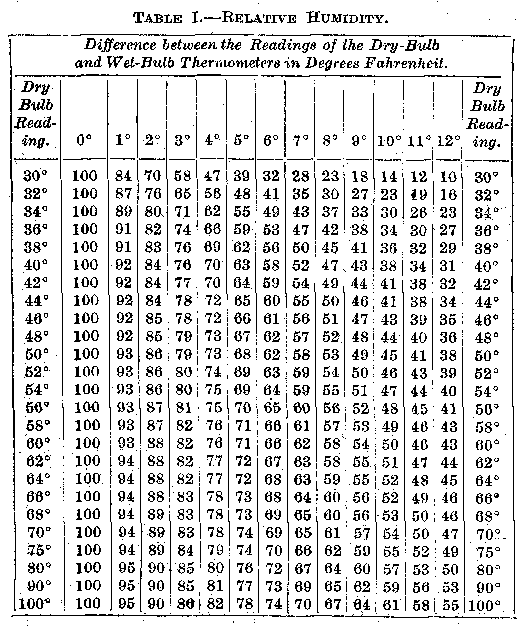
A hygrometer consists of two similar Fahrenheit thermometers which are mounted, on a suitable panel of wood or metal. A piece of muslin is tied round one of the bulbs by a piece of wick which dips into a small glass vessel containing water. The water in the cistern passes by capillarity along the wick to the muslin and keeps it in a wet condition. The Storrow whirling hygrometer is mounted on a handle so that it can be made to revolve to cause the air to pass over the bulbs at about 600 feet per minute. As the evaporation of the water from the surface of the muslin takes place the temperature of the bulb is lowered. When the air surrounding the dry bulb is saturated with vapour the temperature registered is the same as that of the wet bulb thermometer, thus denoting 100 per cent. saturation, but as a general rule the dry-bulb temperature is higher than the wet-bulb temperature, and the difference between them, is a measure of the humidity of the air corresponding to the dry-bulb temperature. When the wet- and dry-bulb readings have been obtained, the difference betweem them is noted, and the relative humidity of the air is obtained by observing in Table 1 the figure in the column headed difference and, on the same line as the dry-bulb temperature.
When, for example, the; dry-bulb reading is 64°F. and the wet-bulb reading is 60°F., the difference is 4°. Looking along the line from 64° to the column headed 4° we find that the relative humidity is 77 per cent.
Significance of Hygrometer Readings.
We may ascertain whether the air-current has a drying or a wetting effect on the roof and sides of mine airways by reading the hygrometers in the main intake and return airways.
For example, the readings of the intake hygrometer were D.B. 50°F. and W.B. 44°F., and the readings of the return hygrometer were D.B. 70°F. and W.B. 68°F. On referring to Table I we find that the relative humidity of the intake air is 62 per cent., and the relative humidity of the return air is 89 per cent.
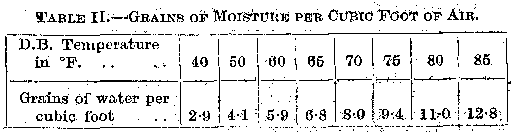
On referring to Table II we find that saturated air at 50°F. contains 4.1 grains of water per cubic foot, therefore at 62 per cent. saturation the absolute weight of water per cubic foot is 0.62 x 4.1 = 2.54 grains. At 70°F. saturated air contains 8 grains per cubic foot, and when the relative humidity is 89 per cent. the absolute weight of moisture per cubic foot is 0.89 X 8 = 7.12 grains.
These figures were obtained at a colliery through which the quantity of air
passing was 180,000 cubic feet per minute, therefore the weight of moisture
taken out of the colliery in 24 hours 
Note. — 7,000 grains = 1 lb. This example shows that the air passing through the mine has a drying effect, and indicates the extent to which water sprays would have to be used to prevent drying of the roadways.
 |
 |
| Names mentioned in this article | |
 |
 |
| Name | Age | Occupation | Notes |
|---|---|---|---|
| Scholes, H. |




 Contains public sector information licensed under the

