


| Newspaper Articles |

|
Newspaper Articles |
 |
 |
28th November 1942, Page: 123, Column: 1
Carbon Dioxide In Mine Dusts
New Method of Determination
The fourth report of the General Research Committee of the Monmouthshire and South Wales Coal Owners' Association describes a new and rapid method for the determination of carbon dioxide in mine dusts. It is recalled in the Preface that one of the Mine Regulations stipulates that the analyses of mine dust samples shall be posted up at the pithead within twenty-one days of the samples being collected, and the suggestion is that in all probability this Regulation will be more rigidly enforced in the future. The development of the new method is explained in the report. The apparatus required for the determination can be made in any laboratory out of a boiling tube, a stout glass bottle, a few rubber bungs, a length of rubber tubing and a couple of pieces of bent glass tubing. An acknowledgment is made to Mr. Norman T. Simmons, F.C.S., F.Inst.F., the Powell Duffryn Associated Collieries chief chemist, who brought the problem to the notice of the Committee and co-operated with the Committee's investigator, Mr. J. Howard Griffiths, M.P.Regulations Quoted.
Whilst no attempt is made to stress the importance of the carbon dioxide content of mine dusts, reference is made to the Coal Mines Regulations which state (M. and Q. Form 128) that a mine dust, sampled according to the Regulations, shall contain at least a certain percentage of incombustible matter, depending upon the volatile content of the coal. In the case of collieries using carbonate stone dusts, this incombustible matter is represented by the sum of the free moisture in the mine dust, determined at the residue on ignition at 950°C, and the carbon dioxide, all expressed as percentages by weight.
The Regulations also state that the carbon dioxide shall be determined in the following manner :—
"B. (iii) A weighed quantity of the sieved dust shall be treated with dilute hydrochloric acid in a suitable apparatus, and the weight of carbon dioxide evolved from the dust shall be either (a) determined directly, or (b) calculated from the volume of carbon dioxide evolved, or (c) determined by any other manner approved by the Board of Trade."
There are several methods available for the determination of carbon dioxide which conform with the above Regulation. The chief of these are :—
(1) Volumetric determination by means of a suitable form of calcimetor ;
(2) Volumetric determination by back titration with a standard alkali solution ;
(3) Gravimetric determination by means of a Schroedter flask ;
(4) Gravimetric determination by drying the gas evolved on boiling the dust with acid and then passing it through a suitable absorbent contained in a weighed vessel.
The General Regulations and Orders relating to Safety and Health stipulate that "samples of dust shall be systematically collected and analysed, and, in respect of roads used for the transport of coal, and of return airways within 200 yards of the working face, the number of samples collected and analysed during each calendar month shall not be fewer (except with the consent in writing of the Inspector) than in the proportion of ten per mile of those roads and airways."
Any method used must be approved by the Board of Trade.
Description of Apparatus.
In an article by Mr. E. B. Hughes (J.S.C.I., Vol. 61, No. 9, 1942) mention was made of an apparatus used for the quick determination of carbon dioxide in baking powders, and the like. "The carbon dioxide is evolved in an evacuated space of fixed volume, the resulting increase in pressure measured, and from this, corrected to 0°C, the weight of CO2 is obtained by direct reading from a graph obtained by treating pure sodium bicarbonate in a similar way." The Committee realised the possibility of using this method for the determination of carbon dioxide in mine dusts. After many trials, the following apparatus was found to be best suited for use with mine dusts.
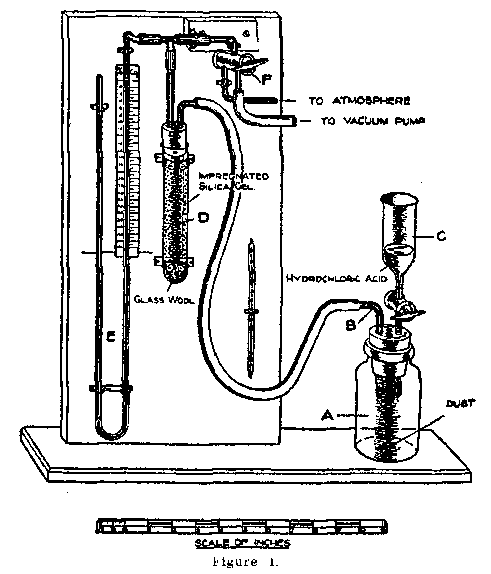
The apparatus shown in Figure 1 consisted of a stout glass reaction flask A, of about 200 ccs. capacity, fitted with a bung carrying an outlet tube B and a dropping funnel C. The outlet tube was connected, via a drying tube D, containing calcium chloride or anhydrous silica gel, to a mercury manometer E, and a three-way tap F, by means of a T-piece. One leg of the three-way tap opened to atmosphere, and the other was connected to a vacuum pump. The dimensions as scaled from Figuee 1 should be roughly adhered to, as experience has shown that they are the most suitable. The apparatus is connected together by means of good rubber pressure tubing, and the taps and joints should have a large surface of contact as they have to Withstand a pressure of about 40-45 cms. mercury (approximately 8 lb. per square inch) without leaking.
After a few preliminary tests, the following procedure was adopted. Exactly 0.5 grm. of calcium carbonate was placed in the reaction flask, and 10 ccs. of 1 : 1 hydrochloric acid containing 2 per cent. Perminal were poured into the dropping funnel. The three-way tap was then turned so as to connect the apparatus to the vacuum pump. When the desired vacuum was obtained (this was determined in the preliminary tests to be about 40 cms. mercury) the three-way tap was closed. The acid was then run into the reaction flask, care being taken to see that no air leaked in through the tap on the dropping funnel. The reaction flask was then shaken to ensure complete contact between the reagents. When the reaction had ceased the manometer was read, and the increase in pressure due to the addition of 10 ccs. of acid and the evolution of carbon dioxide was recorded.
It was also noted that the volume occupied by 0.5 grm. of inert solid material had little or no influence on the reading of the manometer.
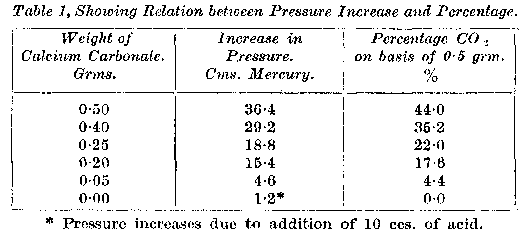
A series of determinations was made using known weights of calcium carbonate, and observing the increases in pressure in the apparatus. The volume of carbon dioxide liberated in each case was calculated, and working on a basis of 0.5 grm. of substance being used in the reaction flask, the percentage carbon dioxide was calculated.
It was thought at first that, as the relationship between percentage and volume of carbon dioxide is linear, and the relation between volume and pressure is a rectangular parabola, the resultant curve obtained by plotting the increase in pressure against the percentage carbon dioxide would be a curve somewhat between a straight line and a rectangular parabola. The graph actually obtained by plotting the results, which are given in Table, was a straight line.
The accuracy of the apparatus will obviously depend upon the accuracy with which the scale is made. Experience has shown that, with care, it is possible to construct a scale reading to within +- 0.2 per cent.
The Report gives a more detailed study of the theory on which the apparatus was based, the method of calibration, and design of an improved form of apparatus for general use.
Conclusions.
The results of the work recorded in the Report show that the vacuum apparatus method is :—
(1) Ideally suited for the determination of carbon dioxide in mine dust.
(2) Accurate within 0.5 per cent., when determining carbon dioxide contents, and compares very favourably with results obtained by the Calcimeter and Schroedter flask methods.
(3) More rapid than either of the above-mentioned methods. Determinations can be carried out in from 5 to 7 minutes.
(4) Simple, requiring no elaborate technique, and can therefore be used with speed and accuracy even by unskilled attendants.
(5) Due to the reduced pressure, the solubility of the carbon dioxide is so low that it is not necessary to heat the reaction flask.
The following points should, however, be stressed :—
(1) The apparatus should be calibrated by an experienced chemist, and care should be taken to ensure that an accurate scale is drawn and correctly fixed to the manometer.
(2) In the case of a part of the apparatus being replaced by another, then the apparatus must be re-calibrated. This will take a skilled analyst only about half-an-hour.
(3) The calcium chloride drying tube will want re-charging from time to time. After re-charging, re-calibrate the apparatus. This can be obviated if impregnated silica gel is used in the drying tube. This silica gel is saturated in an indicator which changes from blue to pink as the gel absorbs the water. When the gel is all pink, disconnect the tube and dry in the drying oven until the colour is restored to blue. Re-connect the tube to the apparatus, which will not require re-calibrating.
(4) In the case of greasy or oily substances, it is advisable to add a solvent of low vapour pressure such as benzyl benzoate.
 |
 |
| Names mentioned in this article | |
 |
 |
| Name | Age | Occupation | Notes |
|---|---|---|---|
| Griffiths, J. Howard | M.P. | ||
| Hughes, E. B. | |||
| Simmons, Norman T. | Chief Chemist |




 Contains public sector information licensed under the

