


| Newspaper Articles |

|
Newspaper Articles |
 |
 |
17th October 1942, Page: 88, Column: 1
Mine Gases And Gas Testing
Firedamp
By "Deputy."
The gases escaping from "blowers" in coal seams or in the strata adjacent to them afford an opportunity of determining the composition of firedamp. The analysis of the firedamp from a blower at Hebburn Colliery, on the Tyne, showed that methane was the only combustible gas present. The composition was :—
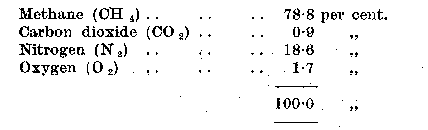
The Journal of the Chemical Society (1875-77) contains analyses of firedamp from "blowers" and boreholes in South Wales, and only in two cases out of fourteen was it found that some other combustible gas than methane formed the combustible constituent. In one sample a trace of ethane (C2H6) was found and in another the percentage of ethane was 0.9.
Prof. T. Gray, of the Royal Technical College, Glasgow, found higher hydrocarbons than methane in samples of firedamp collected in certain mines in Scotland, and in one case the proportion of methane to ethane in the firedamp was about 0.6 to 0.4. At the time that particular sample was taken in the air of the mine the flame on a Davy lamp completely filled the gauze: Had methane been the only combustible gas in the air the "cap" given by 3.32 per cent. of firedamp would not have been much more than five-eighths of an inch high.
Recent investigations by the Safety in Mines Research Board personnel show that ethane is quite likely to be a constituent of firedamp much oftener than it has hitherto been supposed.
Occurrence of Firedamp.
Firedamp is sometimes found pent up in the coal at high pressures, but it is generally contained in coal at pressures not much greater than the pressure of the atmosphere. Those parts of coal seams which abut on faults may, during faulting, have undergone such changes in their physical condition that they have absorbed large volumes of firedamp at very considerable pressures. The pressure may be great enough to dislodge quite a considerable amount of coal from a seam with the force of an explosion. On the 9th March, 1911, a sudden outburst of gas took place at Valleyfield Colliery on the northern shore of the Firth of Forth. A large amount of coal was dislodged from the side of a working place and three men were killed while two others were gassed. Similar outbursts have taken place at other collieries in other coalfields, and at West Leigh Colliery, in the Lancashire coalfield, victims of the outburst had the appearance of having been burned, although the degree of cold produced by the sudden expansion, of the gas was such as to preclude all possibility of an ignition of firedamp having taken place.
Sometimes the outburst of gas may take place in the roof or in the floor, either bringing down the roof or lifting the floor for many yards back from the face of the working.
As coal is undercut by hand or machine forces are released and these may be sufficient to break down the coal all along the face of the working. Firedamp is then given off from the newly exposed faces of coal, and when the coal is broken up preparatory to loading it into tubs or conveyors a further amount of gas is released and enters the general body of the air.
Being lighter than air firedamp is usually found in the higher side of inclined workings, and it is often found in cavities in the roof or in ripping lips. When there is a sharp fall of barometric pressure firedamp may issue from waste ground and enter the general body of the air in such quantities as to make continued working unsafe, but similar circumstances may equally well arise if some part of the ventilating system is broken down or disarranged to short-circuit the air-current.
It is important to note that firedamp may be found in accumulations in places unswept by the air-current or in the general body of the air.
Properties of Firedamp.
Since firedamp is a mixture of gases of which methane is the principal constituent it follows that, the higher the percentage of methane in it, the more closely will the properties of the mixture resemble those of the methane itself.
Methane (CH4) is composed of twelve parts by weight of carbon in chemical combination with four parts by weight of hydrogen, therefore the molecular weight of the gas is 13 and the relative weight 8. Compared with air, which has a relative weight of 14.4, the specific gravity of methane is 8 ÷ 14.4 = 0.55, slightly greater than half the weight of air. Because of its lower density than air it is usual to find methane near the roof of the mine. It is a colourless, odourless, and tasteless gas which is not a supporter of life or combustion, but it is combustible, and when mixed in certain proportions with air it is explosive. When it is mixed in molecular proportions with oxygen it is most explosive. The equation of combustion is

It is seen that the burning of unit volume of methane leads to the formation of an equal volume of carbon dioxide and the consumption of two units of volume of oxygen. The steam formed at the time of the explosion is almost at once condensed to water, and because of that the volume of the products of combustion amounts to one-third of the volume of the methane and oxygen taking part in the reaction.
Methane is an asphyxiating gas in the sense that in high concentrations it excludes from the lungs the oxygen necessary for continued respiration. Persons overcome by breathing an atmosphere containing a large proportion of the gas would recover soon after being brought into fresh air. A person entering a place containing a high proportion of firedamp would become giddy and lose power of the limbs, soon becoming incapable of withdrawing from the danger of suffocation.
Inflammability of Methane.
When an open flame is introduced into a mixture of methane and air, the proportion of the combustible gas being small, the molecules of gas near the flame are burned and the flame becomes surrounded by a halo of burning gas. As the proportion of combustible gas increases the halo grows until there is enough methane in the mixture to enable the flame to be communicated to all parts of the atmosphere. The smallest proportion of methane in air required for the transference of flame throughout the whole body of the mixture has been determined experimentally by a great number of scientists during the last century or more. In 1816 Davy found that the lower limit of inflammability of methane and air mixtures was between 6.2 and 6.7 per cent., in 1883 Mallard and Le Chatelier found that it was 5.6, and in 1911 Burgess and Wheeler verified that it was 5.6.
As the percentage of methane in air increases beyond the lower limit of inflammability the speed at which propagation of flame takes place also increases, and when the proportions of methane and oxygen in the air satisfy the equation, CH4 + 2O2 = CO2 + 2H2O, the violence of the explosion reaches its maximum. As the proportion of methane in the mixture increases to 13 per cent., and the proportion of oxygen in the mixture correspondingly decreases, the explosibility of the mixture diminishes until the higher limit of inflammability is reached, when the mixture ceases to be inflammable.
Causes of Ignition.
Ignition of bodies of methane may have catastrophic consequences or they may merely result in the inflammation of the gas without violence. All depends on the proportion of methane in the air and the temperature of the igniting agent. The ignition temperature of methane in air varies from 650°C. to 750°C, and this temperature is reached in naked flames. Although some mines may not be classified as fiery, and therefore be worked with naked lights, there is the possibility of ignitions of firedamp taking place where gas has been allowed to accumulate. In fiery mines where the use of naked lights is prohibited ignitions of methane may take place as a result of the use of explosives. Safety-lamps may be damaged and expose naked lights, and naked lights may result from spontaneous combustion. Defective electrical apparatus may also lead to the ignition of firedamp with disastrous results.
 |
 |
| Names mentioned in this article | |
 |
 |
| Name | Age | Occupation | Notes |
|---|---|---|---|
| Burgess, — | |||
| Chatelier, Le | |||
| Davy, Humphry | |||
| Gray, T., Prof. | |||
| Mallard, — | |||
| Wheeler, Richard Vernon | Whos Who Page |
 |
 |
| Related Articles | |
|
|
| Pub. Date | Article (Newspaper) |
|---|---|
| 19 Sep 1942 | Mine Gases And Gas Testing, Carbon Dioxide and Blackdamp (The Science and Art of Mining) |
| 03 Oct 1942 | Mine Gases And Gas Testing, Carbon Monoxide (The Science and Art of Mining) |
| 17 Oct 1942 | Mine Gases And Gas Testing, Firedamp (The Science and Art of Mining) |
| 31 Oct 1942 | Mine Gases And Gas Testing, Testing for Firedamp (The Science and Art of Mining) |
| 14 Nov 1942 | Mine Gases And Gas Testing, Hydrogen Sulphide and Nitrous Oxide (The Science and Art of Mining) |
| 28 Nov 1942 | Mine Gases And Gas Testing, Atmospheric Pressure and its Measurement (The Science and Art of Mining) |
| 09 Jan 1943 | Mine Gases And Gas Testing (The Science and Art of Mining) |
| 23 Jan 1943 | Mine Gases And Gas Testing (The Science and Art of Mining) |
| 06 Feb 1943 | Mine Gases And Gas Testing, The Coal Dust Hazard — II (The Science and Art of Mining) |
| 20 Feb 1943 | Mine Gases And Gas Testing, The Coal Dust Hazard — III (The Science and Art of Mining) |
| 06 Mar 1943 | Mine Gases And Gas Testing, The Coal Dust Hazard — IV (The Science and Art of Mining) |



 Contains public sector information licensed under the

