


| Newspaper Articles |

|
Newspaper Articles |
 |
 |
3rd October 1942, Page: 76, Column: 1
Mine Gases And Gas Testing
Carbon Monoxide
By "Deputy."
Carbon monoxide, which is sometimes described by miners as white damp, is a colourless and tasteless gas possessing a distinct garlic odour in concentration. As is signified by the formula CO, this gas consists of twelve parts by weight of carbon combined with sixteen parts by weight of oxygen. It has a molecular weight of 28 and a relative weight of 14. Compared with air, which has a relative weight of 14.4, carbon monoxide has a specific gravity of 0.972.It is an inflammable gas which burns with a characteristic blue flame such as may be seen surmounting a charcoal fire. It is not a supporter of combustion, but is extremely poisonous ; air containing less than one per cent. of the gas is dangerous to breathe.
When mixed in the requisite proportions with air it is explosive ; the lower limit of inflammability being about 16 and the higher limit about 74.5, the proportions of maximum explosibility are determined by the equation :—
2CO + O2 = 2CO2.
Carbon monoxide is a product of the dry distillation of coal, whether the process be carried out in a gas retort or in a gas producer. It is always an important constituent of illuminating gas and the producer gas used for illuminating and power purposes. In the gas producer a mass of red-hot coal is maintained on the grate, and the air necessary for combustion, which is essentially incomplete, passes to the underside of the grate. In the lower region of the mass of red-hot carbon, in the presence of air, carbon dioxide is produced, but as the products of combustion pass upwards through the red-hot carbon the carbon dioxide and red-hot carbon combine to form carbon monoxide according to the formula :—
CO2 + C = 2CO.
The production of carbon monoxide may be carried out in a small way in the laboratory by passing carbon dioxide over red-hot carbon and collecting the resultant gas in gas jars. Whereas carbon dioxide is not inflammable it will be found that carbon monoxide burns.
Occurrence of Carbon Monoxide.
As carbon monoxide is produced by the incomplete combustion of carbonaceous substances, or by the passage of carbon dioxide over or through red-hot carbon, we can readily understand that it may be one of the constituents of the gases resulting from the decomposition of explosives, that it is quite likely to be one of the constituents of the afterdamp found in mines after explosions of firedamp and coal dust, or that it may occur in the gob, or in pillars of eoal, where coal undergoes the process of oxidation. The oil used to lubricate air compressors may, at the comparatively high temperature of compression, be decomposed and carbon be deposited in the air-receiver or intercooler. The volatile constituent of the oil may be burned to carbon dioxide, which, on passing over the hot carbon deposit, may be converted to carbon monoxide.
The Canadian Mining Journal (Vol. 63, No. 7, p. 450) cites the case of two young surveyors entering a cross-cut for the purpose of putting on a bearing three hours after a double round had been blasted. They were assured that the cross-cut was clear of noxious gases, and therefore proceeded to clear away some of the debris so that the theodolite might be set up. Carbide lamps were in use. The younger surveyor was later found dead and the surveyor so badly burned that a leg had to be amputated.
It was recorded that 224 persons died of carbon monoxide poisoning in the explosion at Pretoria Colliery in 1910. In recent years several colliery explosions have resulted from the ignition of firedamp at underground fires which had arisen from spontaneous combustion. A paper by W. B. Brown, H.M.I.M., entitled "The Production of Carbon Monoxide in Compressed-air Ranges," published in Part II, Vol. CI, of the Transactions of The Institution of Mining Engineers, gives particulars of a case in which the compressed air contained an average 0.195 per cent, of CO.
Physiological Effect of Carbon Monoxide.
It has been definitely established that carbon monoxide claims the greater number of the victims of colliery explosions, only a comparatively small proportion being killed by mechanical violence. In breathing normal air oxygen is absorbed by the blood in the alveolar cells and an unstable compound called oxyhaemoglobin is formed by the combination of oxygen and haemoglobin of the blood. The new compound is carried through the circulatory system in which the oxygen is given up for the repletion of the tissues. Not only does haemoglobin unite with oxygen, it also unites much more rapidly with carbon monoxide to form a stable compound called carboxy-haemoglobin. When the blood becomes saturated with carbon monoxide it can no longer fulfil the normal function of oxygen-carrier, consequently when the blood of a living animal becomes saturated with carbon monoxide death is the result. Carbon monoxide combines with the haemoglobin of the blood about 250 times as fast as oxygen combines with it, from which it appears that if air contains 0.1 per cent, of carbon monoxide and 20.9 per cent, of oxygen, the haemoglobin will absorb carbon monoxide at a greater rate than it will absorb oxygen, and consequently carboxy-haemoglobin in the blood will increase and saturation will take place in time.
According to the late Dr. Haldane "the blood of a man will take up about two-pints of carbon monoxide or oxygen. A man at rest breathes about 10 to 12 pints of air per minute, and experiment shows that of the carbon monoxide inhaled about 60 per cent is absorbed by the blood. If a man of average physique breathed air containing 0.1 per cent. of carbon monoxide his blood would absorb about 0.007 pint per minute. It would then take him 2.25 hours to absorb a whole pint, or produce one-half saturation of the blood, at which stage the limbs would become so weak as to cause them to give way when an effort was made to walk. A man who is walking, however, breathes about three times as much air as a man who is at rest, hence he might absorb a pint within an hour. With 0.2 per cent. of carbon monoxide the time would be half as long, and with 0.3 per cent. one-third as long." Although the percentage of carbon monoxide which, if inhaled for a sufficient length of time, will prove fatal to man, seems to vary considerably according to the constitution, it appears that "anything above 0.15 per cent, must be regarded as distinctly dangerous, and probably anything above 0.03 per cent, would in time produce symptoms distinctly felt on exertion."
The exceedingly dangerous character of carbon monoxide is clearly exhibited in the following table :—
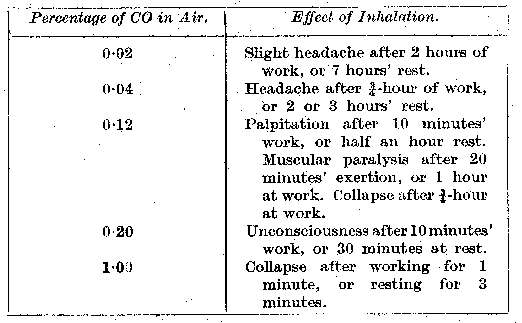
Experiments made by Haldane indicated that while the foregoing figures relate to unacclimatised persons, acclimatised persons would be similarly affected after breathing the specified percentages for double the times stated.
Indications of Its Presence.
Carbon monoxide is produced at an early stage in the spontaneous combustion of coal in mine wastes, and when the air passing from such a district has a petroliferous smell it may be assumed that the air contains carbon monoxide, perhaps in smaller proportions than can be detected by the use of small warm-blooded animals. Local heating is generally accompanied by the deposition of moisture near the site of the coal undergoing oxidation, so that such a deposition of moisture should be sufficient to indicate the possibility of carbon monoxide coming from the heated area.
While canaries, linnets, or mice may be useful as indicators of the presence of carbon monoxide when the poisonous gas forms 0.1 per cent. of the atmosphere, their blood may on the other hand be used to detect the presence of as little as 0.01 per cent. A canary, or a linnet, will soon be unable to maintain its position on its perch if placed in air containing 0.1 per cent, of CO, and a mouse would soon find difficulty in maintaining its composure in such an atmosphere, and would squat to maintain greater stability in its movements about a cage held in a slightly tilted position. Small animals may be used with advantage as a safeguard to those examining workings in which carbon monoxide is suspected, but routine analysis is capable of giving accurate and speedy information concerning the proportion of carbon monoxide in mine air.
 |
 |
| Names mentioned in this article | |
 |
 |
| Name | Age | Occupation | Notes |
|---|---|---|---|
| Brown, William Bertram | H.M. Inspector of Mines | Whos Who Page | |
| Haldane, John Scott, Dr. | Whos Who Page |
 |
 |
| Related Articles | |
|
|
| Pub. Date | Article (Newspaper) |
|---|---|
| 19 Sep 1942 | Mine Gases And Gas Testing, Carbon Dioxide and Blackdamp (The Science and Art of Mining) |
| 03 Oct 1942 | Mine Gases And Gas Testing, Carbon Monoxide (The Science and Art of Mining) |
| 17 Oct 1942 | Mine Gases And Gas Testing, Firedamp (The Science and Art of Mining) |
| 31 Oct 1942 | Mine Gases And Gas Testing, Testing for Firedamp (The Science and Art of Mining) |
| 14 Nov 1942 | Mine Gases And Gas Testing, Hydrogen Sulphide and Nitrous Oxide (The Science and Art of Mining) |
| 28 Nov 1942 | Mine Gases And Gas Testing, Atmospheric Pressure and its Measurement (The Science and Art of Mining) |
| 09 Jan 1943 | Mine Gases And Gas Testing (The Science and Art of Mining) |
| 23 Jan 1943 | Mine Gases And Gas Testing (The Science and Art of Mining) |
| 06 Feb 1943 | Mine Gases And Gas Testing, The Coal Dust Hazard — II (The Science and Art of Mining) |
| 20 Feb 1943 | Mine Gases And Gas Testing, The Coal Dust Hazard — III (The Science and Art of Mining) |
| 06 Mar 1943 | Mine Gases And Gas Testing, The Coal Dust Hazard — IV (The Science and Art of Mining) |



 Contains public sector information licensed under the

