


| Newspaper Articles |

|
Newspaper Articles |
 |
 |
19th September 1942, Page: 61, Column: 1
Mine Gases And Gas Testing
Carbon Dioxide and Blackdamp
By "Deputy."
Carbon dioxide is a colourless and odourless gas, which has a molecular weight of 44 and a relative weight of 22. Since the relative weight of air is 14.4 and the density of it is 0.0807 lb., the density of carbon dioxide is 22 X 0.0807 -÷ 14.4 = 0.12331b. per cubic foot. The weight of 1 litre at 0°C./760 m.m. is 1.965 gm., and the specific gravity of the gas is 1.525.
This gas is the product of complete combustion of substances containing carbon, as signified by the equation :—
C + O2 = CO2.
It exudes naturally from coal seams and the strata enveloping them, having been produced at the time of the decomposition of the vegetable matter from which coal has been formed. The decomposition of the cellulose of plants gives rise to the formation of carbon, carbon dioxide, methane, and water, in the proportions indicated by the equation:—

Sometimes carbon dioxide issues from strata, in which it has been imprisoned at high pressure, with a hissing sound, and occasionally great quantities issue from blowers. At Rochbelle Colleries, Prance, it was estimated that 74,756 cubic feet of carbon dioxide issued from a blower in less than a quarter of an hour. The gas is a product of the oxidation of carbonaceous substances and is exhaled during respiration. It is also produced by flame lamps.
Being the product of complete combustion of carbonaoeous substances in excess of air it is incombustible and does not support life or combustion, and being denser than air it is usually found in ill-ventilated places in concentrations near the floor. Brisk ventilation is needed to remove such accumulations of carbon dioxide from mine workings.
Extinctive Atmospheres.
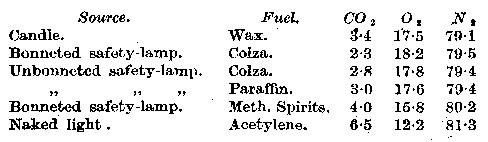
An atmosphere may become extinctive either by the reduction of oxygen by oxidation or combustion, or by the dilution of the air with incombustible gases. In either case the oxygen content is reduced and the incombustible content increased. The smaller the percentage of oxygen in the air the less stable does a lamp flame become, and when a certain percentage is reached flame is extinguished, the extinctive percentage depending on the fuel used and on the form of the lamp. The. following table gives particulars of the composition of extinctive atmospheres produced by the burning of certain sources of light:—
Physiological Effects of Carbon Dioxide.
The effect of breathing air containing carbon dioxide depends on the percentage of that gas in the air. Relatively small percentages of carbon dioxide in air tend to excite the lungs to greater activity, thus causing greater volumes of air to be inhaled, but when the proportion of carbon dioxide is high it acts on the system as a narcotic, producing a state of unconsciousness. When there is 0.5 per cent. of carbon dioxide in air the respiration rate is slightly increased, there is no discomfort at 1.25 per cent., although at 2 per cent. the lung ventilation is increased by 50 per cent. and breathing is slightly laboured. Only slight exertion is possible at 5 per cent., and at 10 per cent. breathing becomes exceedingly difficult. Above that percentage unconsciousness may be produced.
According to Section 29 (3) of the Coal Mines Act (1911) the amount Of carbon dioxide in mine air must not exceed 1J per cent., and the proportion of oxygen in the air must not be less than 19 per cent.
Detection of Carbon Dioxide.
The presence of carbon dioxide in mine air may be detected by the effect of the gas on the flame of a lamp. When there is 1 per cent. of the gas in mine air the flame of a lamp loses about one-third of its illuminating power and it becomes somewhat smoky, the smokiness and depression of illuminating power increasing as the proportion of CO2 in the air increases. Dr. Angus Smith used lime-water to detect the presence of carbon dioxide in air. Half an ounce of N/10 lime-water, to which a drop of phenolphthalien has been added, when added to an 8-oz. bottle containing mine air, loses its pink colour if the air contains more than ¼ per cent. of carbon dioxide. If half-an-ounce of N/2 lime-water is used in an 8-ounce bottle of mine air the presence of more than 1¼ per cent. of CO2 in the air will be indicated by the discharge of the pink colour due to the presence of phenolph-thalein. The principle of this test is signified by the equation :—
Ca(OH)2 + CO2 = Ca CO3 + H2O.
This test is very readily-applied ; the sample of air being collected in the 8-oz. bottle by means of an India rubber hand pump.
The amount of carbon dioxide in mine air is generally determined by routine gas analysis in which the proportion of CO s in mine air is determined by absorbing the gas with caustic potash solution contained in a suitable pipette.
Blackdamp.
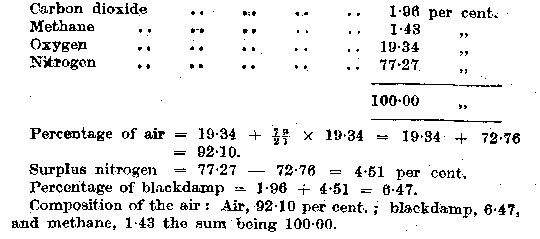
The term blackdamp denotes a mixture, in varying proportions, of carbon dioxide and nitrogen, such as may be found in badly ventilated mines. Normal air is composed of about 79 parts by volume of nitrogen in admixture with 21 parts of oxygen. As the mixture passes through the workings of a mine some of the oxygen is used up in the processes of oxidation, combustion, and respiration, and a certain proportion of carbon dioxide is added to the air as it travels through the airways. On account of the diminution of oxygen in the air there is a surplus of nitrogen beyond that required to form air with the oxygen remaining. The surplus of nitrogen added to the amount of carbon dioxide in the air constitutes the proportion of blackdamp in the air.
We may illustrate the method of determining the proportion of blackdamp in mine air by taking the results of the analysis of a sample of air taken from the face of a heading in a coal mine.
The composition of the air in the heading was found to be as follows :—
Atmospheres deficient in oxygen may contain a large proportion of blackdamp, especially when the diminution of oxygen has been produced by the oxidation of coal and the decay of timber in waste workings. It is therefore desirable that some ready means of determining the percentage of oxygen and carbon dioxide should be available. Dr. Smith's test is a useful one for CO2, and Dr. Haldane's tube provides a ready means of determining the percentage of oxygen, although it is only suitable for use in naked-light mines. Figure 1 is half-size representation of the Haldane tube. It is seen to be graduated in percentages of blackdamp and oxygen, the graduations actually being engraved at the sides of a long opening in an aluminium cylinder which contains the inner glass tube.
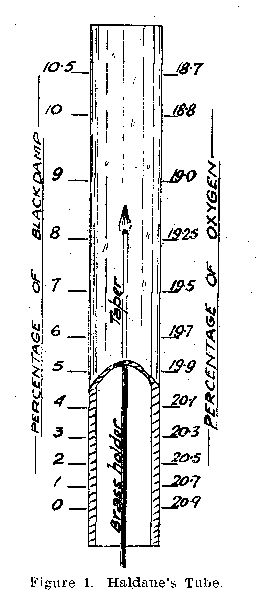
In using the tube a small taper is held in the tube with its upper end projecting from the upper end of the tube. The taper is lit and then it is slowly lowered down through the tube until the flame is extinguished. The point in the tube at which the taper is extinguished gives the percentages of oxygen and blackdamp in the air.
Answer to Correspondent.
1. — In a seam of coal which is liable to spontaneous heating a conveyor face reaches an upthrow fault, which is found to be an overlap fault. When the throw of the fault has been proved a new face is opened out on the higher side and working resumed. What special precautions should be taken in these circumstances to prevent spontaneous heating taking place in the faulted area ? — ((Submitted by W.A.C., Prestonpans).
The spontaneous heating of coal arises from the absorption of oxygen by the coal and the combination of the oxygen with carbon to form carbon dioxide. This reaction is exothermic and consequently the temperature of the coal substance increases, with the result that the heat may accumulate and. the temperature rise to the point at which combustion takes place. If the current of air in the vicinity of the heating mass is swift the heat produced, may be carried away, or if the access of oxygen to the coal is present the reaction may be prevented by suitable packing. Hydraulic packing of the gob in such a case may stop spontaneous heating, but the same result may be attained by hand packing. In any case it is desirable that the gob should be well ventilated, or that air should be excluded by packing. No coal should be left in the faulted area, and since heat may be produced as a result of heavy roof pressure every endeavour should be made to prevent crush by substantially supporting the roof.
In working seams which formerly had the reputation of being liable to spontaneous combustion no fires now take place, and this desirable state of affairs has been achieved by regular advance of the face, total extraction of the seams, complete control of the roof by the use of steel supports, and by the provision of ample fresh air moving swiftly along the face and through the roadways.
 |
 |
| Names mentioned in this article | |
 |
 |
| Name | Age | Occupation | Notes |
|---|---|---|---|
| Smith, Angus, Dr. | Chemist |
 |
 |
| Related Articles | |
|
|
| Pub. Date | Article (Newspaper) |
|---|---|
| 19 Sep 1942 | Mine Gases And Gas Testing, Carbon Dioxide and Blackdamp (The Science and Art of Mining) |
| 03 Oct 1942 | Mine Gases And Gas Testing, Carbon Monoxide (The Science and Art of Mining) |
| 17 Oct 1942 | Mine Gases And Gas Testing, Firedamp (The Science and Art of Mining) |
| 31 Oct 1942 | Mine Gases And Gas Testing, Testing for Firedamp (The Science and Art of Mining) |
| 14 Nov 1942 | Mine Gases And Gas Testing, Hydrogen Sulphide and Nitrous Oxide (The Science and Art of Mining) |
| 28 Nov 1942 | Mine Gases And Gas Testing, Atmospheric Pressure and its Measurement (The Science and Art of Mining) |
| 09 Jan 1943 | Mine Gases And Gas Testing (The Science and Art of Mining) |
| 23 Jan 1943 | Mine Gases And Gas Testing (The Science and Art of Mining) |
| 06 Feb 1943 | Mine Gases And Gas Testing, The Coal Dust Hazard — II (The Science and Art of Mining) |
| 20 Feb 1943 | Mine Gases And Gas Testing, The Coal Dust Hazard — III (The Science and Art of Mining) |
| 06 Mar 1943 | Mine Gases And Gas Testing, The Coal Dust Hazard — IV (The Science and Art of Mining) |



 Contains public sector information licensed under the

