


| Newspaper Articles |

|
Newspaper Articles |
 |
 |
25th July 1942, Page: 13, Column: 1
Principles Of Coal Washing
Extracts from paper on "Some Notes on Coal Preparation in Baum Type Washers at Phoenix Colliery," read before the South African Institution of Engineers.
By M. J. Turner.
The object of preparing coal for sale by washing is to discard impurities and low grade, high-ash coal, which is wholly or nearly incombustible.
The principle in nearly all coal washers is the same. Their action is based on the fact that impurities combined with run-of-mine coal, as it leaves the mine, are of greater specific gravity than the pure coal. This circumstance has enabled mechanical means to be employed for the separation of pure coal and impurities. It is found that if materials of different specific gravities and approximately of the same size, are placed in a sieve and jigged up and down in water for sufficient time, they will arrange themselves in layers according to their density, the heaviest at the bottom and so on.
The machine may be constructed with a fixed sieve on which the coal to be treated is deposited, and motion given to the water by means of a large piston, or by compressed air. In these cases the motion given to the water instead of to the sieve has a similar effect to that obtained by jigging the screen.
A piece of mineral with a specific gravity of six falls through the water more quickly than a similar piece of some other mineral the specific gravity of which is only two, but a large piece of the latter mineral may sink as rapidly as a small piece of the former. Consequently, minerals of varying density can only be separated by water when they are properly classified as to size ; they need not always be of the same size, but it is necessary that the variations in their size shall not affect their rate of fall to the same extent as does their variation in density.
Particles in "run-of-mine" coal are of various sizes ; we find large pieces of coal and small pieces of waste in close proximity, and we can calculate (from the formula by Christopher and Byrom) that the falling velocities of a two-inch cube of coal and a half-inch cube of shale are identical. It is, therefore, of importance that the coal should be correctly screened, and so, as a rule, the diameter of the largest piece should not exceed four times the diameter of the smallest. In jig washers the length of stroke and the number of pulsations per minute are regulated according to the size of the particles treated, a slower speed and longer stroke being used for the larger sizes.
In general, the washing of large coal is much easier than the washing of small coal. The stratification takes place in the larger sizes much more rapidly than in the smaller sizes.
In the compressed air operated machines the principal requirements for accurate stratification in large coal are ample supplies of air and water. The reasons are as follows :—
1. Large coal calls for increased amplitude of pulsation.
2. Greater space between the individual pieces of coal tend to permit water to rise and fall through the bed of material without imparting sufficient movement to the material itself.
3. Increased resistance of larger pieces to horizontal movement through the washer calls for ample water supply, both at the back of the box and in the raw coal launder.
The application of the above principles in the Norton and Simon Carves plants is well known. By means of compressed air a pulsating movement is given to a mixture of water and raw coal in the wash boxes. Stratification takes place in the raw coal in accordance with the varying density of the materials. The wash box is so arranged that it will pass out clean coal and discharge as waste all material which has a higher specific gravity than the float coal specific gravity for which the box is set. The dividing line between float coal and "sinks" is arrived at by adjusting the air and water valves and weighting the float controlling the waste discharge doors till the desired separation is obtained.
This float rises and falls with the water pulsations and can be so adjusted in the box and weighted that it will sink through the coal and rest on the shale bed. The depth of the shale bed is recorded on a graduated scale by a pointer which is attached to the float. As the shale bed rises the float also rises and at a prearranged setting on the scale operates the shale discharge mechanism which delivers the excess of waste to the bucket elevator system to be disposed of. After a discharge of shale the float sinks again to the original setting or a little lower and the discharge of shale automatically stops ; as the shale bed builds up again the process is repeated.
Float and sink tests on coal and discards in solutions of varying density will disclose the percentage of coal floating at any particular density, show how the wash box is functioning, and enable the final settings to be reached very accurately.
Coal in the discards may be reduced by increasing the depth of the shale bed or by making the floats heavier so that they do not discharge so readily. An increase of air and/or water through the valves at the back of the box will reduce the percentage of small coal in the discards.
"Sink" in the washed coal may be reduced by thinning the depth of the bed, or by decreasing the air pressure or by cutting down the quantity of air and/or water in the valves at the back of the box. An increase in the quantity of water required to flush the raw coal into the box will also help to reduce the "sinks" in the coal in the small coal wash box.
Treatment at Phoenix Colliery.
At Phoenix Colliery the lower portion of the No. 2 Main Witbank seam only is mined, the average width of the portion worked being about eight feet. This section carries a holing band in most areas with a width varying from a few inches to several feet. The holing band contains little saleable coal, and in addition the seam contains layers of stone, shale, carbonaceous shale, mineral sulphide, bone coal and splint coal.
The coal preparation plant was originally designed as a washing plant in two units of identical capacity ; No. 1 plant was supplied by Messrs. Norton (Tividale) Ltd., and No. 2 plant by Messrs. Simon-Carves Ltd.
The coal fed to No. 1 plant is delivered to a Norton double deck screen and pick breaker in which the coal screened through 7-inch round holes passes to the lower deck, the oversize coal being broken by the picks on the upper deck to 6-inch maximum size. The total product is then screened over 2½-inch perforated plate, whence the — 2½-inch product is fed to a screen from which the duff coal is eliminated. The balance, consisting of small cobbles, nuts and peas, is fed to the small coal wash box.
In the No. 2 plant the coal fed to the plant is screened to pass the — 2½-inch product to the duff screens as in the Norton Plant; the balance of the coal is then passed over a bar grizzley screen, where the + 2½-inch to 6-inch x 8-inch product is screened out, the oversize being fed to a British Diamond Jeffrey single roll breaker from which it rejoins the main feed to the large coal wash box. The fault in this design is that all the small coal produced by the breaker is fed to the large coal wash box. The duff coal product is eventually recovered from the silt tank, and the small cobble nut and pea coal product which might be discarded, is recovered from a grizzley screen fixed in the waste discharge chute in No. 1 bucket elevator from whence it is fed to the small coal wash box.
Recently a third unit has been added and a rearrangement of the flow to the first two plants has been made. The run-of-mine coal from the tipplers is fed over a jigging screen in which is a 6-inch grizzley bar screen ; the oversize from these two jigging screens is fed to the new plant, where it passes over a 60-inch picking belt from which stone and shale are eliminated and any well defined interbedded stone is cleaned out by hand. The coal is then fed to a Norton screen and breaker where the small coal, from which the duff is screened out, is fed to the small coal wash box. The + 1½-inch coal is fed direct from this Norton breaker screen to the large coal wash box. All the discards from the large coal wash box are delivered to a middlings crusher and the crushed product is re-elevated to the breaker screen for classification and treatment.
The undersize (- 6-inch) from the screens at the main tippler is sent to the original two plants. The amount of work done by the crushers in these plants is considerably less than in the previous arrangement, the only coal to be crushed being the + 7-inch coal that may have passed over the grizzley at the main tipplers and sent to No. 3 plant.
This alteration in the flow was brought about by a desire to increase the capacity of the plant. At the same time it was felt desirable to provide facilities for a preliminary hand picking of the large + 6-inch coal. For this reason it was decided to take out all the large coal and feed it to one plant, leaving the other two plants to deal with the remaining small coal. It was hoped also in this way to reduce the peak loads on the coal breakers and reduce the quantity of small coal made therein. Lastly, the segregation of the coal into + 6-inch and — 6-inch made it possible to distribute the sizing in the small coal boxes more evenly — each box was not called upon to deal with such large variations in size.
The capacity of Nos. 1 and 2 plants is 150 tons of run-of-mine coal per hour, with a maker's guarantee that :—
Washed coal tested in a medium of one point six (1.6) specific gravity taken from either box shall not disclose more than three per cent. of sinks.
Discards tested in a medium of one point five (1.5) specific gravity shall not disclose more than three per cent. of floats.
The capacity of the two plants is, therefore, 300 tons per hour of run-of-mine coal. Three hundred tons to screens and breakers less 40 tons duff coal, screened out, gives 260 tons to the four wash boxes.
The wash box discards vary according to the nature of the coal and range from 15 per cent. to 20 per cent. of the input. Assuming this discard to be 40 tons per hour, the sales output is 220 tons per hour or 55 tons per wash box per hour.
If the wash boxes are fed above their capacity, there will be loss of coal with the discards, and the possibility of low grade coal passing over with the washed products. Without a surge bin at each box, it is impossible to guard against this in a continuous running plant, so that when any one box is overloaded, it is necessary to strip the main feed till the wash box is working normally, which means a reduction of output below the rated capacity of the plant, during any of these periods.
There may likewise be occasional delays in the coal feed to the plant, as well as stoppages in the plant itself for sundry adjustments ; therefore it is not possible to maintain a washed output of 220 tons per hour without overfeeding.
The total output of the colliery is handled by the three plants in the following proportions :—
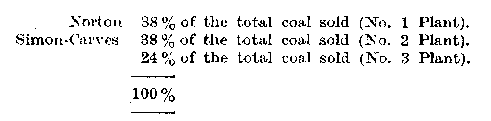
The large coal wash boxes in the three plants have been set to discard natural sinks at 1.5 specific gravity. In No. 3 plant ail discards from the large coal wash box are crushed and re-screened, and washed as nuts and peas in the small coal wash box. In the No. 2 plant the secondary discards only are crushed and re-screened, the crushed product being fed to the small coal wash box. By this means the large coal wash boxes have been set to produce a low ash content coal without loss of coal, any coal which may pass out with the discards as well as the coal in the middlings being recovered as small coal. The only loss of coal can therefore be in the discards from the smalls wash box.
This arrangement was installed in No. 2 plant prior to 1941 and during that year the ash content of shipping coal from this wash box averaged 10.2 per cent., an improvement on previous years.
 |
 |
| Names mentioned in this article | |
 |
 |
| Name | Age | Occupation | Notes |
|---|---|---|---|
| Byrom, — | |||
| Christopher, — | |||
| Turner, M. J. |




 Contains public sector information licensed under the

