


| Newspaper Articles |

|
Newspaper Articles |
 |
 |
27th June 1942, Page: 346, Column: 1
Colliery Accidents In 1941
Cardiff and Forest of Dean Division
See also Nos. 22, 28, 24 and 25, Vol. 52.
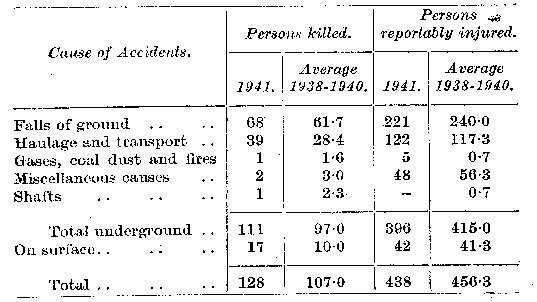
In 1941, in the Cardiff and Forest of Dean Division, there were 128 deaths as compared with 116 in 1940, an increase of 10 per cent. 1940 showed an increase of 17 per cent. over 1939.
Deaths through falls of ground were four less than in 1940, the figures being 68 for 1941 as compared with 72 in 1940, but it must be remembered that the total in 1939 was 55. The fatalities due to haulage and other accidents below-ground were 43 as compared with 35 in 1940, while on the surface the figures were 17 in 1941 as compared with 9 the previous year.
The table represents in brief the position as regards various classes of accident.
Accidents at Roadheads.
Falls of ground accounted for 53 per cent. of the deaths, and further analysing these figures it is found that at the working face 17 deaths were caused while getting coal or taking down stone, 16 while setting or withdrawing props, and 29 whilst other work was being done. Six fatalities occurred on roadways.
Last year Mr. J. Macleod Carey, the Divisional Inspector, emphasised three points for consideration : (1) The substitution of wood by steel; (2) The importance of good solid packs regularly and uniformly built throughout the face, and (3) the necessity of "thought" and "care" in the operation of withdrawing supports. He again asks for earnest consideration of these three points.
In his annual reports he has often alluded to accidents at roadheads, and he specially stresses this point, as this class of accident is far too numerous. There is no reason why the roadhead cannot be controlled as efficiently as other parts of the face, and the Inspector appeals to all managers to take the matter up seriously with their firemen, and thus attain a better result during 1942. Falls at roadheads should be rare occurrences, because there is a definite remedy.
Braking System for Spakes.
As regards haulage accidents, there were 30 deaths on "mechanical" haulage roads, five on "horse" roads, two where trams were operated by "hand," and two associated with conveyors, making a total of 39. Six of the deaths on "mechanical" haulage roads were due to an engineman having a seizure whilst operating a spake journey provided to convey men to and from their work below-ground, the men endeavouring to jump to safety as the spake gathered speed. Fortunately, such occurrences are rare, but in this case everything depended on the foot brake, and Mr. Carey asks for earnest consideration of some system of braking that will preclude similar accidents.
Further analysing haulage accidents, twelve deaths were caused through runaways, and sixteen through causes that come under the general classification "other." Diligence by traffic men will prevent many an accident.
Civil Defence Precautions.
Mr. Carey is pleased that Civil Defence precautions have been taken up whole-heartedly. Shelter accommodation has been provided at all mines in specified areas where legislation demands, and all mines in prescribed areas have efficient fire-fighting schemes approved by him. Under no consideration should any scheme fail. It is a national duty to keep them 100 per cent. efficient, and there should be hearty co-operation between owners and workmen. It is essential that, should the necessity arise, all must be prepared to do their duty at once and with efficiency.
The recruitment of boys into the industry in South Wales calls for special consideration. At present, they enter the mines directly they leave school. They look forward to some attractive employment, and present-day parents guide and encourage them in this. To meet the present and future requirements of the industry more must be done to show mining as providing an attractive career. Mainly to this end, training schemes are being developed by a few colliery undertakings in other coalfields by which all the boys starting at the mine spend a substantial part of their working time under competent instructors at the mine and/or the local mining college. They are gradually introduced and guided into pit work by those who instruct them, and the boys who show promise are picked out and encouraged to continue to learn, and helped to make a successful career for themselves. Mr. Carey asks that the question of recruitment and training of boys be given serious consideration.
 |
 |
| Names mentioned in this article | |
 |
 |
| Name | Age | Occupation | Notes |
|---|---|---|---|
| Carey, Joseph Macleod | H.M. Divisional Inspector of Mines | Whos Who Page |
 |
 |
| Related Articles | |
|
|
| Pub. Date | Article (Newspaper) |
|---|---|
| 02 May 1942 | Colliery Accidents In 1941, Yorkshire Division (The Science and Art of Mining) |
| 02 May 1942 | Colliery Accidents In 1941, Northern Division (The Science and Art of Mining) |
| 16 May 1942 | Colliery Accidents In 1941, Midland and Southern Division (The Science and Art of Mining) |
| 30 May 1942 | N. Midland's Partial Recovery (The Science and Art of Mining) |
| 13 Jun 1942 | Colliery Accidents In 1941, North Western Division (The Science and Art of Mining) |
| 27 Jun 1942 | Colliery Accidents In 1941, Scotland (The Science and Art of Mining) |
| 27 Jun 1942 | Colliery Accidents In 1941, Swansea Division (The Science and Art of Mining) |
| 27 Jun 1942 | Colliery Accidents In 1941, Cardiff and Forest of Dean Division (The Science and Art of Mining) |



 Contains public sector information licensed under the

