


| Newspaper Articles |

|
Newspaper Articles |
 |
 |
13th June 1942, Page: 336, Column: 1
Colliery Accidents In 1941
North Western Division
See also Nos. 22, 23 and 24, Vol. 52.
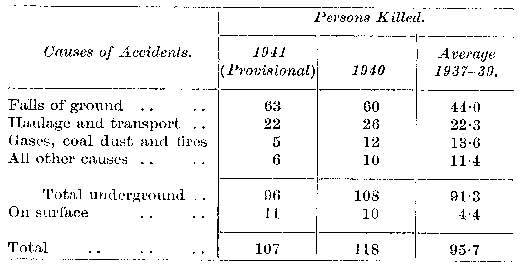
In the North Western Division last year 107 persons lost their lives as compared with 118 in 1940.
On conveyor faces alone the deaths from falls figured out to 52 as against 42, an increase of nearly 24 per cent. Covering a period when the persons employed were fewer and the coal output less than in previous years, Mr. E. H. Frazer, M.Sc, the Divisional Inspector, says in his statement that these regrettable figures indicate that everybody connected with mining, officials and men alike, should take all possible steps to prevent wastage of life, not only on humanitarian grounds, potent as these are, but also because the country is in urgent need of every person connected with coal production.
The following table shows the accident position in the past five years :—
Falls on Conveyor Faces.
In considering the question of falls of roof on conveyor faces, the Inspector says the subject of regularity of working should receive more attention. On a machine-cut conveyor face, working on a regular cycle, the coal should be cleared within a definite time to permit the sequence of operations to continue uninterruptedly. If, for whatever reason, that work falls behind, men are often taken from any occupation that does not appear to be urgent in order to fill coal. For instance, men who should have been erecting packs are temporarily removed from that work and packs are not put up at the proper time. Before they are eventually built, the roof has had time to fracture and lower, the packs do not contain so much material and do not become effective sufficiently early. A vicious spiral is started and leads to ineffectual roof control, loss of face supports, reduced output and accidents. Yet if the working cycle is allowed to be interrupted because fewer men are available, valuable output is lost. Managements balance matters as best they can, nevertheless, Mr. Frazer suggests that more attention given to packing would result in improved output per man. If there are insufficient persons to erect packs as wide as usual, they might for the time be built narrower, for the quantity of packing is not so important as the quality and the early application of support.
Another matter needing more attention is the withdrawal of supports. When they are situated in the waste it is necessary to set temporary supports and to use a safety apparatus. When they are in the space which is to be occupied by packs they should never be removed until the adjoining pack is pinned tightly to the roof.
All persons on a face must pass a gate-end and some must work there. The potential risk that a fall of ground at such places will kill or injure somebody is great, and precautions taken there require to be of the highest order.
Finally, the mixing of steel and wooden props on faces should be avoided. If, owing to war conditions, both must be used temporarily on the same face, the steel ones should be confined to one part and wooden ones to the other, so that there is but a single plane of weakness, i.e., where the two kinds adjoin.
Some Typical Examples.
Examples of the foregoing points are afforded by the following accounts :—
In a seam 22 inches thick at a Lancashire mine where pack building had been delayed, the roof had lowered until the height at the last completed pack, 21½ feet from the face, was only nine inches. A dataller was lying in the pack hole, 15 feet from the face, casting dirt back, when a stone from the roof fell on his head and killed him. Two bars in the fourth track were dislodged, but it is probable that the props under them were broken previously. The packing could, and should, have been advanced three cuts. It was also a waste of timber to keep five rows standing in front of the packs.
At another Lancashire mine, where the roof was of massive sandstone and the floor soft, packs built of dirt from the floor were of insufficient strength to control the roof, which was subject to periodic weights. In addition the props were mixed : 60 per cent. of wood and 40 per cent. rigid steel props. After a heavy weight had produced a wide break in the roof men were clearing away the dirt when a further fall killed one of them. In this case roof control could have been improved by creating dummy roads with packs on each side formed by the ripping from them. The problem of the control did not appear to have, been studied for the particular conditions, and methods were adopted which might have been successful in some conditions but were entirely unsuitable there.
A Lancashire collier knocked out with a hammer a prop 10 feet back from the face without any precautions other than a preliminary tap on the roof. Immediately the prop came out he was crushed and suffocated by a fall of rock roof from between joints and breaks. This demonstrates that immunity from accident is not ensured by long experience and by seemingly safe natural conditions. Sylvester prop drawers were provided and said to be used when the roof appeared to be bad, but when men have been accustomed to using a hammer for withdrawing props they do not readily recognise the need for a safety appliance.
At another colliery the roof at the top end of a conveyor face, stripping an old waste, was intersected by breaks from the older workings and by other breaks at right angles produced by the advance of the newer face. Yet, in these conditions, a packer-knocked out a bar with a hammer, causing a fall that killed him. A workmate stated at the inquest that when necessary they used a Sylvester, but if they thought it safe a hammer, notwithstanding that they knew the law required a safety contrivance to be used. The officials must have been negligent to allow such a practice to continue.
Most of the gate-end accidents would not have occurred if early and adequate support had been provided. In one case a fireman shot down the ripping and told the workmen to clear the debris without venturing under the exposed roof, evidently suspecting it was bad. Immediately he had departed a ripper disregarded his instructions and went on top of the loose dirt. Later he was caught by the fireman and again instructed to keep under the low roof, but disobeyed and, nearly two hours after the shot was fired, was fatally injured by a slab of stone that fell from the unsupported roof. The fireman neglected two opportunities to give orders for the roof to be plucked or supported and preferred unorthodox instructions.
In a North Staffordshire colliery a ripping was blown in advance of the packs, contrary to custom, but the precaution of setting breaking-off timber to confine the action of the explosive was omitted. When a ripper was building the gate side pack he knocked out a prop and the shot-shaken roof in front of the previously completed pack fell and mortally injured him. Neglect of good practice led to this fatality. It is, of course, easier to dispose of the ripping dirt if the roof is blown in advance of packs, but it is a method to be deprecated when not enforced by the thinness of the seam and, even then, bars with numerous props under them should be set to restrain the explosive from affecting the adjoining roof.
Two surface fatalities were directly due to the "black-out." Managers should ensure that extra precautions are taken to guard against this added risk to night operations. Two other surface deaths were caused by insecurely fenced machinery, the danger of which is well known.
Mr. Frazer reiterates his appeal for the revival of safety classes for boys in Lancashire and North Wales, where, apart from the praiseworthy work of one or two of the larger colliery undertakings, they have been allowed to lapse.
 |
 |
| Names mentioned in this article | |
 |
 |
| Name | Age | Occupation | Notes |
|---|---|---|---|
| Frazer, Edgar Hamilton | H.M. Divisional Inspector of Mines | Whos Who Page |
 |
 |
| Related Articles | |
|
|
| Pub. Date | Article (Newspaper) |
|---|---|
| 02 May 1942 | Colliery Accidents In 1941, Yorkshire Division (The Science and Art of Mining) |
| 02 May 1942 | Colliery Accidents In 1941, Northern Division (The Science and Art of Mining) |
| 16 May 1942 | Colliery Accidents In 1941, Midland and Southern Division (The Science and Art of Mining) |
| 30 May 1942 | N. Midland's Partial Recovery (The Science and Art of Mining) |
| 13 Jun 1942 | Colliery Accidents In 1941, North Western Division (The Science and Art of Mining) |
| 27 Jun 1942 | Colliery Accidents In 1941, Scotland (The Science and Art of Mining) |
| 27 Jun 1942 | Colliery Accidents In 1941, Swansea Division (The Science and Art of Mining) |
| 27 Jun 1942 | Colliery Accidents In 1941, Cardiff and Forest of Dean Division (The Science and Art of Mining) |



 Contains public sector information licensed under the

