


| Newspaper Articles |

|
Newspaper Articles |
 |
 |
13th June 1942, Page: 334, Column: 1
Coal Mining In Scotland
At the May meeting of the Mining Institute of Scotland the new president, Mr. John Finlay, devoted his address to "The Evolution and Distribution of the Coal Mining Industry in Scotland." In the earlier days of the industry production was fairly evenly distributed over Lanarkshire, Fife, Ayrshire and the Lothians. Coal was first used for heating by the monks occupying the monasteries in the carboniferous areas in Scotland, particularly in Midlothian, East Lothian and Fife. The earliest records known were those of the monks of Holyrood and Newbattle Abbeys (1200).
Selected notes from Mr. Finlay's address are appended :
The coal mining industry gradually developed during the 16th century, mainly due to the efforts of King James the Sixth of Scotland (King James I of England). This development was progressive until the year 1800. The total output in that year was 10 million tons for Great Britain. There is no record of the area outputs until after the passing of the Coal Mines Act of 1875, although the output had increased to almost 15 million tons in Scotland and over 110 million tons for great Britain in the year 1870. The output gradually increased all round until the year 1913 when the output of coal from the British coalfields reached its maximum, the output from Scottish coalfields in that year reaching a total of approximately 42½ million tons.
In the year 1880 the total output from the Scottish coalfields was 18,274,886 tons, 54.81 per cent. of which was produced in Lanarkshire. Although there was a steady increase in the Scottish output, Lanarkshire maintained its position and continued to produce over 50 per cent. up to the year 1905 when the percentage fell to 46.75, this despite the fact that in the Lanarkshire field output was steadily increasing, and reached its peak in 1910. In this year, however, the output from Lanarkshire was only 43.29 per cent. of the Scottish total. From 1910 onwards we see a gradual decline in the output from Lanarkshire until in the years 1940 and 1941 it is well under 30 per cent. of the total output from Scotland. In the latter part of last century exploitation of the coal seams in the Carboniferous Limestone series was tackled on an extensive scale in Fife. The gradually increasing output from this area was responsible for the increase in output from Scotland and consequent decline in the percentage of output from Lanarkshire.
It is interesting to note that, even in normal years, since 1913 the Scottish output has rarely exceeded 75 per cent. of the output of that year. This is due to the gradual exhaustion of the Lanarkshire coalfield, as in latter years the other three main areas have been gradually improving.
Referring to the Clyde Basin Mr. Finlay said that if one studies the evolution of the coal mining industry it will be seen that modern intensive methods have been cradled, nursed and brought to maturity in this much maligned area. It was in this area that we have recorded the first attempt at coal production by machinery. In the year 1870, William Baird and Co. introduced a coal-cutting machine with fairly successful results.
Electricity was first applied to coal-cutting in 1887 by Messrs. Bower and Blackburn, when an attempt was made to drive a machine by a 10 h.p., d.c. motor. This was not too successful and compressed air continued to hold the field until near the end of the last century when rapid strides were made with the bar type of coal-cutter. This early type lent itself to the application of electricity, and once it had been established the advance made by electrically driven coal-cutters was very rapid.
Mr. Finlay noted another phase in the development of mechanical mining, viz., coal face conveyors. The introduction of coal-cutting machines to longwall faces did not eliminate the excessive number of times the coal had to be handled before it was filled into the tubs. With a view to minimising this excessive handling, the attention of engineers and managers was turned towards the mechanical conveying of the coal from the coal face. Many schemes and types of conveyors were devised by different people, but in this phase of mechanical mining Mr. Finlay said they had to give pride of place to one South of the Border for the first successful application. Col. Blackett patented his conveyor in 1902 and several were installed in the North of England and in Scotland.
The development in mechanical methods of mining is illustrated in the following table over the quinquennial periods since 1900 :—
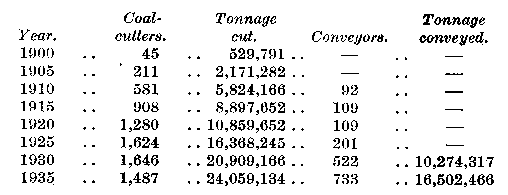
No information is available for the year 1940.
The necessity for more expeditious handling of hutches to take away coal from the face conveyors called for a greater application of mechanical apparatus, and Mr. Finlay thinks it is true to say that almost 100 per cent. of the coal conveyed along the face is now filled into hutches by means of (1) loaders, or (2) gate road conveyors. In the year 1935 there were 175 of the former in use and 219 of the latter.
From a national point of view it is essential that the mining industry should be kept in a healthy and progressive state and that it should fulfil the following functions :—
(1) Provide an adequate supply of coal for the successful prosecution of the essential industries.
(2) Provide employment for a certain percentage of the people.
(3) Provide an adequate surplus — over the required amount for home consumption — for export in order to pay for many of the essential imports.
 |
 |
| Names mentioned in this article | |
 |
 |
| Name | Age | Occupation | Notes |
|---|---|---|---|
| Blackburn, — | Mine Owner | ||
| Blackett, William Cuthbert, Colonel | Mining Engineer | Whos Who Page | |
| Bower, — | Mine Owner | ||
| Finlay, John | Mine Owner | Whos Who Page | |
| Finlay, John | President |




 Contains public sector information licensed under the

