


| Newspaper Articles |

|
Newspaper Articles |
 |
 |
30th May 1942, Page: 322, Column: 1
N. Midland's Partial Recovery
See also Nos. 22 and 23, Vol. 52.
Mines Department Provisional Statement.
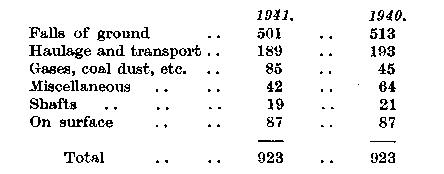
During 1941 at the mines in Great Britain under the Coal Mines Act the number of persons who lost their lives as the result of accidents was 923, which corresponds exactly with the deaths in 1940 but compares unfavourably with the 1939 figure of 783. As shown in the Mines Department provisional statement, the most serious accidents last year were due to explosions on 3rd June, 10th July, 29th July and 19th October in which the deaths numbered 12, 16, 22 and 6 respectively. The explosions occurred in the given order at the Whitehaven "William" (Cumberland), Rhigos No. 4 (West Glamorgan), Crigglestone (West Yorkshire) and Bullcroft Main (South Yorkshire).
Examining the two most general sources of accident, under the head of falls of ground there were 351 deaths from falls of roof at the working face (350 in 1940), 82 from falls of face or side at the working face (83), and 68 from falls on roads (83) ; on conveyor faces 225 of the deaths from falls of roof occurred (209) and 52 of the deaths from falls of face or side (38), while 41 deaths were caused while repairing or enlarging on the roads (29). The deaths through accidents by haulage and transport may be subdivided as follows: Breakages of ropes or drawgear, 10 (10); mechanical haulage, 120 (129) ; horse haulage, 15 (17) ; hand and gravity haulage, 28 (20) ; conveyors or waders, 16 (17).
The accidents last year due to various causes may be shown and compared briefly with those of 1940 in tabular form as below :
N. Midland's Partial Recovery.
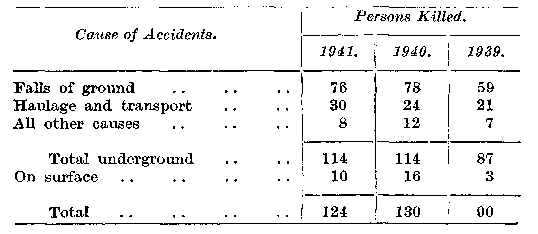
In the North Midland Division there were 90 deaths from accidents in 1939, and in 1940 the figure rose to 130. Last year, in the report he has circulated, Mr. George Cook, the Inspector in Charge, referring to the partial recovery (there was "no change" underground), but apparently with the records of previous years in mind, says "this will be not only a matter for regret by all persons connected with the industry but a stimulus to renewed efforts towards safety." In the table classifying the fatal accidents for the past three years the figures show :—
Inspector Reviews Situation.
Mr. Cook proceeds to say :—
Falls of Ground. — Deaths from accidents caused by falls of ground account, as usual, for the greatest part of the total. There were two fewer deaths compared with the previous year, but the number is still greater than it should be having regard to the favourable geological conditions which obtain through almost the whole of the Division. Material reductions in the chief coal producing districts of North Derbyshire and Nottinghamshire were offset by a big increase in Leicestershire. It is often said that more accidents occur under good roofs than under bad ones, and he says this appears to be true in the N. Midland Division. If accidents are to be avoided supports must be set as carefully and systematically under a good roof as under a bad one. Unnecessary risks should be avoided, and it should never be forgotten that one prop will support more roof than years of experience.
There was an increase of accidents from falls of side at the face, fourteen of them being falls of coal and six of stone, and investigation showed that many of these could have been avoided if more care had been exercised in taking up a safe position when coal or side was being brought down. None of the accidents caused by falls of ground during the year could be attributed to lack of quantity or quality of roof supports ; the majority was found to be due to lack of ordinary precautions. It may be that workmen and officials are not as alert as usual in these days of mental stress, and an effort should be made when at work to put outside happenings from the mind and concentrate on the job in hand. There is no doubt that if this were done a reduction in accidents would result.
Mr. Cook draws attention to the following general points which have been found to lead to accidents :—
Delay in setting supports when coal getting ;
Lack of temporary supports when drawing off;
Use of hammers to withdraw supports ;
Leaving of "backs" when filling ;
Working on the "fronts" instead of from buttocks ;
The omission to set bars where their use would be very beneficial.
It appears it is sometimes not realised that the leaving of a few inches of coal, while giving a more even and better looking roof, does not make the roof stronger and therefore does not warrant any reduction in the amount of support necessary. In some cases the coal is a source of danger as it conceals breaks in the roof above it.
Haulage and Transport. — The number of accidents under this head has increased during the past two years and in 1941 reached the high figure of 30. Most of them, according to the circular, could have been avoided by ordinary precaution and better training of the persons concerned. Under present conditions there must of necessity be many changes in haulage personnel, and therefore more attention should be paid to instructing men and boys in the proper performance of their duties.
Surface. — Mr. Cook avers that the number of accidents remains much higher than it should be, particularly so in Nottinghamshire. None of the accidents can be attributed to war-time lighting restrictions, as all except one occurred in daylight and the odd one took place at night under the same conditions as in daylight.
In his letter last year he urged the formation of more safety committees and the appointment of more safety officers, and this he again stresses. They should be associated with a campaign to bring to the notice of both workmen and officials the need for greater care and attention to safety measures. Apart from humanitarian reasons for preventing accidents — and this should bo the first consideration — the resulting loss of output, which in present circumstances is vital to the war effort, has also to be kept in mind.
Informal committees of representatives of the owners, workmen, managers, and deputies have been formed in each of the districts of the Division, and a special Senior Inspector has been appointed to investigate and consider what measures can be taken to reduce the number of accidents from falls of ground. The co-operation of everyone is asked, and Mr. Cook has no doubt that it will be given, to put into effect the recommendations of the Committee.
The training and instruction of boys at their work should be extended as far as possible, especially as the number of safety classes organised by the Education Authorities, where such instruction is usually given, has been curtailed by the war.
In concluding the Inspector repeats that it is only by continual vigilance and effort that the accident rate will be reduced, and it is with this in mind that he appeals to the officials and workmen in the industry to work to this end.
 |
 |
| Names mentioned in this article | |
 |
 |
| Name | Age | Occupation | Notes |
|---|---|---|---|
| Cook, George | H.M. Divisional Inspector of Mines | Whos Who Page |
 |
 |
| Related Articles | |
|
|
| Pub. Date | Article (Newspaper) |
|---|---|
| 02 May 1942 | Colliery Accidents In 1941, Yorkshire Division (The Science and Art of Mining) |
| 02 May 1942 | Colliery Accidents In 1941, Northern Division (The Science and Art of Mining) |
| 16 May 1942 | Colliery Accidents In 1941, Midland and Southern Division (The Science and Art of Mining) |
| 30 May 1942 | N. Midland's Partial Recovery (The Science and Art of Mining) |
| 13 Jun 1942 | Colliery Accidents In 1941, North Western Division (The Science and Art of Mining) |
| 27 Jun 1942 | Colliery Accidents In 1941, Scotland (The Science and Art of Mining) |
| 27 Jun 1942 | Colliery Accidents In 1941, Swansea Division (The Science and Art of Mining) |
| 27 Jun 1942 | Colliery Accidents In 1941, Cardiff and Forest of Dean Division (The Science and Art of Mining) |



 Contains public sector information licensed under the

