


| Newspaper Articles |

|
Newspaper Articles |
 |
 |
16th May 1942, Page: 312, Column: 1
Colliery Accidents In 1941
Midland and Southern Division
See No. 22, page 300.
In the Midland and Southern Division six fewer persons were killed during 1941, 49 as against 55 in the previous year, but Mr. E. Rowley, the Divisional Inspector, says in his report that it is disturbing to find that 58 per cent. of these accidents were classified as avoidable. From his summary table the following figures are extracted :—
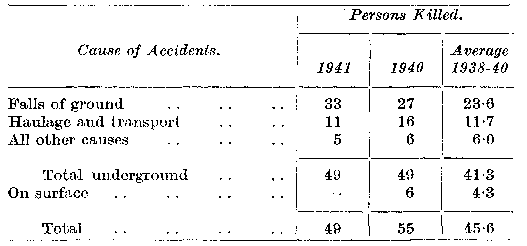
It is pointed out that much remains to be done, and that with reasonable care the position can be greatly improved. Falls of ground and haulage again accounted for the large majority of the accidents — 89 per cent. of the total coming under these two heads — the reduction in haulage accidents being more than offset by the increased proportion of falls.
Review of Falls.
During 1941 falls of ground caused the death of 33 persons, an increase of six as compared with the previous year. Of this number 27 persons were killed by falls of roof and six by falls of side.
Fifty per cent. of the fatalities occurred in the Cannock Chase coalfield. Mr. Rowley formerly had occasion to comment on the disproportionately large number of accidents from falls in this coalfield ; conditions are not materially different from other districts, and he cannot help but think that the continued high accident rate is a reflection on those immediately concerned.
Of 28 accidents at the coal face, eight occurred at roadheads and caused the death of ten persons. Last year he had to refer to the increased risk from falls at such places, and it is disturbing to him to have to record no improvement in the general position. A common feature of the majority of the accidents was the extensive nature of the fall, which resulted in complete collapse at the wayhead more from a failure of the general system than from failure of individual supports. In fact, the Inspector says investigation usually indicated that the supports had been dislodged without fracture, and it can only be presumed that an unstable condition existed due to relative lateral movement between roof and floor. The tendency at the ripping lip is for the strata to move outwards, and a better appreciation of this factor is required in the design and erection of the supports.
Many of the accidents from falls of roof on the actual face line again occurred during stripping in the area between the last row of props and the back of the undercut coal. The majority of the accidents were associated with inherent slips or induced breaks, which might well have been anticipated and the fall prevented by a more suitable method of support. Such accidents can be avoided by better supervision, particularly in regard to the general roof condition so that the supports can be adjusted to meet any additional dangers.
Five of the six accidents from falls of side were caused by falls of undercut coal. The danger arising from falls of this nature has been repeatedly pointed out, and Mr. Rowley emphasises that the ordinary undersprag or cutter nog does not provide the necessary support in the thicker seams. Systematic support of undercut coal should be made general and incorporated in the Support Rules.
There does not appear to be any appreciable improvement in the general standard of roof control, and numerous accidents from falls of roof associated with induced breaks indicate that the problem of falls of ground is closely allied to this subject.
Suggested Haulage Precautions.
Eleven persons were killed in accidents connected with underground haulages — a reduction of five compared with the previous year, and yet, in the opinion of the Inspectors who investigated the accidents, all but one could have been avoided by reasonable care. An analysis of the accidents shows the need for more attention to the following precautions :—
(1) More unobstructed height and width on roads should be provided wherever possible.
(2) Robust, automatic, and positive, safety devices should be provided at suitable intervals along haulage roads, and especially near the top and bottom of inclines. Wherever practicable, double interlocked blocks should be installed just below the top of an incline and an automatic warrick, or similar safeguard for both backward and forward runaways, should be fixed just above the foot.
(3) The use of horizontal girders under the driving head of conveyors at loading points should be avoided wherever practicable. This can be done in many cases by suspending the driving gear from above, thus leaving an unobstructed passage below. Should this method of support not be possible, safety devices should be installed and the road so graded as to avoid the inadvertent movement of both full and empty tubs.
(4) Creeper chains should be controllable from any part of their length.
(5) Travelling on haulage roads when the haulage is in motion should be avoided.
(6) Greater care on the part of the individual.
Other Accidents.
During the year two persons were killed in accidents associated with the use of coal cutters when "jibbing" operations were in progress. It is difficult to devise a guard which will make existing machines entirely safe during jibbing operations, but Mr. Rowley would ask all concerned to apply their minds to the problem. Meanwhile the persons engaged in cutting operations should exercise the greatest care to keep well clear of the moving picks.
Two fatal accidents occurred in shafts. One of the accidents involved a boy 14 years of age, who was caught by a descending cage whilst attempting to cross the uncovered space at the shaft bottom. If proper supervision had been exercised it would not have been possible for him to reach this position.
 |
 |
| Names mentioned in this article | |
 |
 |
| Name | Age | Occupation | Notes |
|---|---|---|---|
| Rowley, Elijah | H.M. Divisional Inspector of Mines | Whos Who Page |
 |
 |
| Related Articles | |
|
|
| Pub. Date | Article (Newspaper) |
|---|---|
| 02 May 1942 | Colliery Accidents In 1941, Yorkshire Division (The Science and Art of Mining) |
| 02 May 1942 | Colliery Accidents In 1941, Northern Division (The Science and Art of Mining) |
| 16 May 1942 | Colliery Accidents In 1941, Midland and Southern Division (The Science and Art of Mining) |
| 30 May 1942 | N. Midland's Partial Recovery (The Science and Art of Mining) |
| 13 Jun 1942 | Colliery Accidents In 1941, North Western Division (The Science and Art of Mining) |
| 27 Jun 1942 | Colliery Accidents In 1941, Scotland (The Science and Art of Mining) |
| 27 Jun 1942 | Colliery Accidents In 1941, Swansea Division (The Science and Art of Mining) |
| 27 Jun 1942 | Colliery Accidents In 1941, Cardiff and Forest of Dean Division (The Science and Art of Mining) |



 Contains public sector information licensed under the

