


| Newspaper Articles |

|
Newspaper Articles |
 |
 |
2nd May 1942, Page: 301, Column: 1
Colliery Accidents In 1941
Northern Division
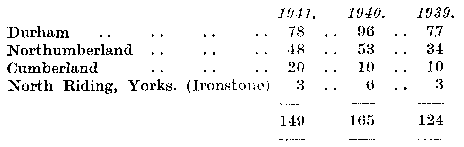
In his letter to agents and managers in the Northern Division Mr. R. Yates, Inspector in Charge, reviews the fatal accidents which occurred during 1941, the distribution of fatalities being shown as follows :—
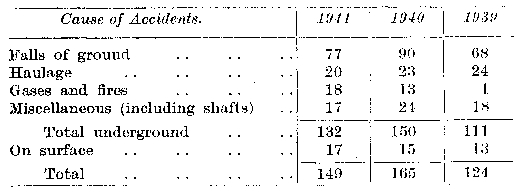
The following summary analyses the fatalities for the past three years :—
Falls of Ground.
An analysis over the past four years shows that fully half the fatalities on longwall faces occur at roadheads, i.e., the area bounded in width by the width of the road and extending for ten yards from the working face, and that more than two-thirds of these (or one-third of the total) occur at top rippings. The main remedies are more systematic support at these places and temporary support during ripping operations.
Unstable supports are another frequent cause of serious accidents on the coal face in this Division. In 33 fatal accidents during 1941 roof supports were canted out by falls of roof. Mr. Yates is satisfied that, if all the supports had in the first instance been driven up tight (with an axe or hammer, instead of a pick in many instances) and set in proper alignment and without delay, some of these accidents might have been obviated.
Haulage.
Mr. Yates notes with satisfaction that there were no fatalities due to conveyor machinery. Four persons were killed while travelling mechanical haulage roads (three by runaway tubs one by breakage of a link). Lack of clearance and riding on limbers wore associated with most of the horse haulage fatalities, while failure to control tubs on low gradients or to use the safety contrivances provided caused three fatalities under "hand" haulage.
Gases and Fires.
In addition to the William pit disaster, two persons were killed (and one injured) by an explosion of firedamp, probably due to illegal smoking, in an old back heading in a section of arc-wall places. Nine persons including a deputy were employed there, and it was fortunate all those men were not lost as the area filled with afterdamp shortly afterwards. Coal work should have been suspended there until a long overdue second outlet had been completed. Illegal smoking also brought about an explosion of gas at the face of an arc-wall heading, killing one man and injuring another.
Two hewers in a shallow Durham mine were overcome by stythe in old workings which they entered apparently out of curiosity, leaving their candles behind, by penetrating a fence.
Other Underground Accidents.
Two explosives fatalities were due to a stoneman drilling into an unexploded charge in the face of a stone drift which the deputy assumed to have been fired by a previous shot, and to a deputy prematurely approaching a "hang fire."
A cutter man was electrocuted while handling the pummel of a trailing cable which had been wrongly assembled by the electrician; and a pumpman while repairing an inbye pump along an old roadway, and a would-be rescuer, were asphyxiated by carbon monoxide carried down the compressed air main from a fire at a compressor on the surface.
Training of Boys.
It is now generally recognised that one of the biggest problems confronting the coal mining industry is how to overcome the diffidence of boys to enter the mines. One main objection, by their parents at least, is doubtless the high accident rate to boys, which can be overcome only by systematic training in safety principles, and it is becoming abundantly clear to Mr. Yates that such training will have to be given to boys as they enter the industry and during their working hours. This is already the practice at several groups of mines in the area. He estimates that about 50 per cent. of the boys (up to 18 years) at coal mines in the Division are holders of safety badges ; but this proportion is unfortunately gradually decreasing, and it is significant that of ten boys killed during 1941 only one had been safety-trained, and he was a victim of circumstances beyond his own control (a breakage of haulage gear).
 |
 |
| Names mentioned in this article | |
 |
 |
| Name | Age | Occupation | Notes |
|---|---|---|---|
| Yates, Robert | H.M. Divisional Inspector of Mines | Whos Who Page |
 |
 |
| Related Articles | |
|
|
| Pub. Date | Article (Newspaper) |
|---|---|
| 02 May 1942 | Colliery Accidents In 1941, Yorkshire Division (The Science and Art of Mining) |
| 02 May 1942 | Colliery Accidents In 1941, Northern Division (The Science and Art of Mining) |
| 16 May 1942 | Colliery Accidents In 1941, Midland and Southern Division (The Science and Art of Mining) |
| 30 May 1942 | N. Midland's Partial Recovery (The Science and Art of Mining) |
| 13 Jun 1942 | Colliery Accidents In 1941, North Western Division (The Science and Art of Mining) |
| 27 Jun 1942 | Colliery Accidents In 1941, Scotland (The Science and Art of Mining) |
| 27 Jun 1942 | Colliery Accidents In 1941, Swansea Division (The Science and Art of Mining) |
| 27 Jun 1942 | Colliery Accidents In 1941, Cardiff and Forest of Dean Division (The Science and Art of Mining) |



 Contains public sector information licensed under the

