


| Newspaper Articles |

|
Newspaper Articles |
 |
 |
2nd May 1942, Page: 300, Column: 1
Colliery Accidents In 1941
Yorkshire Division
It is unlikely that the annual reports of the Divisional Inspectors of Mines will be published during the present year. As the fatalities for 1941 for the Yorkshire Division are considerably more than those for 1940, Major H. J. Humphrys believes it will be advantageous to make known the figures with comments showing where and how the increases occurred and to indicate ameliorative measures which might be adopted. The fatalities for 1940 were 40 per cent. higher than those for 1939. The output in 1941 was lower than for either of these years.
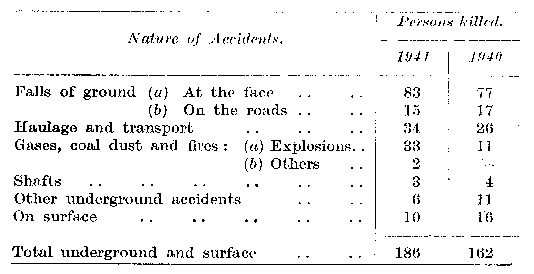
The Inspector trusts the table will be carefully studied in view of the steady worsening in the accident position since the war began. He is convinced that this deterioration is due to causes directly connected with the war, such as the calling up of young, vigorous men, often key men ; war strain ; disorganisation due to absenteeism and other causes, which is more serious in these days of mechanical mining with its regular cycle of operations ; the greater strain on the many who work full time ; and the effort to attain maximum output in spite of all. He adds that we cannot adopt an attitude of laissez-faire. On the contrary, like other war problems, this one should be attacked with vigour and determination, and when remedies are found they should be fearlessly applied.
Falls of Ground.
The falls of ground fatalities, 98 in number, amounted to 53 per cent. of the whole. It is evident that the increase has occurred on conveyor faces, and although it may be urged that the fatalities on the two kinds of faces are not disproportionate when the tonnage conveyed is taken into account, when it is considered that fewer persons are employed on conveyor faces for a given output, the accident rate per manshift must be a good deal higher on conveyor than on other faces.
The document informs that a number of the accidents occurred in the vulnerable area between the front row of props and the face. No matter what system of support is adopted, props should be set next the coal face as soon as possible after cutting has taken place. These face props afford considerable protection when the colliers start to fill coal. Special care is also needed towards the end of the shift when the last pieces of coal are being worked off. The removal of this coal sometimes starts roof movement, and the risks are increased if supports are not kept well within distance ; indeed, the aim should be to look one stage ahead and, by setting additional supports, ensure that the extraction of coal does not lead to a contravention of the support rules.
Some of the accidents were associated with unusual conditions, such as the presence of a heading driven in advance of the face, whilst falls of coal in thick seams have again caused several fatalities. In no case was there evidence that the coal was overhanging, and improved methods of spragging both to cut and uncut coal should be put into operation.
Other falls on conveyor faces were directly associated with delay in building packs. Intensive mining calls for detailed attention to packing. The most important requirements are quality and early building. A well devised and properly executed system of packing should increase output and reduce the amount of explosive used. It is the main factor in efficient roof control.
The accidents occurring during ripping operations point to the necessity of securing both the newly exposed roof in the gateway and the face of the lip as early as possible.
During 1941, 44 per cent. of the serious accidents (fatal and others) from falls occurred in the neighbourhood of the gate end, i.e.. the ten yards of gate next the face and the four yards of face on either side of the gate.
Haulage and Transport.
There was an increase from 3 to 8 in the fatalities from runaways on mechanical haulage roads. All the accidents were avoidable. In four of them the deceased and sometimes others were illegally travelling. It is general practice, and one which Major Humphrys commends, to stop haulage whilst shifts of men travel in and out, and workmen should wait until the rope stops and not travel at their peril whilst it is moving. In four accidents there was insufficiency of safety devices or those provided were not placed in position. In two accidents lashing chains slipped on the rope because they were not wrapped round a sufficient number of times, and in another the lashing chain broke.
Gases, Coal Dust and Fires.
The persistence of explosions in the last two years is causing the Inspector deep anxiety. Three explosions of firedamp causing loss of life occurred during the year. Coal dust did not enter into any of them, but he feels it necessary to emphasise the importance of maintaining the highest standard of preventive measures against coal dust in view of the fact that the proportion of adverse dust samples collected by his staff is increasing. Whatever the difficulties, and at all costs, necessary stone-dusting must never be delayed.
The lesson to be learnt from two of the explosions, and also from five fires due to friction and six other ignitions of firedamp by sheathed explosive which occurred during the year without causing injury to anyone, is that the risk of explosion has been increased by the great growth of mechanisation in the most dangerous part of the pit, and the increase in shotfiring, also in the same zone, which has taken place in recent years. The Inspector is convinced that the number of shots fired could be reduced with advantage. In certain areas there is now great difficulty in obtaining competent shotfirers, and one way of easing the position would be to reduce the amount of shotfiring as far as practicable. Investigations have shown that sheathed explosives do not always get a fair deal, and the sheathing is liable to be damaged or become detached from the cartridge in a variety of ways.
The outstanding lesson which these accidents teach is, however, the paramount importance of adequate ventilation. Expert advice within or outside his firm, the Inspector says, should be available to the manager in laying out his system of ventilation, and he should have assistance by frequent air sampling, air measurements, and in other ways to ensure that the ventilation system is maintained at the highest level. Samples and measurements should bo taken at different periods in the 24-hours as the percentage of firedamp varies so much. Greater attention is also needed to the provision for the use of workmen of an adequate number of firedamp detectors, whether automatic or flame lamps, and to ensure that they are constantly used.
Once more Major Humphrys would like to recommend that instructions be posted in every ambulance room that carbogen, hot water bottles, blankets, and stretchers, be sent immediately to a district where an explosion has occurred without waiting for specific instruction from the manager or other official.
General.
Referring to the present difficulties of maintaining a high standard of safety, the Inspector says the necessity for a high standard of discipline was never greater nor perhaps more difficult to attain. The insistence on safety measures and safety standards is a sound measure in days when every manshift devoted to the production of coal is a matter of such vital importance. Every shift lost by accident weakens the national effort.
Never was the need for the usual ameliorative measures greater. He refers to safety campaigns, posters, lectures, and the appointment of safety officers and safety committees. The falling off in the number of boys enrolling in safety badge courses is a matter of deep concern. Agents and managers are urged to do all in their power to persuade and encourage boys to join these classes.
 |
 |
| Names mentioned in this article | |
 |
 |
| Name | Age | Occupation | Notes |
|---|---|---|---|
| Humphrys, Herbert John, Major | H.M. Divisional Inspector of Mines | Whos Who Page |
 |
 |
| Related Articles | |
|
|
| Pub. Date | Article (Newspaper) |
|---|---|
| 02 May 1942 | Colliery Accidents In 1941, Yorkshire Division (The Science and Art of Mining) |
| 02 May 1942 | Colliery Accidents In 1941, Northern Division (The Science and Art of Mining) |
| 16 May 1942 | Colliery Accidents In 1941, Midland and Southern Division (The Science and Art of Mining) |
| 30 May 1942 | N. Midland's Partial Recovery (The Science and Art of Mining) |
| 13 Jun 1942 | Colliery Accidents In 1941, North Western Division (The Science and Art of Mining) |
| 27 Jun 1942 | Colliery Accidents In 1941, Scotland (The Science and Art of Mining) |
| 27 Jun 1942 | Colliery Accidents In 1941, Swansea Division (The Science and Art of Mining) |
| 27 Jun 1942 | Colliery Accidents In 1941, Cardiff and Forest of Dean Division (The Science and Art of Mining) |



 Contains public sector information licensed under the

