


| Newspaper Articles |

|
Newspaper Articles |
 |
 |
7th March 1942, Page: 251, Column: 1
Coal Dust Regulations
Analysis of Mine Dusts — IV
By "Tester."
The problem of how to prevent explosions of coal dust involves consideration of (a) methods of reducing the amount of coal dust produced during the processes of getting and transportation, (b) methods of removing the dust deposited on the roadways, (c) precautions to be taken to prevent the ignition of coal dust, and (d) the methods that may be adopted to prevent the propagation of the effects of an initial explosion.
There can be little doubt in the minds of those who are chiefly concerned with the promulgation of safety measures in collieries that the problem is worthy of the most serious consideration, as witness the number of explosions which have recently occurred.
It is now almost seventy years since Galloway established as a fact that coal dust is highly explosive, and more than thirty since the efficacy of stone dust as a quenching diluent was discovered ; nevertheless, it does not appear that we have quite solved the problem of preventing coal-dust explosions. If a blown-out shot results in the raising and ignition of a cloud of coal dust, proof is at once adduced that obligatory steps had not been taken to render the coal dust non-explosive, and the propagation of an explosion of coal dust following an explosion of firedamp offers further proof that obligatory steps had not been taken to dilute the firedamp sufficiently or to treat the dust in such a way that it was impossible for it to spread an explosion.
In both of these aspects of the question raised we are concerned with the sampling and testing of the dust that is deposited on the roof and sides of underground roadways, and if it proves possible to have a coal-dust explosion in a roadway in which representative samples of the dust were found to contain the required percentage of incombustible matter the influence of some factor that we have not yet specified remains to be determined. Obviously, the matter of collecting and analysing representative samples of mine dust is one of great importance, but having regard to the fact that samples are taken monthly it does not surpass in importance the whole matter of applying the diluent by which the coal dust is rendered non-explosive.
Sampling Zones
General Regulation 6 (a) requires that samples of dust shall be collected in all roads used for the transport of coal and in the return airways within 200 yards of the working face. The number of samples collected and analysed during each calendar month shall not be fewer than 10 per mile of those roads and airways. Taking the case in which the roof and sides are supported by steel arches, one sample may be collected either by "strip" or "spot" sampling from the roof and sides, the sample being collected from a length of not less than 50 yards of roadway and comprising the dust collected to a depth of one-quarter of an inch as near as may be. The corresponding sample collected from the floor shall comprise the dust collected to a depth of not more than one inch. Since the minimum number of samples collected per mile is 10, and two samples are obtained from each zone, there must be at least five zones per mile. The length of each zone would therefore have to be 352 yards as a maximum.
Division of Roads into Zones.
General Regulation 6 (b) requires that the samples of dust collected shall be representative, that is, they shall be representative of all the dust within the portions of the roads from which they are collected. It is intended that not less than one per cent. of the aggregate area of the road surface will be sampled. If samples were collected from one per cent. of the road surface within a zone of 352 yards they would be somewhat bulky, and for that reason the length of road from which samples may be collected is fixed at a minimum of 50 yards, with complete freedom for the manager of a mine to fix a greater distance should he deem that greater distance desirable. The General Regulations allow considerable latitude in that respect, and consequently there may be differences in the length of the sections into which roads are divided for the purpose of collecting and identifying samples. At one colliery the zone of 352 yards is divided into six equal parts, and at another it is divided into three equal parts, so that one mile of roadway would, in the latter case, be divided into 15 equal parts. Each sub-zone is of the same length, and its ends are marked by boards placed on one side of the roadway.
To enable the location of all samples to be identified the sub-zones are allotted distinctive colours which are used in painting the boards erected underground, and in colouring the corresponding sections of the roadways on the plan. This is done in accordance with General Regulation 6 (e) which requires that "Except at mines employing less than 100 persons underground, each analysis shall be given in the book (to be kept at the mine for the purpose of recording analyses) a distinctive colour, number, letter or mark, identifying it as relating to a particular length of road which shall be legibly marked in the same way on a suitable plan or plans to be kept for the purpose with the book."
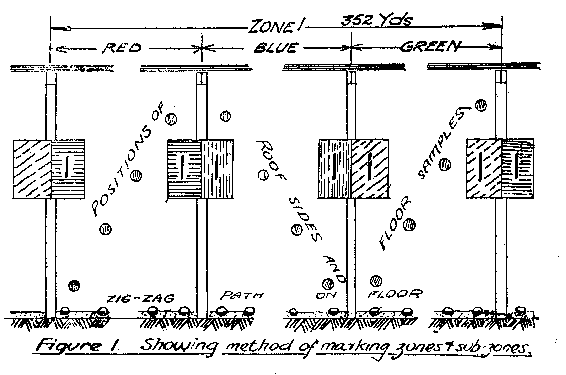
At the colliery referred to the zones on a given road are numbered 1, 2, 3, and so on, while the sub-zones are coloured red, blue, and green respectively in each zone. Figure 1 indicates the arrangement of zones and sub-zones, together with the method of colouring and marking the boards placed underground.
Collection of Samples.
On the appointed date the dust sampler, being provided with brush, tray, spatula, and sampling tins, proceeds to collect samples in, say, the red sub-zones, and having collected the samples he labels them R1, R2, R3, and so on. Whether the "strip" or "spot" sampling method is used to collect samples, it may be necessary to reduce their bulk to suitable proportions by thoroughly mixing the several portions of each sample and quartering it, finally passing the representative portion of the mixture through a 60-mesh sieve before putting it in the receptacle used for transporting the samples to the laboratory. The samples are then analysed, the proportion of moisture, carbon dioxide, and ash being determined, so that the total incombustible matter can be ascertained. The result, bearing the appropriate reference letter and number, is recorded in the report book, and the analysis of each sample shall be posted at the pithead within 21 days. On the appointed day of the next month the samples are collected from blue sub-zones, and a month afterwards they are collected from the green zones. In this way the dust in each sub-zone is collected, analysed, and reported on once in three months.
 |
 |
| Names mentioned in this article | |
 |
 |
| Name | Age | Occupation | Notes |
|---|---|---|---|
| Galloway, — |
 |
 |
| Related Articles | |
|
|
| Pub. Date | Article (Newspaper) |
|---|---|
| 10 Jan 1942 | Coal Dust Regulations (The Science and Art of Mining) |
| 07 Feb 1942 | Coal Dust Regulations, Analysis of Mine Dusts. — II (The Science and Art of Mining) |
| 21 Feb 1942 | Coal Dust Regulations, Analysis of Mine Dusts — III (The Science and Art of Mining) |
| 07 Mar 1942 | Coal Dust Regulations, Analysis of Mine Dusts — IV (The Science and Art of Mining) |



 Contains public sector information licensed under the

